You wrote three articles and the fourth draft has been stalled for two weeks. Sitting down to write, you stop knowing what there is to write. There is no sign of anyone reading, so the point of writing is unclear too. On the same day, you put out the short posts without any resistance at all.
The state itself carries an observation that shows where the cause resides. The same person, on the same day, with the same quantity of will and the same time secured, continues only one of the two kinds of publishing. What splits them is the time between writing and something coming back. One returns a reaction in minutes; the other can return nothing for months. Several orders of magnitude sit between them. And what that gap moves is not the quantity of will but the side of judgement. When the fourth draft stalls, what has stopped it is not necessarily perseverance.
The explanation on offer, meanwhile, generally sits on the side of will or habit. The bar was set too high, no time was fixed, perfection was aimed at. Each is partly right, and acting on it does move things a little. What moves is the friction of getting started. Since none of it touches the slowness of the return, a few stalls later the explanation shifts to your nature: I am someone who does not keep things up. Nor does the failure prove the responses wrong. It only shows that what they work on lies elsewhere.
The work here divides into four. How many kinds of stalling the phrase it does not last actually covers. Which of them the advertised responses act on. Why slow returns move the side of judgement rather than the side of will. And what the slow period is spanned with.
Three things do not appear in exchange. No procedure for acquiring a habit — what time to write at, how to arrange the environment — is covered, since those are written about in quantity already and work well on the side of getting started. The choice of medium is not covered either: not whether a blog should be chosen, but only what happens when the place chosen has slow returns. The mechanism by which behaviour in general reverts also sits elsewhere, in Nothing lasting is only a normal function at work. What is looked at here is only the condition specific to publishing — that the returns are slow, and that the slowness differs by orders of magnitude between media.
What is assumed is a state in which the writing skill itself is sufficient. At a stage where how to write is the question, that comes first. Once the four have been worked through, three indicators are placed for confirming whether things are continuing. None of the three measures the frequency of updating.
📖 Contents
- The Place It Stalls Comes in Three Kinds
- The Prescriptions on Offer Lower Only the Friction of Starting
- Same Will, Same Time, and Only One of Them Continues
- A Distant Return Appears to Have Lower Value in Itself
- In Slow Places, the Returns Get Manufactured on Your Own Side
- Having Nothing to Write About Comes From the Same Structure
- The Relation Between Count and Accumulation Is Not Proportional
- When Things Stall, Nothing Is Actually Lost
- What Can Be Counted Once Frequency Is Set Aside
The Place It Stalls Comes in Three Kinds
The same phrase covers three different places at which things stop.
The first is stalling before you can begin writing. What to write does not get settled. Sitting down, you stop knowing whether this content has any value, and your hands stop.
The second is stalling with something written that cannot be put out. The drafts pile up. Whether this is fit to publish, however, cannot be judged, and you go on revising.
The third is stalling after putting things out. You published several pieces, and the motive to write the next one ran out with no response. In this case the work itself is being done.
All three share nothing beyond the fact of having stopped. The operations required differ. The first requires a way of extracting material, the second a criterion for the judgement to publish, the third a design of returns.
Would all of them be resolved by building machinery for continuing?
The first and the second do move with machinery. Fix the time for writing; settle the criterion for publishing in advance. Both are operations lowering the friction of starting and of judging, so they work. The third does not move. Fix the time and the condition that nothing comes back does not change.
The three occur in sequence. When a state of putting things out with nothing returning persists, the grounds for deciding what to write next are lost, and this appears as the symptom of the first. That is, there are cases in which the third is the cause and the first is showing up as the symptom. And handled as the first, the work becomes one of devising better ways to find material, which never reaches the cause.
There is one clue for telling them apart. Ask whether you could write if you knew for certain that ten people would read this and three would respond. If you could, what has stalled is the third. If you still could not, it is the first or the second. The problem of material and the problem of returns can be separated by this supposition.
Of the three, only the second differs in quality from the others. The first and the third arise from an absence of grounds, whereas the second arises from having too many. Drafts stall when you hold several criteria for judging fitness to publish and those criteria contradict one another. What should be reduced is not effort but the count of criteria for judgement.
Keep the three folded together under the name it does not last and the cause gets placed in the person’s nature. Handled as a matter of nature, the prescription becomes a reinforcement of will. And when someone in the third state carries this out, the condition of nothing returning remains exactly as it was while the effort invested alone rises.
The Prescriptions on Offer Lower Only the Friction of Starting
Seven responses can be counted in wide circulation.
Do not aim for perfection from the outset. Fix a time for writing within your life. Set small targets for word count or number of pieces. Prepare an environment that makes writing easy. Clarify your purpose. Bring the volume down to something compatible with work and household. And know that the majority stop partway.
The seven each operate in a different place. The prescription against aiming for perfection acts squarely on the second way of stalling. The criterion for the judgement to publish rising without limit is what causes drafts to pile up. Fixing the time also acts on the first, since it removes starting itself from the objects of judgement.
Telling people they are in the majority is accurate as a function too. Once it is understood that not lasting is not exceptional, self-assessment falls less sharply when things stall. The retention figures quoted at this point, though — so many in ten after a year, so many after three — generally cannot be traced to a source. Presented as numbers they act strongly, and for that reason it is worth checking whether they can be traced.
On that basis, look at what the seven address. All of them handle the friction upstream of the behaviour occurring. Perfectionism, environment, time, volume. They are designs on the input side.
Not one touches what comes back after the behaviour. This is not a defect in the prescriptions; it means the problem being handled is a different one.
Once it becomes a habit it continues without returns — this holds in part.
This partly holds. Behaviours performed without awareness of returns, like brushing teeth, genuinely exist. Such behaviours, however, share the feature that the discomfort of not having done them is distinct. If no discomfort occurs on a day you did not write, it will not become a habit of this type.
The seven are not being called ineffective. Against the first and second ways of stalling they fall squarely within range. The third sits outside that range.
The prescription to clarify your purpose looks as though it might reach the third, and it does not. Being clear about a purpose and that purpose being weighted heavily in today’s judgement are separate. A purpose placed far ahead has its value discounted at the moment of judgement, however clear it is. Clarity does not alter the strength of the discount.
When this prescription fails, what gets doubted is not the prescription but the person carrying it out. The conclusion emerges that someone unable to secure even thirty minutes a day is poor at setting priorities. And knowing that the majority drop out gets read as material reinforcing that conclusion — I dropped out of a territory where most people drop out, so I am simply one of the many. The same knowledge serves equally well as consolation and as grounds for resignation.
Same Will, Same Time, and Only One of Them Continues
Here is an observation showing where the cause resides. A person whose blog has stalled is often still continuing with the short posts.
The same person. The same day. Under the same conditions of life. The quantity of will and the time available are unchanged between the two. And still one continues and one stops.
This observation refutes accounts that place the cause inside the person. When the internal conditions are the same and the results differ, the difference lies outside.
What differs, then? The length of time before a reaction reaches you after you act.
With short posts, a reaction returns within minutes of putting them out. Within hours at the latest. With a blog, several months before anyone arrives from search is ordinary. And for the first several months, hardly anyone reads what you write. This is not a matter of ability but an external condition: the side that runs search takes time to assess a new location.
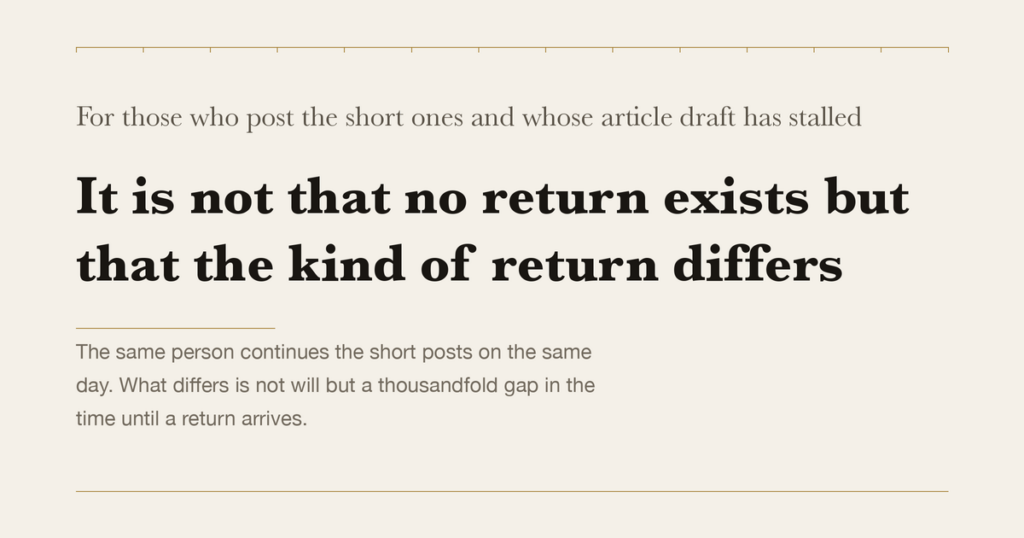
For the same behaviour, the time until a return arrives differs between minutes and months. The gap exceeds a thousandfold. The source of the confusion is that two behaviours a thousandfold apart are gathered under the same word: publishing.
This observation does not mean short posts are superior. A fast return carries a different cost. In places where the return is fast, what you wrote flows past and disappears fast. This point is handled in Being tired of social media comes from stacking on rented ground.
People who can write without responses genuinely exist, so surely it is a difference in the person after all. They do exist. And observe them, and they generally hold a different return. Writing itself organises their thinking; they write towards a specific party who is not the reader; or they once had an experience of a large return arriving late. It is not that no return exists but that the kind of return differs.
The slowness of the return moves somewhat with the writer’s standing. Someone who already holds readers and builds a new location gets responses from the first day. That is, the slowness is a property of the medium and at the same time a function of the routes you hold at that moment. It is slowest when starting from holding nothing.
That one of the two continues is generally not assessed positively. The fact that short posts continue while long writing does not gets read as escaping to the easier one. The condition of the difference in speed of return stays invisible inside that reading.
A Distant Return Appears to Have Lower Value in Itself
The mechanism has a name. Delay discounting — the property by which a return of the same magnitude has lower value in a present judgement the longer the wait until it is received (Ainslie, 1975, Psychological Bulletin 82(4), 463-496).
What matters is the shape of the fall. It does not fall gently in proportion to time; it falls steeply over the first delay and then flattens (Mazur, 1987, Quantitative Analyses of Behavior V, Erlbaum). That is, the difference between today and tomorrow is very large, and the difference between three months and four is almost nothing.
This shape agrees with the observation. Set an action returning in minutes beside an action returning in months and the value of the latter drops sharply within the judgement. And set an action of small value beside an action of distinct value and the latter gets chosen. This is not idleness but a rational choice following the estimate of value.
This property is not a malfunction. Handle distant returns with the same weight as present ones and you become unable to meet the needs in front of you. Because there is a working that discounts, living things can live today.
The strength of the discount varies between people, and varies with circumstance. In periods of unstable income, immediate needs grow larger, so the value of distant returns tends to fall further. Several years into working independently, with next month’s revenue not yet visible, is precisely this condition. That is, the more a period needs long-term accumulation, the harder long-term accumulation becomes to choose.
Understanding the importance would raise the estimate of value, one might think. Understanding and the estimate operating at the moment of judgement are separate. Between knowing something is important and that action being chosen today sits this discount. Knowledge does not fill the gap, so filling it means changing the side of the returns.
Discounting occurs not only when the return is uncertain. Even known to be certain, a distant return is discounted. Guaranteed that continuing for three years will certainly produce inflow, the value in today’s judgement still rises poorly. This is why the presentation of certainty is weak as a prescription.
This discount is invisible to the person writing. What is visible is only a sense of somehow not feeling up to it. And appearing as a sense, it gets explained as a problem of motivation. Explained as a problem of motivation, the prescription heads towards raising motivation. The discount itself does not move, so the raised motivation gets discounted again at the next moment of judgement.
In Slow Places, the Returns Get Manufactured on Your Own Side
If returns from outside are delayed by months, a return is required that fills that period. And what fills it is not supplied from outside, so it gets defined on your own side.
There is one condition. It must be confirmable, with certainty, immediately after the action. A return depending on the presence of responses cannot be used during this period.
Three kinds of thing satisfy the condition. One is making the accumulation itself visible. The count of published pieces, the list of subjects handled. This increases by exactly one immediately after writing.
The second is the definitions left inside you. Write one piece and how you think about that subject becomes settled. What was vague before writing is, after writing, in a state where it can be used as language. This occurs irrespective of anyone else’s reaction.
The third is use with parties you are already in contact with. Use what you wrote in replies to enquiries, or in conversation with existing parties. In this case the return comes back within days.
Returns you define yourself are weaker than returns from outside. They do not reach the strength of a response coming back. This is not a substitute but a bridge for spanning a period. When the external return occurs several months later, the bridge is no longer needed.
A return you decided on yourself is merely deceiving yourself, one could say. It becomes deception when something unconfirmable is made the return. I feel as though I am growing cannot be confirmed, so it does not work as a return. The count of pieces, the subjects handled, the number of times something was actually used are all countable. Countability is the dividing line.
The third — use with parties already in contact — differs in property from the other two. It is not a return you defined yourself but a return genuinely coming back from outside. And that return occurs irrespective of how search assesses you. As a way of filling the slow period, this third is the strongest.
Manufacture your own returns and, when external responses do arrive, you hold two criteria for judgement. A state arises in which your own counting says things are going well while the external response is thin. Return the criterion to the external figures at that point and the assessment of the entire preceding period inverts at once. Switching criteria rewrites the assessment of the past at the moment of the switch.
Having Nothing to Write About Comes From the Same Structure
A reason often cited for being unable to write is a shortage of material.
First, confirm the quantity of material. For someone several years into working independently, the enquiries handled in that period, the jobs declined, the explanations repeated, the procedures corrected after failure, add up to no small number of things an article could be made from. As quantity, the material is sufficient.
Why, then, does it feel absent. Because the signal of what is being asked for has not come back.
In places where responses return, what to write in order to be read becomes evident automatically. In places where they do not, it does not. And having to choose without knowing, everything looks as though there is no reason to write it. It is not that material is absent but that grounds for choosing are.
This state has a solution that does not depend on external responses. Use the questions you have already received as material. A question is a record of what that person did not understand at that moment, so it can be used directly as evidence of demand.
At a stage where no questions have arrived, this solution is unusable too. In that case the material becomes what you yourself did not understand several years ago. The precision falls, and it is still more selectable than a state with no grounds at all.
Someone has already written the same thing, so there is no point writing it — this needs separating. Handling the same subject and being the same content are different. Write from a case you actually handled and the process of judgement enters. The process of judgement is not in anyone else’s article. The conclusions may overlap; the path to them does not.
When a question is used as material, it should not simply be written up as it stands. One person’s question contains one person’s circumstances, so as it stands it does not apply to others. What gets used is not the question itself but the framework the person was presupposing in order for the question to hold. Write the side of the presupposition and it reaches everyone holding the same presupposition.
Handle nothing to write about as a problem of material and the work of hunting for material begins. Reading other people’s articles, collecting topics, searching for subjects that look writable. This work consumes time and supplies no grounds, so you return to the same question after the hunt. And hunting itself takes the shape of postponing the start. The person hunting is left with the feeling of preparing.
The Relation Between Count and Accumulation Is Not Proportional
Without knowing what happens after how many pieces, no grounds for continuing can stand.
The inflow at ten pieces and the inflow at twenty are not double. The growth is settled not by the count but by how much of the territory handled has been covered.
The reason lies in the property of search as a route. What people are looking for is a subject, not a writer. With one article handling a given subject, the possibility of inflow from that subject is generated. Write three on the same subject and what increases is not possibility but duplication of options.
That is, the way continuing works lies in coverage, not volume. Adding one piece on a different subject and adding one on the same subject are entirely different operations.
This is not to say writing several on the same subject is meaningless. Handling one subject from different entrances does sometimes change who is reached. That, however, is when it is done by design, and differs from writing something adjacent because nothing else comes to mind.
This difference is hard to see at the moment of judgement. What is easiest to write is whatever sits next to the subject written just before. The material is still to hand and little needs looking up again. And go on writing what sits next door and the count alone rises while the range covered stays narrow. Choosing in order of ease and increasing coverage frequently point in opposite directions.
One could therefore list out every subject at the start, it might seem. There is a limit to what can be listed. Which subjects hold demand is not knowable until something has been written and placed. Try to settle everything first and it is the settling that never finishes. Placing and then adjusting in fact proceeds faster.
Coverage is not something to be widened without end. Widen it beyond the territory you handle and the character of those reached scatters. What settles the range covered is not the total count of writable subjects but the side of whom you wish to reach. Increase coverage without settling the range and you arrive at a state where inflow rises and commissions do not.
What coverage measures is only what arrives through search. What arrives through referral or from parties already in contact rises by a different route from the count of subjects handled. Coverage is the indicator for search, the slow route, not an indicator of inflow as a whole. Try to read both from one number and which route moved becomes unknowable.
Hold the notion of coverage and the target of writing daily loses its meaning. What is required is not frequency but a reduction in subjects not yet handled. And a target of frequency is legible while a target of coverage is not. The legible one gets chosen, so the frequency target goes on standing.
When Things Stall, Nothing Is Actually Lost
The cost of stalling differs decisively from every other place.
In the place of short posts, stalling reduces display. What was stacked up decays, so you go backwards in proportion to the rest. The pressure to keep going comes from this decay.
With a blog, this decay does not occur. A published article does not disappear from search results when updating stops. The assessment can also stabilise with time and inflow rise.
That is, stall for three months and what was written up to then goes on working. What is lost is only the articles that could have been written in those three months. What already exists does not decrease.
This difference changes the design of continuing. There is no structural need to update daily. In a place that does not decay, the cost of an interval is small. What is required is not frequency but only machinery preventing a stall from becoming a permanent one.
And this fact can be used in working backwards. If one piece goes on working, the effort for one piece is paid once and the returns occur repeatedly. With short posts, effort and return corresponded one to one. In a one-to-one place, stop and the returns stop. In a one-to-many place, stop and the returns continue. The two acts gathered under the same word publishing differ in the very correspondence between cost and return.
Continue a state of no updating at all for long and the information in the territory you handle goes stale. And someone visiting for the first time sometimes infers your present activity from the date of the last update. The cost is not zero. It is, however, not of a scale that can be called decay.
There is also an explanation that update frequency affects assessment. Subjects where recency is assessed genuinely exist. In current affairs, and in territories whose specifications change often, the recency of updates becomes material for judgement. In subjects handling structures and ways of thinking, this effect is small. The conditions differ by subject, so it cannot be handled as a general rule.
What does not decrease is articles that have already been assessed. An article published recently has no settled assessment yet, so it sits outside this protection. Stall in the earliest period and you stall before what you had written begins to work. The property of not decaying is acquired over time.
The fact that nothing decreases when you stall works in the opposite direction too. Nothing decreases, so the cost of being stalled is not felt. A cost that is not felt does not rise into the judgement. And three months becomes six, and the psychological cost of returning grows larger first.
What Can Be Counted Once Frequency Is Set Aside
In place of frequency there are three things: coverage, use, and the interval until return.
First, count the subjects handled rather than the frequency.
Whether you managed to write weekly cannot serve as the test. What should be measured is how many subjects not yet handled have been reduced. Switch to this counting and the assessment of a week with a gap changes. A week without writing was a week without added coverage, not a week of going backwards.
Second, count the number of times what you wrote was used.
Not the number of times read but the number of times you used it. Shown in a reply to an enquiry, referred to in conversation, cited from another article. This count rises with no responses at all, so it works as a return during the slow period.
Third, look at whether you were able to return after stalling.
Not stalling is not a target. What should be measured is whether the interval between stalling and returning is getting shorter. If something that stalled for three months next returns within three weeks, the state has improved. In this medium, the substantive indicator is not that things continued but that you can return.
Not one of the three has measured the frequency of updating. Not lasting was a normal response to a distant return, so looking only at whether it lasted will not separate a case where the return moved closer from a case where the load was raised and pushed through.
The draft stalled for two weeks and the short post put out the same day with no resistance were written by the same hand. Searching your own side for the reason only one of them stopped turns up nothing. Between the two acts lies a thousandfold gap in the time until something comes back, and that gap sits where the writer cannot see it. An invisible condition does not rise as a candidate cause. What stands in place of the candidate that never rose is the account in terms of will.
What settles whether something continues is not the character of the act but the distance between the act and its return. On that distance the account in terms of will takes its proper place. Where the distance is short, little will is needed. Where it is long, the same will does not reach. The advertised responses act on the friction of getting started because, on the short side, friction is the last obstacle. On the long side, lowering friction does not change where the reaching ends. Only with something placed to span the distance do the same prescriptions begin to work.
So there is one more thing available to read the next time things stall. The stall can be read as the return of that act being far away, rather than as something having been lacking on the day. Having read it that way, whether to place one return on your own side, or to leave it stalled for now, is settled by what the period in question is already carrying. Neither choice gets recorded as evidence about your nature.
Which stages lie between writing something and its being found through search is treated in the design of a marketing funnel, and the judgement of where to place what you write so that it stacks on your own side in the cost of switching web hosts. The attrition occurring in places with fast returns is handled in Being tired of social media comes from stacking on rented ground, and the separation of the figures of a place from the figures of a business in Followers not growing is not a problem of the business.