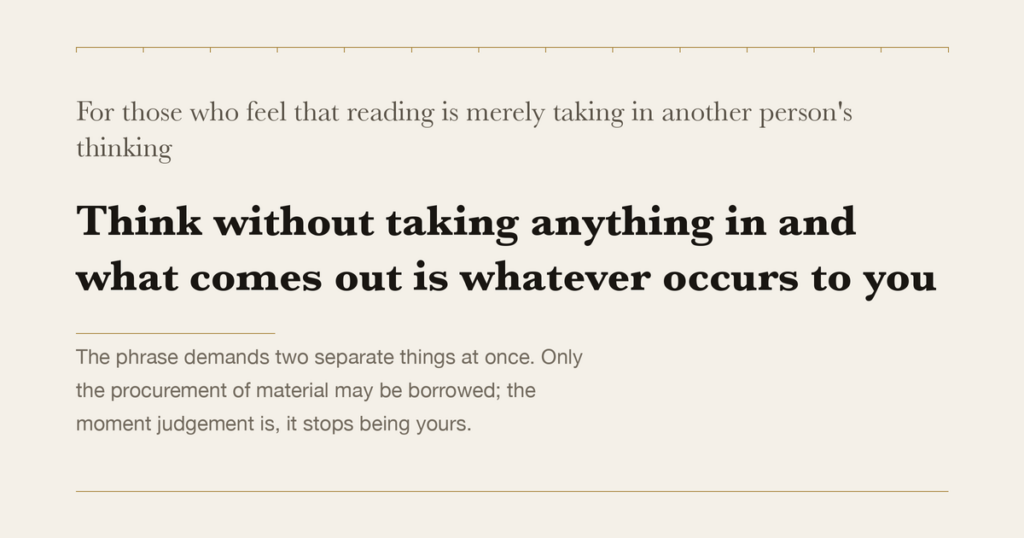
You are told to think for yourself. The meaning is clear, and what to do from here is not. Read a book or listen to someone and the feeling comes that this is merely taking in another person’s thinking. Think without taking anything in, and what comes out is only whatever occurs to you.
The answer comes down to a single demarcation. Material may be borrowed. What stops being yours once borrowed is the judgement. Because these two are folded into one word, the mistaken conclusion arises that touching another person’s information is itself a failure to think for yourself. Conditions do attach in some situations, and they attach to how material is handled rather than to the act of borrowing.
What is taken on here is carrying that demarcation to the point where it can actually be drawn. Material and judgement sit in the same scene, so the line cannot be drawn in the abstract alone. Why borrowing is rational, why what you borrow gets counted as something you understand, and whether there is any way to confirm from the outside that a judgement was in fact handed down. These three are placed in order.
The side this article does not take on is worth stating in advance. Training the faculty of thought is not covered. Nor are methods for increasing how often or how long you think. Not because they fail, but because the problem here is location rather than quantity. How to design the incoming information itself belongs to Being at the mercy of information comes from not selecting the entrances, and the case where the entrance to judgement never opens at all is handled in Having stopped questioning things is not idleness.
This demarcation neither recommends learning alone nor discourages learning from others. It carries the opposite implication. Once the line’s position is settled, the meaning of the act of receiving from others changes with it. How it changes becomes visible once the line has been drawn.
Placing this demarcation splits the act of receiving from others in two. Receiving material is taking the gains of a division of labour as they stand. Receiving a judgement is handing the other party the work of checking whether that judgement fits your own conditions. The first lowers the cost; the second defers it. What was deferred comes back in one piece at the moment the fit turns out to be wrong. So the question is not whether to learn from others but whether, each time, you can tell material from judgement.
📖 Contents
- “Thinking for Yourself” Demands Two Things at Once
- The Five That Come Up Most Raise the Quality of Judgement and the Time Given to It
- Material May Be Borrowed. What May Not Be Borrowed Is the Judgement
- Borrowing Is Rational Because the Object of Assessment Moves From Content to Person
- Borrowed Material Gets Counted as Something You Understand
- Reasons Come Out the Same Way for Judgements You Never Made
- Whether a Judgement Was Handed Down Is Legible From What Was Not Taken
- Where in the Inputs to a Business Material and Judgement Get Mixed
- Judging From Outside Whether the Judgement Is Your Own
“Thinking for Yourself” Demands Two Things at Once
Thinking for yourself names two separate pieces of work.
The first is gathering material yourself. Touching the underlying facts rather than someone’s summarised conclusion. Looking at the figures yourself, seeing the site yourself, reading the original yourself.
The second is handing down the judgement yourself. Deciding, on your own criterion, what matters among the assembled material and how to handle it.
The two are independent. You can gather all the material yourself and still leave judgement with someone else. Conversely, you can borrow all the material and hand down the judgement alone.
When that independence is invisible, the response goes wrong. On feeling that you are not thinking for yourself, suspecting the material side and suspecting the judgement side lead to opposite actions. One moves toward increasing input; the other moves toward reducing input and examining the criterion. The same symptom carries two prescriptions pointing in opposite directions.
An objection stands here: the two cannot be separated, because deciding what to treat as material is itself a judgement, so the two are entangled.
That objection states half the situation accurately. Deciding what to treat as material is indeed a judgement. It is a different matter, however, from who produced the content of the material. Deciding to read a book someone else wrote is your judgement; the contents of that book are another person’s material. The two sit in the same scene and on different layers.
The boundary does blur when material has been edited toward a particular conclusion. An article carrying an opinion, or a set of cases selected by working backwards from a conclusion, is judgement in the shape of material. Handling such a source requires a prior stage that separates where the facts end and the interpretation begins.
What can be checked is whether the account includes facts inconvenient to the writer’s own conclusion. Material assembled as a set of facts tends to contain items the writer would rather not have. An account containing none of them is likely to be a subset of facts chosen from a conclusion. It remains usable, and it arrives in an incomplete form as material.
Left folded into one word, only the side with volume gets credited. The volume of material is countable. Books read, cases collected, hours spent researching. The volume of judgement is not countable. Only the visible side accumulates, so gathering material becomes a substitute for thinking.
The Five That Come Up Most Raise the Quality of Judgement and the Time Given to It
Five methods are advertised repeatedly as ways to think for yourself.
Hold questions constantly. Trace causation by repeating “why” against information you receive. Recognise that gathering information and thinking are separate, then make thinking time visible and increase it. Learn critical thinking and doubt your own view. Discard premises.
All five work in real situations. The demarcation that reading and checking the news are information gathering rather than thinking is particularly accurate, and it matches the position of this article.
All five operate on the quality of judgement. Repeating “why,” looking critically, discarding premises. Making time visible increases the resource allocated to judgement.
Raise both the quality and the resource, and whose criterion the judgement is handed down on still does not move.
Critical examination, one might read, makes the criterion your own as well. This is where the paths diverge. Critical thinking is a technique for inspecting the validity of a claim presented to you. Inspection requires a criterion, and where that criterion came from is not among the objects of inspection. Inspecting rigorously on a borrowed criterion is entirely possible, and in that case the judgement is precise without being your own.
Repeating “why” also has a place where it stops. Trace causation backwards and you eventually arrive at a point of “because that is how it is.” What sits at that point is that person’s criterion. The five methods carry you as far as that point without containing the work of setting down what sits there. How to hold the criterion itself is handled squarely in Being unable to decide is not character but the consequence of a structure in which judgement has been handed over.
Increasing thinking time also fails under one condition: when the material is thin. Increase time alone against few objects to examine and you circulate the same material repeatedly. Depth appears to increase, and what tends to increase is the strength of conviction.
Training in critical examination carries a further asymmetry. It operates readily on other people’s claims and poorly on your own. Another person’s claim stands up outside you as an object. Your own claim shares one criterion between the inspecting side and the inspected side, so a contradiction never surfaces as a contradiction.
This prescription also carries a side effect: it can manufacture guilt about gathering material. The demarcation that information gathering is not thinking is accurate, and jumping from there to the conclusion that time spent taking in information is wasted leaves the material barren. A judgement with no material is indistinguishable from whatever happened to occur to you.
Material May Be Borrowed. What May Not Be Borrowed Is the Judgement
Borrowing material is rational.
The reason is cost. Touching primary facts yourself requires time and access. Reproducing on your own what someone has already measured, already read, already tested serves no purpose. The cost paid for reproduction is resource that could have gone into raising the quality of judgement.
Not borrowing material is the riskier state. When only what you have seen counts as material, the sample is confined to your own experience. That range was produced by the choices you have made so far, so it is already skewed.
Judgement, by contrast, cannot be borrowed. More precisely, it can be borrowed, and the moment it is borrowed it stops being your judgement. What matters, what takes priority, where you compromise. These are statements of what a person holds important. Have the statement made on your behalf and what comes out is the order belonging to whoever made it.
The average rate charged in your field is material. Borrow it freely. Looking at that figure and deciding “then I will sit around there” borrows the judgement. Looking at the same figure and deciding “inside this band nothing differentiates except hours, so I will set a different axis” leaves the judgement yours. The input is identical and the output diverges.
Treating another person’s judgement as reference is itself a kind of material. That holds. Another person’s judgement can be handled as material, on one condition: you have to see why that judgement was handed down, criterion and all. Take the conclusion alone and it is borrowing. See the criterion with it and it becomes an object for comparison against your own criterion, which returns it to material.
Seeing the criterion, however, requires the other party to have put it into words. Information circulating as conclusions alone, in the form of “this is the right answer,” cannot be converted into material. What remains usable in that case is the single fact that such a claim exists.
Understanding this demarcation reduces the volume of information you can draw on, at least temporarily. Sources that hand over conclusions alone stop being usable. Not a little circulating information takes the shape of conclusions alone. Filling the gap means finding sources that write down their criteria, and those take time to find.
The reduction is not itself a loss. Conclusion-only information looks like material in volume while doing no work as input to judgement. The reduced state does, however, register first as a feeling. Incoming volume falls immediately; the quality of judgement rises on a delay. Return to the old sources during that interval and the demarcation stays drawn without ever being used.
Borrowing Is Rational Because the Object of Assessment Moves From Content to Person
Saying material may be borrowed sounds careless. If borrowed material is wrong, the judgement standing on it misses too. That deserves sorting out.
The philosopher John Hardwig published a paper called “Epistemic Dependence” in The Journal of Philosophy in 1985 (volume 82, number 7, pages 335–349) 10.2307/2026523. Its argument is that in fields where expert knowledge is divided, a layperson’s dependence on expert testimony is not irrational but a requirement of rationality itself.
The paper’s concrete case is a collaborative paper in particle physics. No author can verify the whole experimental process alone, and the authors themselves receive one another’s portions as testimony. Even experts depend on others inside their own field. Refusing dependence does not increase the quantity of knowledge; it shrinks the knowable range down to what you can verify with your own hands.
The point of the argument is that the rationality of the dependent party resides in the assessment of the person rather than the assessment of the evidence. A layperson has no material for judging the content. What can be judged are properties on the other side: whether the person stands inside the procedures of the field, whether their interests bear on the direction of the conclusion, whether there is a record of corrections coming back when they were wrong. Judgement does not disappear. The object of judgement moves from the content to the person.
What it moves to is still judgement. Have someone else decide whom to trust and the judgement is borrowed after all. Borrowing material does not amount to abandoning judgement because the judgement of whom to select remains on your side.
There is also a range where this rationality does not reach. Hardwig’s argument presupposes a division of expert knowledge. Where no experts exist, the rationality of dependence does not hold. What matters to you, which losses you will absorb, in what order you prioritise. No expert can adjudicate correctness on these. Import the form of the division of labour into a domain that cannot be divided, and someone else’s order arrives as your order.
Business decisions sit where the two are mixed. Portions with divided expertise, such as tax and legal matters, and portions that cannot be divided, such as what to take on and what to decline, coexist within one decision. The confusion arises when experience of depending correctly in the divisible portion is extended straight into the portion that cannot be divided.
Borrowed Material Gets Counted as Something You Understand
Even granting that borrowing material is rational, how the borrowed item is handled afterwards is a separate matter. A shortfall sits here that is invisible from the inside.
The psychologists Leonid Rozenblit and Frank Keil published a study in Cognitive Science in 2002 (volume 26, number 5, pages 521–562) 10.1207/s15516709cog2605_1. Participants rated, on a seven-point scale, how well they understood how everyday devices work, such as zips and flush toilets. They then wrote out step-by-step explanations of the mechanisms. Then they rated themselves again.
The rating after writing the explanation fell below the rating before. The researchers named this the illusion of explanatory depth. Asked to produce an actual explanation for something they believed they understood, participants exposed that what they held was not the mechanism but the memory that a mechanism existed.
The paper’s own limitation on scope matters as well. The gap appears large for objects with causal chains and small for lists of facts or narratives. How a device works invites the illusion; who did what and when does not.
That difference carries straight into how material is handled. Facts and figures you borrow stay in your hands with a small gap. The large gap belongs to what you borrowed as an explanation of a mechanism. Borrow the answer to “why does that work,” and what remains is the conclusion that it works, plus the memory that an explanation existed.
Judgement then rests on top of that empty portion. Assemble a subsequent decision on the premise that you understand the mechanism, and the decision assembles even when the premise is hollow. The hollowness surfaces only when the decision misses. And when it misses, the cause appears to sit on the judgement side. The material side being empty stays invisible until you try to explain it.
The prescription is output rather than introspection. Write the mechanism out in steps. The portions you can write yourself are the material you hold; the portions where you stall are the material still on loan. This verdict uses nothing about how you felt. It uses only the externally visible fact of whether you could write it.
One caution. Failing to write it is not a reason to discard that material. Tools used without any grasp of their mechanism are numerous in both daily life and business, and in many situations that is sufficient. The verdict matters only when another decision is stacked on that mechanism. If nothing is stacked, borrowed is fine.
Reasons Come Out the Same Way for Judgements You Never Made
If borrowed material carries an illusion, what about judgement? A stronger form of experiment sits here.
The psychologist Petter Johansson and colleagues published a study in Science in 2005 (volume 310, number 5745, pages 116–119) 10.1126/science.1111709. Participants were shown two photographs of faces and asked which was more attractive. The chosen card was handed to them, and they were asked to explain why they chose it. To this point it is an ordinary preference survey.
On some trials, the experimenters used a conjuring technique to hand over the card that had not been chosen. Participants then explained their reasons for choosing a face they had not chosen.
Trials in which the swap was noticed were few. Most participants gave specific reasons for preferring the face they had not selected. This phenomenon carries the name choice blindness.
The result separates two things. The sense of having chosen and the fact of having chosen can arise independently. The sense assembles afterwards, from the state of holding the card. It therefore arises at the same strength even when no choosing occurred.
A limit on scope belongs here. Some participants did notice the swap. This study does not claim that people have no grasp of their own choices. Its claim is that the sense of having chosen is not a record of having chosen. The sense follows the judgement rather than logging it.
Choices about photographs and decisions in a business are different things. That reading is available. Important decisions leave a record of deliberation, which raises the precision. What the record holds, though, is only the deliberated portion; whether undeliberated factors were operating never appears in it. Precision rises only across the range that was recorded.
The practical consequence is single. Strength of conviction is not evidence that a judgement was your own. Conviction rises identically around borrowed judgements. Learning this makes conviction itself look suspect, and lowering all conviction makes judgements impossible to execute. What has to be lowered is not the conviction but the practice of using its strength as grounds.
Set beside the illusion of explanatory depth, the two form a pair. That one counts borrowed material as something understood. This one counts a borrowed judgement as something handed down by you. One illusion sits on the material side and another on the judgement side. Careful inspection of the interior therefore cannot draw the demarcation. It can be drawn only on records placed outside.
Whether a Judgement Was Handed Down Is Legible From What Was Not Taken
If confirmation from the inside is unusable, an externally visible record is needed.
A judgement is the operation of selecting one item from several candidates. If the operation occurred, candidates exist that were not selected. Being unable to state what was not selected means what happened there was not a selection but the receipt of a default.
Asked “why this price,” answering “because this price seemed appropriate” looks like the description of a judgement. What it lacks is which other prices were examined and why they were dropped. With no candidates examined, no comparison took place. By contrast, “I looked at double the price, found that band would require three times the explanation, and dropped it” reports a judgement that occurred. The reason for not taking something displays that person’s criterion.
This verdict is needed because stating the opposing side is not a skill that arrives automatically. The educational psychologist David Perkins published a study in the Journal of Educational Psychology in 1985 (volume 77, number 5, pages 562–571) 10.1037/0022-0663.77.5.562. Asked to freely produce arguments on a social issue, participants produced many arguments supporting their own position and few on the opposing side. The imbalance barely shifted with years of higher education.
Stating the candidates you did not take is not a skill that arrives on its own with years of education. It has to be placed explicitly on each occasion, so it gets left as a record.
Failing to think of alternatives still leaves a judgement — so one reading has it. Where nothing was thought of, the issue is the range of recognition rather than judgement. With only one candidate, a judgement does not formally occur. What is needed then is more material rather than practice in judging. The demarcation between material and judgement does work here as well.
Not every judgement needs its candidates written out. Most daily judgements can run on defaults. The targets for this verdict are the small number of places that govern subsequent judgements. Sorting which ones those are is handled in Having stopped questioning things is not idleness.
Being able to list candidates you did not take is also not the same as those candidates having been examined. Lining some up for form’s sake, with no intention of taking them, is available. The mark that distinguishes the two is whether the dropped candidates have advantages written against them. A candidate with no advantages is not an object of comparison but the appearance of having compared.
Keeping records carries an unfavourable side. Record what you did not take and later inspection can reveal mistakes. With no record of the judgement, the mistake goes unrecorded too. Holding records makes your own errors traceable. That burden is sometimes the real reason judgements are not left explicit.
Where in the Inputs to a Business Material and Judgement Get Mixed
Among what comes into the business, three inputs are where the confusion occurs.
The first is the consumption of learning. Receive a procedure through a course or a book and execute it as given. The procedure is material, and the judgement of whether to apply it to your own business is not contained in the procedure. What is not contained does not get executed, so implementation proceeds with the judgement stage missing.
The second is market research. Investigate demand, investigate competitors, decide your positioning from the results. The findings are material, and what to select from them does not emerge from the findings. Try to make it emerge and either the largest demand or the emptiest position tends to get selected automatically. Neither is a judgement; both are defaults. Selecting the emptiest position takes the shape of setting originality as the target. What that order produces is handled squarely in How a concept is built and Choosing to stop competitor analysis.
The third is the receipt of advice. Execute the conclusion of whoever you consulted, as given. A conclusion is judgement rather than material, so executing it runs your business on that person’s order. Converting advice into material requires asking why that conclusion was reached, criterion and all.
In all three, confusion arises when you move to the next stage without confirming whether what arrived was material or judgement.
Adopting an expert’s judgement is rational. It is. As established earlier, dependence is a requirement of rationality where expert knowledge is divided. What has to be distinguished is whether you are aware of delegating. Delegate knowingly and you can take it back when conditions change. Without awareness, that judgement settles in as your own view.
There is no need to take the three on at once. Learning, research and advice are all required inputs for a business. Rather than removing them, placing one question immediately on receipt — is this material or judgement — creates an opportunity to notice the confusion.
Adding that check slows execution. Executing a conclusion as given is faster, and speed shows up as results in the short run. The gain from inserting the judgement stage appears only when conditions change, so for a while it looks like a loss.
The asymmetry favours whoever skips the check. Someone moving fast by skipping is observable; the cost of having skipped is not. The cost surfaces when premises shift and conclusions have to be rebuilt, and by then the cause does not look like the earlier speed. What tends to be visible is that the market changed.
Judging From Outside Whether the Judgement Is Your Own
Three verdicts can be applied from outside.
The first is whether you can write the candidates you did not take. Pick several recent judgements and write, for each, what was examined and why it was dropped. A judgement you cannot write up was the receipt of a default rather than a judgement. This can be left as a record rather than a memory, which routes around the unreliability of introspection.
The second is whether you can write a step-by-step explanation of borrowed material. Pick one mechanism you have placed as a premise of your business and write out in sequence why it works. Where you stall is where a conclusion alone was borrowed and placed as a premise. The verdict comes from whether you could write it, not from self-assessment.
The third is whether you can move the conclusion when premises change. Ask yourself what happens to this decision if the market changes in a given way. If you can state how it moves, the judgement is held conditionally. If nothing comes out, you are holding the conclusion alone.
How much material you gathered yourself is in none of the three. What they look at is the record of candidates, the output of an explanation, and the tie to conditions. The ownership of material is not an indicator of the ownership of judgement.
Reading a book is merely taking in another person’s thinking. That suspicion faced the entrance, the material side. What actually stood open was the exit, and what was borrowed there, in most cases, was the judgement. The place that needed closing was not visible, so the work of closing it never began either.
Whether what you borrowed carries a label. That is what settles thinking for yourself. Reaching a state of having borrowed nothing does not enter the question. With the ability to place items separately — this is material, this is another person’s judgement, this is my own judgement to trust that person — borrowed things become part of your own construction. Without labels, borrowed things settle in as your own views.
Attaching labels does not itself require reducing the information. How much to take in is a separate question settled on the side of entrance design, and it moves independently of this demarcation. With a label attached, what arrives can be placed as material for your own construction. Look not at what you take in but at what is written on what you took in. The next time something arrives, place it once as material or as judgement. The order gets assembled after that.
Tracing where the criterion you now hold came from is handled in Patterns of thought are not something to be corrected, and the work of giving shape to the order of what matters in Building a view of the world. A nearby question is handled from another side elsewhere. The way choices align with those around you is in What is occurring inside someone easily influenced by others, and the state of having no written range of what you may decide in Why “act on your own initiative” leaves people unable to act.