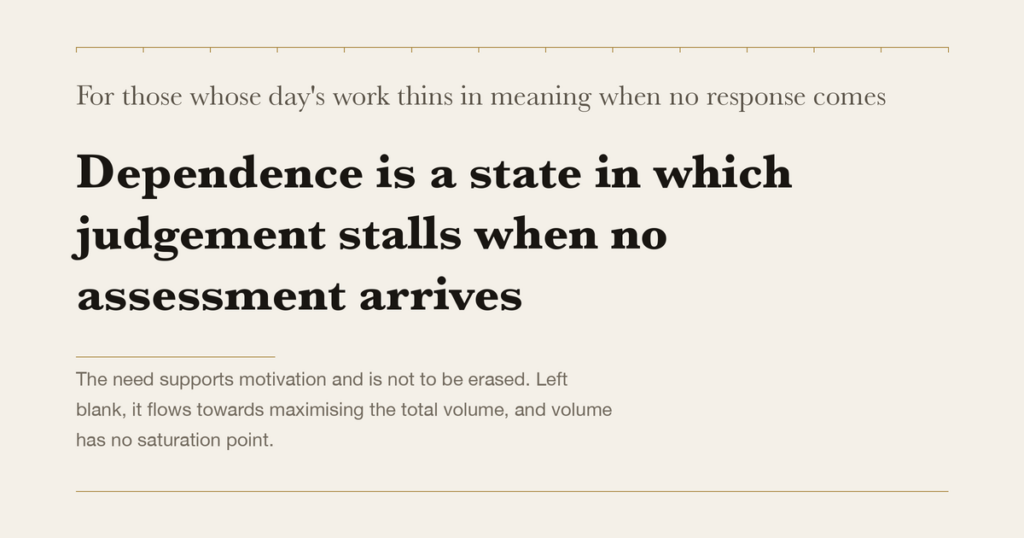
When nothing comes back on what you put out, the day’s work loses some of its meaning. On days when the numbers rose you can keep going, and on days when they did not, no reason to write turns up. There are days when the number of times you check for reactions exceeds the time spent making anything. You have noticed that the wish to be recognised is entering your business decisions, and you regard that as a fault.
The wish to be recognised is real, and it is not something to be removed. What gets handled here is not the quantity but the addressee. Whether it is settled who you want to be recognised by decides how the same wish behaves.
Prescriptions point almost entirely at the quantity. They line up in the direction of reducing, and the distress really does fall.
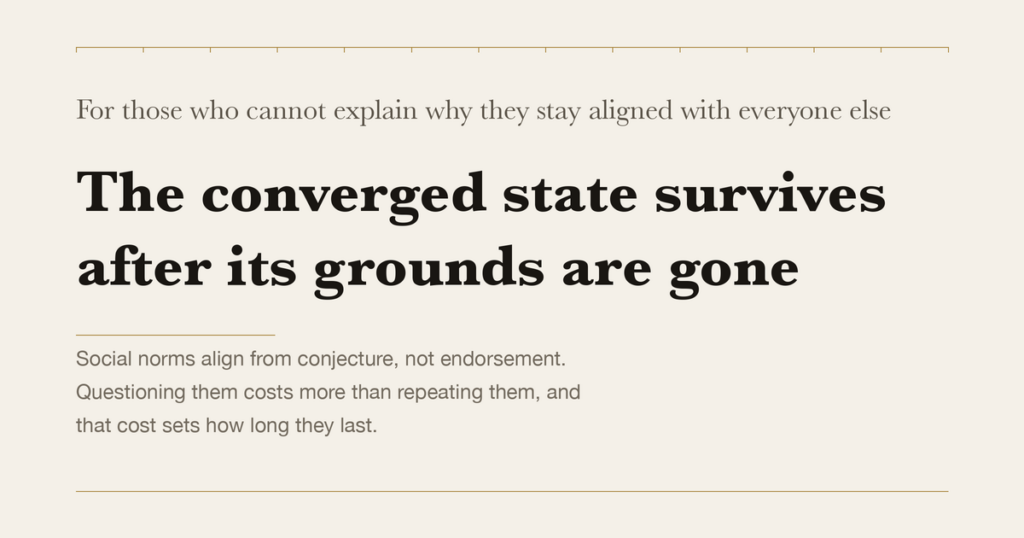
What the reduction leaves untouched is the addressee, which stays blank. Lower the quantity while the field stays blank, and when the quantity returns it flows to the same place. If the source of the difficulty is the blank field rather than the strength of the wish, then a prescription that operates on strength has nowhere to land.
What happens while the field is blank is not obscure. A wish with no object turns towards quantity. That is not negligence but the default behaviour when no object has been specified. And quantity has no end, so however much is collected, no basis emerges for judging whether it was enough.
There is one further structural property. Assessment earned by a form built to collect quantity is conferred not on the work but on the position it occupies. Anyone can stand in that position, so however much assessment arrives, it is hard to receive as directed at you. That is where the sensation of thinning returns comes from, even as the reactions increase.
The damage shows up in how time is allotted before it shows up in how much you feel. There are days when the count of checking for a reaction exceeds the hours spent making — this state is a description of working hours, not of how strongly something is felt. With no addressee settled, there is no ground on which the checking can be stopped. The basis for deciding whether it is enough sits outside, so a reason to stop can only come from an arrangement made outside it — fixing the hour in advance, say. Without such an arrangement, the hours for making are subtracted from there.
This article does not perform the work of choosing an addressee for you. Who to aim at cannot be settled from outside somebody’s business. What is handed over runs as far as the material for judging, yourself, whether it is settled.
The seeking side and the avoiding side mix as symptoms and point opposite ways as prescriptions. And almost everything advertised as a response lands on the quantity of the seeking side, never on the field where the addressee goes. The side that wants to avoid being judged is handled by Being preoccupied with other people’s eyes comes from leaving the verdict on their side, and the location of the yardstick itself by The mechanism behind minding other people’s assessment.
📖 Contents
- Wanting to Be Assessed and Minding Assessment Are Different States
- The Wish to Be Recognised Is Real and Is Not Something to Remove
- The Recommended Responses Go After the Quantity of the Wish Itself
- The Problem Is Not the Wish but the Blank Addressee
- With the Field Blank, Movement Goes Towards Maximising the Total
- Assessment for Quantity Attaches to the Position, Not the Work
- A Blank Addressee Can Be Counted From Outside
- Choosing an Addressee Tends to Lower the Short-Term Volume
- A Filled Address Shows Up in How Judgement Behaves
Wanting to Be Assessed and Minding Assessment Are Different States
Separate the two that get mixed. The seeking side and the avoiding side.
The seeking side goes to fetch approval that has not yet arrived. The direction of movement is forward, and the volume put out can rise. The avoiding side evades a denial that might arrive. The direction is backward, and the volume put out falls.
Both operate within the same person, so as symptoms they mix. The prescriptions still run in opposite directions. The avoiding side responds to work that returns the authority to judge to your own side. For the seeking side that is not enough on its own. Return the authority and the wish to be recognised still remains.
The line between the two runs here. How it feels when nothing at all comes back. Relief means the avoiding side is dominant. Emptiness means the seeking side is dominant.
The view that separating them is pointless, since both are present, is reasonable. It is still worth doing. When both are present, the periods in which the avoiding side is strong and those in which the seeking side is strong alternate, and applying a prescription to the wrong period does not work. Narrow the addressee during a period when fear keeps you from publishing, and the volume does not rise, so no change can be observed.
As a sequence, the avoiding side comes first. While nothing is going out, the question of the addressee does not begin. It becomes a question of where to aim only once things are going out.
The two can also operate towards the same person at once. You want to be recognised by them, and at the same time you are avoiding being denied by them. What goes out then leans towards the innocuous, because you are reaching for the chance of approval while trimming the chance of denial. The result is neither a form that reaches nor a form that stays clear of the middle.
Place the boundary one further step on the practical side. If the avoiding side dominates, what needs fixing is the sequence of the decision to publish. If the seeking side dominates, what needs fixing is how you decide what to make. The first is a question of process and the second a question of content, so they touch different places.
There are also periods that are neither. Nothing comes back and you feel neither empty nor relieved. Approval is not entering the decision at all then, so the reason for the stalling sits elsewhere. The separating work is required only where the presence or absence of reactions is moving the decision.
And the seeking side has a property that makes it hard to find. A high volume of output and a movement that goes to fetch reactions look active and forward-facing. Results really do follow. So the fact that this state is distorting decisions is hard to observe for the person or anyone around them. It tends to surface as a problem some years later, at the point where you can no longer explain what you have been making.
The Wish to Be Recognised Is Real and Is Not Something to Remove
This wish is not an object of conquest; it sits on the side of the conditions for motivation.
Self-determination theory, systematised by Edward Deci and Richard Ryan, organises human motivation as a continuum running from the external to the internal, and shows that satisfying three basic needs — autonomy, competence and relatedness — supports intrinsic motivation (Ryan & Deci, 2000, American Psychologist 55(1)).
The load-bearing point is that relatedness sits among the basic needs. Being accepted by others within a connection is a condition that supports motivation, not a weakness to be overcome.
The three needs themselves were not invented by the theory. The paper indicates the origin of each need itself, and what was done was to gather the three into one framework as needs common to human beings. The attribution of a theory and the attribution of the parts it gathers have to be handled separately.
So a prescription aimed at eliminating the need for approval is an attempt to remove part of the foundation of motivation. Remove it and the distress of wanting recognition falls. So does the reason to continue.
Is a state free of dependence on the assessments of others not the ideal? Dependence and having a wish are different. Dependence names a state in which judgement stalls when no assessment arrives. A wish can be present without judgement stalling, and then it is not dependence. What the theory states is that motivation is supported when relatedness is satisfied, not that judgement should be handed to assessment.
Nor does satisfaction take the form of quantity. Being accepted within a relationship with a particular person and receiving reactions from an unspecified many do not satisfy the same need. How that difference works in practice is handled in the sections that follow.
The theory carries one further practical implication. The three needs are not parallel; they act on one another. As the movement to fetch recognition strengthens, the decision about what to make shifts to the other party’s side, and autonomy gets eroded. Trying to satisfy relatedness through quantity reduces a different need. The nature of the difficulty is not the wish but this exchange.
A framework that denies the wish has a side effect of its own. Once seeking approval counts as a fault, seeking it can no longer be said aloud. Unsaid, the work of choosing an addressee never begins, because choosing one requires first admitting that you are seeking. The denying framework stops that first step.
The Recommended Responses Go After the Quantity of the Wish Itself
What is advertised as a response comes to six.
Approve of yourself. Reduce your dependence on the assessments of others. Stop comparing. Put distance between yourself and social platforms. Learn the traits of people who are strong in this respect. Accept that you are seeking approval.
All six have situations where they hold. The last in particular — admitting that you are seeking it — is, as shown below, the precondition of the work of choosing an addressee.
The remaining five broadly share where they touch. Most of them try to lower either the quantity of the wish or the quantity of contact with assessment. Approve of yourself, reduce dependence, put distance in. They line up in the direction of lowering.
As a design for relieving distress, that is correct. Lowering the quantity still leaves the addressee blank. And while the field stays blank, the moment quantity returns the old shape returns with it.
Will the addressee not become unnecessary once you can approve of yourself? Part of it does and part of it remains. The first-pass judgement of whether your own work is good can be issued by you. That belongs to the side of judgement. The satisfaction of relatedness — being accepted by somebody — cannot be met alone. By definition it requires another party.
That party does not have to be numerous. A specified few will do. More of them does not by itself make satisfaction easier.
The five prescriptions share a premise: that reducing the amount of assessment received also reduces the amount by which assessment throws you around. The premise is correct, and the amount received and the amount sought are separate variables. Cut the contact and the seeking side does not fall. With supply stopped and the wish intact, the reaction on the next contact can be stronger rather than weaker.
There is a situation where putting distance in works well: where checking for reactions is genuinely eating into working time. What is being consumed there is time rather than judgement, so reducing contact restores it directly. A problem of time and a problem of criteria present as the same symptom and resolve separately.
One of the five, stopping comparison, belongs to a different lineage. It is a matter of measuring where you stand rather than of approval. The two are advertised together and land in different places. That lineage is handled by The mechanism by which you compare yourself with others.
Prescriptions that lower quantity carry a side effect when they succeed. Stop seeking reactions and part of the reason to publish disappears with them. Where the publishing is the business, a fall in volume translates directly into a thinning of the route. Distress falls and reach falls with it. That shape can look like progress or like a stall, which makes it hard to judge.
The Problem Is Not the Wish but the Blank Addressee
Move from the side of the wish to the side of the field.
The wish to be recognised requires an object. By whom do you want to be recognised? With the field filled, the wish works as material for judgement, because whether something has value for that party decides what gets made.
Unfilled, the wish keeps looking for an addressee. With no destination settled, a number moves into the slot the destination would occupy. Anyone will do, so long as there is a lot. The mechanism simply runs that way; strength of will plays no part in it.
With the addressee settled, a good reaction from that party satisfies it. One instance is enough. With the addressee blank, no number of returns supplies a basis for judging whether it was sufficient.
What to do at a stage with no clients yet has an answer. The addressee does not have to be an actual client. What is required is being able to say what state the person you want to reach is in. One concrete figure is enough. And building that figure from somebody you have actually met is the more reliable route. Take a stratum you have never met as the addressee, and when reactions do arrive, it is hard to judge whether they came from the addressee.
The addressee also does not have to be the whole market. Making the whole market the addressee has the same effect as leaving the field blank. “I want it to reach a lot of people” specifies a quantity, not an addressee.
Changing it later is permitted. Look at who actually received it, and rewrite the field where it differs from what you assumed. The aim is not to fix it but to keep it from being blank. A blank field and a provisionally filled field behave completely differently. Provisional or not, a filled field functions as a basis for judgement.
Place the standard for writing it. Write the addressee as a state, not as an attribute. Not age or occupation, but where they are stuck now, what they tried and what failed. Written as a state, it settles what content will work for that person. Written as an attribute, what it mainly settles is the vocabulary.
A cost comes with it. Choose an addressee and assessment from outside that addressee stops working. That is the intended result, and in practice it creates friction, because favourable reactions from people outside the addressee no longer carry the weight they did. Even with the total unchanged, the satisfaction feels temporarily lower. Judge that period a mistake, and the field returns to blank.
With the Field Blank, Movement Goes Towards Maximising the Total
Once the addressee is no longer a specified few, the only basis for judgement is more. And a movement aimed at more affects the selection of content directly.
First, subjects with wide reach get selected. What applies to anyone collects many reactions. Second, forms with fast reactions get selected. Short conclusions that need no checking. Third, positions that are hard to deny get selected. Drop the limits and the reservations and the pushback falls.
All three are correct choices for increasing quantity. And all three wear down the reason to be chosen. What applies to anyone, arrives fast and is hard to deny tends to resemble what anybody else would write.
Quantity also has no end. Get used to ten reactions and the next baseline is thirty. That is not greed but the mechanism of a moving reference point. While the reference point keeps moving, the state of satisfaction is slow to arrive.
The point that quantity is the only thing to chase early on has grounds. At zero recognition, quantity is almost the only observable signal. Who it is reaching cannot be known until it reaches them. Watching quantity early is a correct judgement.
What divides is the period of watching quantity from the period of taking quantity as the aim. Watching is observation; taking it as the aim is setting a criterion. Whether it is being used as observation shows in what you do when the quantity rises. Looking into the content of the increased reactions is observation. Thinking about how to increase them further is an aim.
The moving reference point has a downward face as well. After once receiving a large number of reactions, a return to the earlier volume is experienced as a decline, even where the level matches what it was before. The same figure carries a different meaning depending on the direction it arrived from. While quantity is the criterion, there is no getting off this oscillation.
The three selections share a further property: each presents, in the moment, as a judgement about quality. The wide subject is useful to many people, the fast form is readable, dropping the limits is clear. Choices that run towards quantity all arrive dressed in the vocabulary of good judgement, so the fact that quantity has become the criterion stays invisible.
And the form produces results early. So it settles in accompanied by an experience of success, and a reason to change a working form rarely arrives from inside. A reason arrives when the quantity plateaus, or when you can no longer explain what you are making. Both come considerably later.
Assessment for Quantity Attaches to the Position, Not the Work
Dig one layer further. This is the practical core.
Assessment obtained through a form built to collect quantity also appears, in the moment, to be conferred on the content. And the more that content applies to anyone, the more anyone else can produce the same content. The assessment is genuine, and its addressee does not have to be you. Had somebody else published the same thing first, the assessment would likely have gone there.
That assessment for the same work varies with who produced it has been observed and named in the world of science. The Matthew Effect, reported by the sociologist Robert Merton in 1968, handles the bias by which credit and recognition accumulate on the side of the already eminent researcher, even for work of equal merit (Merton, 1968, Science 159(3810)). For the same paper, whose achievement it reads as can change with the composition of the authors. Merton described this as a property of the system that allocates credit, not of individual character.
What is borrowed here is not the account of the sciences. It is one point: that assessment can be allocated to the position a piece of work occupies rather than to the work itself. Assessment attached to a position attaches to anyone in that position. And a form that maximises quantity is, by definition, a form that selects a position anyone can stand in.
That is why assessment for quantity has difficulty producing satisfaction. The person receiving it can tell, somewhere, that it was not directed at them. The sensation of thinning returns as reactions increase comes out of this structure.
With an addressee settled it runs differently. Something built for a party in a particular state, in a form that works only for them, is hard for anybody else to substitute. The assessment that returns is directed at the work rather than the position.
Is it not the same, provided you are assessed, substitutable or not? In the short run it is. What differs is what accumulates over time. Assessment at a substitutable position does little to improve the terms of the next piece of work, because others can always stand there too. That structure is handled directly by Stepping out of price competition.
Nor is a substitutable form wrong. Where quantity is required, that is the correct form. The test is whether this is a phase for quantity or a phase where a reason to be chosen is required.
What makes it awkward is that substitutability is hard to see from inside. Assessment really is coming back, so the thinness of the return gets interpreted as a shortage of quantity. With that interpretation, the prescription becomes more quantity. Where substitutability is the cause, more quantity raises substitutability further. A mistaken diagnosis doubles as a procedure for making it worse.
And something built to match an external yardstick moves towards substitutability at the moment it matches. A yardstick outside you is a yardstick others can consult as well. The more successfully you match it, the less you can be told apart from everybody else matching the same one. Success and substitutability rise together, so occasions to notice along the way are few.
A Blank Addressee Can Be Counted From Outside
Generality, checking frequency, the way requests are chosen. Count those three.
First, how general what you write is. Lay out what you have published recently and see whether you can write in one line who each piece was aimed at. For people working independently is too wide. If only a wide addressee can be written, the field is close to blank.
Second, how often you check reactions. What interval passes between publishing and looking at the numbers. The higher the frequency, the more quantity has entered the input to your judgement. Frequency is self-observable, which makes this the easiest of the three to measure.
Third, the kinds of request you cannot decline. With no addressee settled, requests tend to look equivalent, since any of them might lead to assessment. Settled, a request outside the addressee falls out of consideration at that point. And a request that has fallen out requires no decision to decline. What never entered the shortlist is not declined; it is simply never selected.
Does narrowing the addressee not reduce the work? It does. And the reduction is also a sign that the addressee has started working. Narrow first without a route to make up the difference, though, and all that happens is the reduction. As a sequence, narrowing after a certain volume of route exists is the safer order.
There is no right figure for any of the three. A checking frequency of zero is not the goal, nor is declining as much as possible. What is read is not the value but whether it has become an input to judgement.
They also differ in difficulty. Checking frequency can be counted from today. Generality and the kinds of request require laying out recent output and records. So counting the frequency first and looking at the other two once that figure moves is the practical order. Attempt all three at once and none of them gets measured.
Of the three, the kinds of request also move for reasons other than the addressee. In a tight period, requests outside the addressee get accepted. That is a judgement rather than an absence, and what distinguishes them is whether you can state the reason for accepting.
Two of the three can move while the third does not: the frequency falls and the generality stays where it was. What changed then is the habit of checking, not the way the object is chosen. Frequency moves fastest and returns most easily. Only when generality moves can the addressee be said to have entered the judgement.
And from outside, the three look like diligence. Writing widely looks open, checking reactions looks careful, accepting requests looks reliable. They take a form that can be praised, so no pressure to correct them arrives. Uncorrected, the reason to be chosen keeps thinning.
Choosing an Addressee Tends to Lower the Short-Term Volume
This prescription usually carries an accompanying phenomenon. Start without knowing it and you stop partway.
Narrow the addressee and the range reached narrows. That follows by definition. And with the range narrowed, the total volume of reactions tends to fall.
The awkward part is that this decline has the same shape as failure. The numbers fall, the returns thin, and the reason to continue becomes hard to see. Meanwhile the effects of narrowing — the quality of reactions from the addressee, better terms on requests, parties who need no explaining — appear later.
The loss comes first and the gain comes after. And a loss carries more weight than a gain of the same size. The internal calculation tends to tilt back towards the state before narrowing.
So how do you tell decline from progress? Read the composition, not the total. Not the number of reactions but what kind of party they came from. If reactions from parties close to the addressee are rising in absolute number, it is progressing. Even with the total falling.
Reading the composition requires a specific addressee. People considering going independent does not permit any judgement of composition. Specifying to the grain where judgement is possible is the practical condition.
The depth of the decline also varies with how you narrow. Narrow the subject matter and the decline is large. Narrow only who it is for while keeping the subject matter, and the decline is small. Starting from the second shortens the period needed for a judgement. What can be chosen is not whether to narrow but where to narrow from.
There is a way to avoid the decline itself: run the narrowed form and the unnarrowed form in parallel. Run them in parallel, though, and which reactions came from which gets mixed, so the material available for judgement shrinks. It becomes an exchange between safety and a form you can judge. Running one at a time for a set period leaves more that can be read afterwards.
The period carries a condition too. Composition takes a certain number of publications to move. One or two do not reveal the distribution of who received them. Deciding in advance how many publications in you will judge prevents the accident of judging partway down the decline. Undecided, the judgement tends to get made at the hardest point.
In this period the incentive to return to the pre-narrowing form is strong. You know the earlier way of writing, and you know the numbers will recover if you go back. The recovery then reads as proof that going back was right. The decision to return looks, at that moment, like the most reasonable one available. What is operating in this phase is handled by Not continuing is the normal mechanism at work.
A Filled Address Shows Up in How Judgement Behaves
Whether the addressee has settled is read from the following three.
Whether the addressee can be written in one line. Write who you are writing for as a description of a state. Not occupation or attribute but what situation they are in now. Attributes alone still specify a quantity.
What the reason for declining was. Among what you declined recently, was anything declined on the grounds that it did not match the addressee? Capacity and terms alone mean the addressee has not entered the judgement. Even one instance means it has.
What you did on a day with no reactions. On a day when nothing came back, did you publish the next thing? If you did, quantity is likely not an input to the judgement. Stopping, or changing the content, means quantity is functioning as a criterion.
The three readings can be confirmed afterwards from records, and the third returns a judgement most directly. Where the addressee is working, the decision to publish that day is made independently of yesterday’s numbers.
None of them measures the strength of the wish to be recognised. The wish is not something to remove, so its strength is not the object of the judgement. What is measured is only whether the wish has an object. Wanting recognition while the addressee is settled is, in this structure, the normal state.
Reread the day when, with no reactions, the work loses its meaning. What thins on that day is not the value of the work. The one number being used for judgement simply did not return that day. With the addressee filled in, other material remains on the same day. Who it was aimed at, and whether it reached them. Even at zero, those two can be used to judge.
The weakening prescription and the work of filling in the field can stand side by side. The weakening work acts on how much you feel, and the work of filling in the field turns what you feel into something usable for judgement. They land in different places, and both are needed. Their speeds differ, though. Weakening acts fast and filling acts late. The more hurried the period, the more the fast one gets selected, and as a result of that selection the field stays blank.
Writing the addressee in one line can be done today. Whether the line you wrote is right is not yet knowable. A field filled in without certainty and a field left blank already behave differently in judgement. Which of the two you are in shows the next time you decide what to publish.
The order of what goes above what is handled by How to build a worldview and How to design a concept, and the work of placing that order back on your own side by Your own axis is not found but placed again.