Educating the customer has settled in as a phrase. Educational marketing names the whole sequence: deliver information, get the problem recognised, raise the appetite to buy.
Delivering information is necessary work. Nobody chooses what they do not know about. What is worth looking at is that this name carries its purpose inside its definition. Defined as providing information in order to raise the appetite to buy, the information gets selected in line with that purpose.
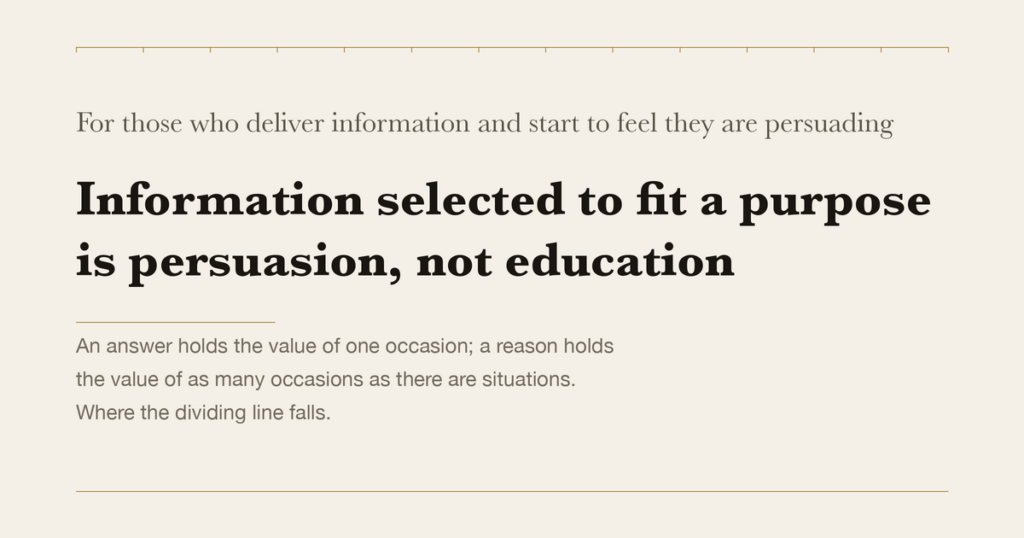
Information selected in line with a purpose is persuasion, not education. The two look alike, and the state they leave the other person in is entirely different.
Three things settle here. What arrangement the word education creates the moment it is used. Why the material left unselected lines up in one direction when you keep choosing only what raises appetite. And where to see whether what you are handing over is an answer or a reason.
Some questions go unsettled. In which fields a design that hands over answers is right, and in which a design that hands over reasons is. That balance reverses between fields where doing it for someone is itself the value and fields where becoming able to judge is the value, so no figures and no ratios appear here. The same holds for how often to publish and how deep to go.
The damage lands somewhere unexpected. A design built on answers takes your time before it takes anything from the other person’s capacity to judge. Requests for answers arise at their convenience, and your work stops the moment one arrives. The number of interruptions rises in proportion to the number of answers you have handed out. The added interruptions eat the time for writing reasons. With that time eaten, you hand over another answer. The cycle runs hardest for a business of one, because the person taking the interruptions and the person doing the design are the same person.
A second loss arrives on a delay. That the information you handed over was skewed does not surface just after purchase. It surfaces when the other person actually uses the thing and hits a condition nobody described. At that moment, the cause does not look like the information you supplied. What it looks like is that expectations were not met. A satisfaction survey cannot catch this, because it arrives before they have hit anything.
The word education, the moment it is used, sets up an arrangement of one side teaching and another side being taught. What that arrangement settles is which information gets handed over and which does not. And whether an answer or a reason is what reaches the other person shows not in your manner of handing it over but in the shape of the questions that come back.
📖 Contents
- Customer Education Carries Its Purpose Inside Its Definition
- The Two Arrangements the Word Education Puts in Place Silently
- Choose Only What Raises Appetite, and the Unselected Lines Up in One Direction
- The Line — Is It an Answer or a Reason That You Are Handing Over?
- What You Assemble Yourself Stays Better Than What You Are Handed
- A Design Built on Answers Has No End
- Someone Who Does Not Yet Understand Deletes the Step of Asking
- Does Handing Over Reasons Mean Nothing Sells?
- The Shape of Their Questions Shows What Is Being Handed Over
Customer Education Carries Its Purpose Inside Its Definition
Customer education means publishing information to prospective buyers so that they recognise a problem they are carrying. They come to see the product or service as something that solves their issue, and the stated purpose is raising the appetite to buy. The purpose is written into the definition of the activity itself.
The means offered is the provision of content: articles, videos, documents, sequences of email. You deliver material of value at no charge and build a relationship out of it.
Three effects get cited. The proportion of conversations reaching agreement rises. Haggling over price becomes less frequent. Satisfaction after adoption rises.
The reason given is that someone holding material for judgement decides faster. There is less explaining to do, and less gap between expectation and reality.
As an observation of practice, this is accurate. Conversations with people who hold material do move faster, and someone who understands beforehand runs into fewer mismatches afterwards.
With that granted, the set carries a premise. Whether the information succeeded gets measured by whether the appetite to buy rose.
For a business, looking at whether something leads to purchase is only natural. The trouble is that once the test of success sits on appetite, the selection of what to hand over gets worked backwards from it. Information that raises appetite goes out; information that does not, stays. And inside the information that does not raise appetite sits what the other person needs in order to judge for themselves — the conditions under which it fails, the cases it does not suit, the other ways of solving it.
Someone who receives only backwards-selected information decides with a skewed set of material. Noticing the skew after deciding, the noticing shows up as distrust rather than as dissatisfaction.
The address of the distrust slips here. What was skewed was the selection of information, and what gets suspected is the product. All that remains in their hands is the information they were given. That information they were not given existed stays invisible from their side. What is visible is the single point that the account and the reality diverged, and tracing back from that point reaches the product and stops.
An opposite view stands here: the three effects are actually observed, so pointing at a definitional problem changes nothing. The effects do not change. What changes is what you suspect when the effects fail to appear. As long as the definition is raise appetite, suspicion can only fall on the volume and the delivery. The information you never sent is not an object of suspicion.
The limit shows up in practice as the direction of improvement. When response falls, either the number of instalments goes up or the writing changes. Both are operations on the sending side. Sending what you have not been sending does not appear on the list of options. Not appearing, it never gets tried.
The Two Arrangements the Word Education Puts in Place Silently
The word carries two premises without stating them. Both hold from the moment it is used.
First, an asymmetry between the one who teaches and the one who is taught. One side knows; the other does not yet.
Second, an assumption that the one being taught is in a state that ought to be changed. Education is understood as an activity that moves someone toward a preferable state.
Both are reasonable in a school. The trouble is using the arrangement on the other party to a transaction.
The other party knows more about their own business than you do. What they do not know concerns the field you work in. Bound to that field, the asymmetry is a fact. Say educate them without the binding, and the whole person is placed on the taught side.
Once placed there, the authority to judge migrates to you without anyone saying so. Someone standing in the position of the taught starts checking with the teaching side about what is correct.
In the short run this speeds up conversations, since you are the one they check with and your proposals pass more easily. In the long run it builds something else: a state of not being able to judge. And someone in that state needs to check again on the next decision.
Is this not a turn of phrase, with nobody taking it that far? In most cases nobody is. With that granted, vocabulary runs ahead of judgement. If someone who still needs more educating passes as an internal phrase, the way that person gets handled follows the phrase.
Changing the name does not settle anything. Change it while the substance stays the same and nothing moves. What can be said is that the name sets a default direction, and the default is worth looking at once. Defaults show themselves when you are busy.
The second premise carries something further. An assumption that someone ought to be changed leads to treating them as an object of correction.
Being treated as an object of correction registers on their side. Once registered, reception changes. The same substance lands differently as material for judgement than as a note on what needs fixing.
The direction shows up in small features of the writing. People tend to slip into… Many people believe…, but… Both place the other person on the mistaken side. From the placing side it reads as a helpful note; from the placed side it reads as a verdict. A sentence received as a verdict does not get adopted, however correct it is.
Choose Only What Raises Appetite, and the Unselected Lines Up in One Direction
Where the same fact admits an account that raises appetite and one that does not, the first gets chosen. With the purpose inside the definition, this is compliance rather than deviation.
Say your method works under seven conditions in ten and fails under three. Explaining the seven carefully and not touching the three is the choice the definition calls for.
Nothing false has been said. Some things have gone unsaid. And what goes unsaid is invisible from the receiving side. What is invisible does not enter the material for judgement.
Here is where education and persuasion part. Persuasion hands over material selected to lead toward a conclusion. Education hands over material so that judging becomes possible.
The two overlap in part of what they hand over. Overlapping, they cannot be told apart from outside. What can be told apart is the information not handed over.
Handing over information against your own interest makes a business impossible — the objection comes from the practical side. It does not. Showing the conditions first makes unsuitable people leave sooner, and sooner means neither side spends time. Those who remain after seeing the conditions have chosen with the conditions understood. In that state, mismatches after adoption become fewer.
You cannot hand over all the information. There is a ceiling on volume and a ceiling on what anyone can process. What can be said is that as long as the criterion is does this raise appetite, the unselected information skews systematically in one direction. The skew is invisible choice by choice and appears only once it has piled up.
One method detects the pile-up. Lay out everything you have published and count how many pieces touch on the conditions where it does not work.
Zero all but settles the question. A record with not one is hard to put down to chance. A few out of several dozen means the criterion is not running in a single direction.
The count is hard to run on yourself. Writing them one at a time, each had a reason. This one was an introduction, so I left the conditions out. This one was a case study, so I did not go into it. Each reason is sound, and the sum is skewed. The skew does not exist inside any single piece; it exists only in the set.
Having counted, placing the addition is awkward. Conditions where it does not work do not get read as a standalone piece. Almost nobody opens something whose subject is who this is not for. It lands better placed at the same depth inside a piece that explains where it does work. Placed in the same piece, that piece becomes less persuasive. The amount it loses is the amount the sorting was doing.
The Line — Is It an Answer or a Reason That You Are Handing Over?
An answer is an instruction about what to do in a situation. In this case, do this.
A reason is the structure of why it comes out that way. With this condition in place it goes this way, and when the condition changes it goes that way.
The two differ in how they are useful straight after being handed over. An answer is usable at once. A reason is not usable as it stands.
Because it is usable at once, an answer draws thanks. Thanks come back as a response, so a record survives on your side too: you handed over something good.
Then the next situation arrives, with conditions slightly different.
Whoever received the answer cannot use it here. What they received was an instruction about that situation. So they come back to ask. Whoever received the reason can use it here, because how things go when the conditions change was inside the reason.
An answer holds the value of one occasion. A reason holds the value of as many occasions as arise.
A practical consequence follows. Keep handing over answers and the other person never gets the occasion to judge. Without occasions, no criterion grows.
This sits in the same place as the loop that fails to close, handled in being unable to decide is not a personality trait but the result of handing judgement away. A criterion takes shape as the accumulation of one loop: you put something down, a result comes back, you assess it yourself. Keep receiving answers and the first step, putting something down, happens on your side instead.
Where the other person wants answers, will a reason please them? Sometimes it does not, in the moment. With that granted, a reason can be handed over with the answer inside it. In this case we do this. The reason is that this condition holds. Change the condition and the handling changes. That form is useful in the moment and usable in the next situation. It costs more effort; it is not impossible.
A reason handed over is not automatically used. Unless the receiver does the work of fitting it to their own situation, it goes unused. That fitting can only happen on their side. What you can do is put it in a shape that is easy to fit.
An easy-to-fit shape has its conditions written concretely. It depends on the situation is not a reason. What counts as a reason is: with this condition met it goes this way, and unmet it goes that way.
Write the conditions concretely and people the conditions exclude will leave. Write them vaguely and it reads as applying to everyone. Whoever reads it as applying to them does not, in fact, have it apply.
What You Assemble Yourself Stays Better Than What You Are Handed
Handing over reasons has backing on the side of memory.
In 1978, Norman Slamecka and Peter Graf compared memory for words participants generated themselves against words they simply read (Slamecka & Graf, 1978, Journal of Experimental Psychology: Human Learning and Memory, 4(6), 592–604). Across all five experiments, the self-generated condition outperformed the read condition. Recognition, recall and confidence all pointed the same way.
A result in the same direction comes from a different operation. In 2006, Henry Roediger and Jeffrey Karpicke compared a group that reread a passage against a group that read it once and then practised recalling it (Roediger & Karpicke, 2006, Psychological Science, 17(3), 249–255). After five minutes the rereading group scored higher; after a week the ordering reversed. The recall group retained more, and the gap grew with time.
Moved onto the handing over of material, the two say this. What the other person arrived at themselves stays better than what you wrote out to the conclusion and handed across. And arriving at a conclusion requires material. The material is the reason.
The same experiment yields one more thing worth holding. A difference showed up on the side of felt experience too. The rereading group not only scored higher immediately but also rated their own memory higher. The receiver’s sense of how well it went and the amount that survives were pointing in opposite directions.
Both experiments handled memory for words and short passages, and business judgement runs under different conditions. If the work of generating is too heavy, nobody engages with it. What can be said is that a form in which you write everything out is at a disadvantage on the side of memory. The advantage lies with a form that leaves the other person one step to take.
A form that leaves a step looks unhelpful in the moment. So what should I actually do comes back. Adding an answer at that point is easy. Add it and satisfaction rises. What survives falls by as much as you added.
What does leaving a step consist of, concretely? Stop just before the conclusion, having finished laying out the material. Show three conditions, show how each works, and stop before therefore, in your case. Filling in what comes after the stop is their work.
The form carries a hard constraint. If the material is short, they cannot fill it in. A sentence stopped without enough material is just an unhelpful sentence. So a form that leaves a step pairs with handing over more material, not less. Handing over little and withholding the conclusion is doing something else entirely.
A Design Built on Answers Has No End
A design built on answers carries an advantage for you: there is always a next time.
The other person cannot judge in the next situation, so they come back. Each return produces a transaction.
The structure builds itself without intent, because handing over an answer is faster, draws thanks, and scores higher on satisfaction in the moment. No ill will is required.
Once built, it is hard to leave. Switch to handing over reasons and the frequency of their coming back falls, and the fall shows up directly in the figures. Showing up in the figures, the switch looks like a loss. Decisions that look like losses do not last.
The structure is maintained from their side too. Someone used to receiving answers feels that a reason adds work. You do not need to explain that far, just tell me what to do. For both sides, continuing to hand over answers is more comfortable. Being comfortable, it becomes the default.
If they want answers, meeting that want is the job — this counter can be met in part. There are occasions to meet it. The line falls on what you add after meeting it. Hand over the answer and stop, or add one line after it saying which conditions the judgement came out of. It is a one-line difference, and it decides whether the thing is usable next time.
Not every occasion needs a reason. In an emergency, the answer is the correct thing to hand over. What can be said is that handing over answers alone on every non-emergency occasion means non-emergency occasions stop existing. Keep someone unable to judge and every occasion becomes urgent.
This structure eats your time through interruptions: interruptions eat the time for writing reasons, and the eaten time produces another answer. A company can cut the cycle by separating the people who take the enquiries from the people who do the design. Alone, there is nowhere to cut.
One method cuts it. When the same question arrives twice, write the reason down at that point. From the third time on, you hand over the document. Whether you notice at the second is what decides whether the cycle starts.
Noticing at the second requires that the questions be recorded. Without a record, a second time does not look like a second time. A design built on answers is the one least likely to keep that record, since the exchange ends there and no motive to keep it arises.
The form also works on pricing. An answer holds the value of one occasion, so the fee is one occasion’s worth. Repetition does not raise the unit price. With the unit flat and the count rising, the take per hour falls. Handing over reasons lowers the count, and because one delivery works across as many occasions as arise, it can be loaded onto the unit instead. The subject matter is the same and the shape of the income is different.
Someone Who Does Not Yet Understand Deletes the Step of Asking
The frame of education places the other person as someone who does not yet understand. The placement is practically convenient: it lets you design the order of explanation, where to start and how far to go. The order of explanation can be designed in advance because you are the one settling the other person’s position. Settling that position from the side of their involvement is in relationship first, sale after.
In exchange for the convenience, one thing happens. What the other person already holds drops out of view.
They have been thinking about their own business for a long time. On why things are not working, they usually hold some estimate. The estimate may be inaccurate. That they hold one is a fact.
Treated as someone who does not yet understand, the step of asking for that estimate gets skipped. Skipped, your explanation does not connect to the frame they already hold.
An explanation that does not connect does not land, however correct. Not landing, you explain again. Still not landing, the reading that arrives is they need more educating. The reading is closed: the only conclusion available inside it is that the volume of explanation is short. That the connection is missing does not come out of this frame.
Asking for their estimate takes too long, comes the reply. It does. With that granted, explaining without asking also takes time, in the form of repetition. The first concentrates the cost at the start; the second spreads it out.
Asking carries a separate effect. Someone who has put their own estimate into words holds those words as a baseline. Later explanation is received as a difference from that baseline, and what is received as a difference stays in memory. The effect that works only when the other person assembles it themselves becomes usable from your side, in the form of asking.
Asking does not guarantee an answer. Some people’s estimates have never been put into words. What can be said is that without asking, you cannot know whether one exists. And the default is a form that does not ask, because the order of explanation was designed first.
Publishing to everyone at once makes individual asking impossible. That constraint is real. With that granted, you can ask inside the publication. Place the question — how are you currently thinking about this point — and take the replies. Few come back, and what comes back represents the many in the same position.
Put the estimate drawn from a few replies at the start of the next instalment. In that shape, the work of connecting can be done even at scale. The form changes the order in which you write. Rather than starting from what you want to explain, you start from the words that came back. The first can be written from stock; the second cannot be written without replies. In a form with no route for replies, the order is unavailable.
Does Handing Over Reasons Mean Nothing Sells?
If you hand over reasons and the other person becomes able to judge, do you become unnecessary?
At one stage, yes. Someone holding a criterion can make that stage’s judgement themselves. Then something else happens. Someone who has become able to judge widens the range of what they judge. They reach into territory they could not handle before, and there they meet new questions.
The need does not disappear. Its position rises.
If nothing is waiting above the raised position, the person leaves. They leave not because you handed over reasons but because there is no stage above. That structure is handled in how to raise revenue per customer.
Handing over reasons also carries a direct effect for you. Someone who can explain the reason can explain it to other people.
Referral runs in the referrer’s words, not yours. Someone who received only an answer can say no more than it was good. Someone who received a reason can say what was good and how. Whoever hears that arrives having understood, and someone who arrives understanding is ready to connect from the start.
Does handing over reasons increase the number who do it themselves? It does. And those people were always going to do it themselves. Withhold the reason and they go elsewhere, still unable to judge.
Which of the two you take on — those who do it themselves having become able to judge, or those who stay unable — is a question of business design. Choose the second and a design built on answers suits it. The first is not universally right either; in some fields, doing it for people is itself the value. What can be said is whether you know which one you have chosen. Hand over answers without knowing, and a structure gets built that nobody remembers choosing.
The question has a time dimension too. The effect of handing over reasons arrives late. Referral, and the rise in the position of the need, run on a scale of months to years. The effect of handing over answers arrives that day. In the early period, therefore, a design built on answers looks better. Looking better, it settles in.
Switching after it has settled is harder. The people already there entered on a relationship of receiving answers. Change the form midway and the change registers as a loss on their side. The choice is cheaper made early, and the cost of switching rises the longer it waits.
The Shape of Their Questions Shows What Is Being Handed Over
What is being handed over shows up not in the volume you sent but in the shape of what comes back. Three places carry it.
First, the shape of their questions. What should I do continuing means answers are what is going across. Shifting to given this condition, I took it that this follows means the reason is in use. The shape of a question points directly at which side the criterion sits on.
Second, whether the structure you handed over shows up in situations you never anticipated. Your way of thinking gets brought into a judgement in another field. If it gets brought in, it went across as a reason rather than an answer. An answer is unusable outside the situation it was handed over for.
Third, the substance of the explanation at the moment of referral. What was good and how, said concretely, means the reason survived. It was really good means what survived is the memory of an experience. Memories fade; structures do not.
The volume of information you sent appears in none of the three. Whether education succeeded rests on whether the other person became able to judge, so what needs checking is the side of their judgement.
The three carry a limit. None of them appears until time has passed. What is visible straight after handing something over is satisfaction and response. And satisfaction runs higher for answers. Measured through a short window, a design built on answers tends to look better.
Should short-run figures then be ignored? They cannot be. With that granted, knowing that short-run figures and long-run states sometimes point opposite ways lets you keep a design when the short run looks bad. Not knowing it, short-run figures are the only material available, and with one material you go where it points.
How often to publish, how deep to explain, when to move to a proposal. None of these gets settled here. The conditions that settle them — the field, the other person’s state, the length of the relationship — sit on the ground rather than on this page. Specify the same count of instalments under different conditions and you are specifying different things.
The word education sets an asymmetry as the default the moment it is placed, and pulls the purpose inside the definition. A purpose pulled inside quietly decides what information gets selected.
The line runs in one place. A design built on answers has the shape in which the other person comes back. A design built on reasons has the shape in which they stop coming back, and the position of their judgement rises instead. Which you take is business design, not right and wrong. What becomes hard to recover is only the case where nobody chose, and the default carried you.