What settles the length of a sales letter is the count of confirmations remaining between writer and reader. It is not the size of the subject, and it is not the writer’s skill. Price does bear on it, but not directly: a larger purchase raises the number of things a reader wants to check, and it is that number which moves the length.
A confirmation here means one of the questions a reader passes through on the way to buying. They run from whether this has anything to do with me through to why now, and they are passed in order. Many still outstanding and the sections increase; few and they decrease. For the same product, a different addressee leaves a different number outstanding, so the length moves with it.
What gets advertised as the way to write tends to sit on a different axis. The arrangement of components — headline, body, close, postscript — with the names of order templates such as the PASONA law or the QUEST formula added to it. Components and templates function as tools of practice. A letter with no conditions written in it hands the reader nothing to judge on, and a letter that skips stages does not get taken up.
This organisation, however, answers one question not at all. At what length should it be written. Every component can be present and arranged in the template’s order, and still nothing in that tells you whether the letter needs three sections or twelve.
Length always arrives last among the topics of writing. What to write, how to say it, what order to place it in — length is taken to be the quantity that falls out once those three are settled. The order is the reverse. The moment you settle who it is addressed to, the count of remaining confirmations is fixed, and the number of sections follows from it.
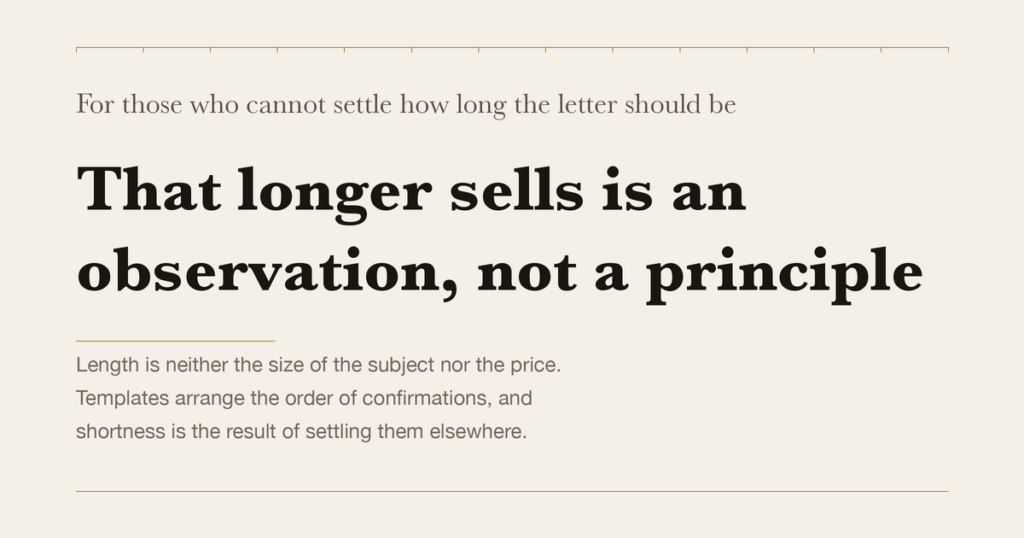
What gets handed over instead is guidance of the form longer sells better and people who read will read to the end. These are observations, not principles. An observation is a record of what happened in someone else’s letter, so carrying it home still does not settle how many sections to assemble your own from.
How to write a letter well is not treated here. What is treated is the grounds on which the number of sections is decided. Skill in expression rides on top of the section count being right. Reverse that order and the work becomes filling a wrong section count from the side of expression — pushing with stronger words, adding figures, raising the register. Each moves the numbers for a while, but none of them moves the shortfall.
The sections below set out accurately what is advertised as a sales letter, then extracts what the templates are actually arranging. On that basis it looks at why the postscript gets read, the conditions under which writing short is possible, and the fact that deadlines and bonuses do not fill a shortfall of confirmation. It closes with three ways to check, before sending, whether the length you assembled is right.
📖 Contents
- What Is Advertised as a Sales Letter
- What Settles Length Is the Count of Things to Confirm
- What Templates Arrange Is Not Components but the Order of Confirmations
- The Postscript Gets Read Because of Position
- Writing Short Is Possible Only When the Confirmations Were Settled Elsewhere
- Deadlines and Bonuses Do Not Fill a Shortfall of Confirmation
- Address One Person and the Length Settles Itself
- What Transfers Through Copying Out, and What Does Not
- Where Can It Be Confirmed That a Sales Letter Is the Right Length
What Is Advertised as a Sales Letter
A sales letter is a form that completes the path to purchase with a single piece of writing. There is no face-to-face explanation and no exchange of questions. Hence, it is explained, the writer must place in advance every doubt the reader is likely to hold.
The components are set out. The headline at the top. The lead that draws the reader into the body. The body proper. The offer, which states the conditions of the product. The close, which prompts action. And the postscript.
Templates for the order are set out too. Three come up most often. The PASONA law strings together problem, affinity, solution, offer, narrowing down and action: present the problem, draw close to the reader, produce the solution, state the conditions, narrow the audience, then prompt action. The QUEST formula runs qualify, understand, educate, stimulate, transition, and begins by sorting the readers. AIDMA — attention, interest, desire, memory, action — arranges the movements that occur on the receiving side. They cut the sequence differently and start from different places, but each is a form that proceeds through stages.
Advice per component is added. The headline settles whether anything gets read. The opening and the postscript are read most. Include figures. Carry customer voices. Copy out excellent letters by hand to acquire the craft.
As practical advice, none of it is wrong. A letter with no offer written into it hands the reader no material for judgement. Ask for a purchase without proceeding through the stages and it will not be received. Copying out genuinely functions as a method for cultivating a sense of the sentence.
One premise runs through the whole set. A sales letter is organised as a set of components to be assembled. With every component present and arranged in the template’s order, the letter holds. It is a problem of coverage and placement.
Coverage itself is not the thing being questioned. If what the reader naturally wants to know is not written, the letter cannot be used for a judgement. Gap-filling work is required, and nobody disputes that.
The trouble with organising it entirely as coverage and placement is that it makes the letter complete at the point where the components are assembled. The grounds on which the quantity of writing was settled are recorded nowhere.
One view holds that length settles itself by sending and watching the response. A response does emerge. What comes back, however, is a single figure. That figure does not distinguish too long from too short. To distinguish them, a record of which section answered which confirmation must be kept before sending. Without the record, what gets rewritten next is whatever was bothering the writer most.
With no grounds for the length, length cannot be doubted when the response fails to appear. Too short, too long, or not a matter of length at all cannot be separated. Unable to separate them, what gets touched next is the side of expression. The work of rewriting the headline and strengthening the tone begins.
What Settles Length Is the Count of Things to Confirm
A confirmation is one of the questions a reader passes through on the way to buying. The number still outstanding is the number of sections that have to be placed.
Written forms in general share this structure. The general form — a large gap in premises requires more sections to fill it — was handled in the principles of article structure. In a sales letter, this gap appears as a concrete sequence of questions.
The judgement to buy passes through several confirmations. Is this relevant to me. Does the person writing understand it. Will this solve it. Can I do it too. Will what I pay come back. Why now.
Each confirmation is either settled or unsettled. Write about a settled confirmation and it becomes information the reader already holds. Fail to write an unsettled one and no judgement lands even after reading to the end.
The length, therefore, varies by addressee even for the same product. For someone who has been reading for years, no section confirming whether the writer understands the matter is required. For someone reading for the first time, that section is where it begins.
Long writing does not get read, runs the standard objection. What does not get read is a long treatment of confirmations that reader no longer has. Spend three paragraphs explaining relevance to a reader who already believes it is relevant and they leave there. Conversely, confirmations that do remain get read however long they are. The reader is not appreciating the prose; they are reading while hunting for their own unresolved confirmations.
Where the confirmations are few, it comes out short. Small in price, recoverable if it fails, with content already known. Here a long letter becomes decoration rather than confirmation.
And the count of confirmations cannot be reduced by the writer. What can be chosen is only whether a given confirmation is handled inside the letter or settled outside it.
Suppose the same product announcement goes to someone met once at an event and to someone arriving from search for the first time. For the former, what is handled and the conditions suffice. For the latter, it begins from what the matter even is. The person writing is the same, the product is the same, and the difference is only distance.
Once length is understood as a quantity of shortfall, adjusting it stops being work on the writing. To make the letter shorter, the confirmations get settled at an earlier stage. For as long as it is treated as solvable inside the letter, length is not a variable you can move. This is not an improvement in writing but a change in the design of the relationship.
What Templates Arrange Is Not Components but the Order of Confirmations
Line up the three templates that go by different names and exactly one thing remains in common.
Share the problem, show the cause, produce the solution, show that it can be used by this reader too, prompt action. This sequence is not a sequence of components. It is the order in which the reader passes through confirmations.
The order is fixed because the next confirmation does not arise until the previous one is settled. Explain the superiority of a solution to a reader who does not think this is my problem and no object of comparison is standing. Confirmations take the shape of stacking up.
The section explaining the reasonableness of a price works only after the confirmation this will solve it has settled. Before it settles, a price is not high or low; it has not become an object of judgement at all.
This stacking cannot be returned to once skipped. Arriving at the section of an unsettled confirmation, the reader suspends judgement there. They read on with it suspended, so every subsequent section passes as hypothetical. A letter with one section missing partway being read to the end and producing no response takes this shape.
Write to the template and it sells, runs the expectation. A template is a generalisation of the order of confirmations. Being generalised, it applies in most cases. Where it fails to apply is when the template contains confirmations that reader has already settled. Follow the template and you write that section.
Judge it section by section rather than by the template’s name. Try writing out, in one word, which of the reader’s confirmations each section answers. A section you cannot write out is a section that filled a slot in the template.
There are stages at which writing to the template is better. Until you have some idea of which confirmations remain, you have no grounds for settling the order yourself. A generalised order produces steadier results than an order with no grounds.
And the judgement to depart from a template is available only to someone who knows what the template is doing. Remembering a template’s name and knowing what the template arranges are separate.
Remember the template’s name and you stop considering the grounds for the order. With slots prepared, filling them produces the sense of having finished assembly. What a slot asks is whether a component is present, not whether that reader requires that section.
Furthermore, as more writers use the same template, the order gets learned on the reader’s side too. A state in which reading the opening tells them what comes next. Once they know, that section goes unread and is skipped. A template ceasing to work is not because the template is wrong but the result of its being shared.
The Postscript Gets Read Because of Position
The postscript is read more than the body not because what is written there is stronger, but because of the position it occupies.
This observation has corroboration from the side of memory research. Ask people to remember a list of items and the first and last items are recalled more readily, with the middle falling away. This bias is called the serial position effect, organised by Murdock in a free-recall experiment in 1962 (Murdock, 1962, Journal of Experimental Psychology, 64(5), 482–488).
What that experiment measured, stated exactly, is how much of a list of words can be recalled. It did not measure which part of a letter gets read. It is corroboration for the general tendency that retention varies with position, not direct proof that postscripts get read.
The explanation from the side of practice is simpler. Readers do not read everything from the top in order; they skim. The positions they pick up are the first and the last. They return to the middle when a need arises.
What should be placed in the postscript is therefore settled. Not a summary of the body. The one sentence you want left at the end. In most cases that is the answer to a confirmation that tends to linger — why now, or what happens if what I pay does not come back.
Suppose a letter explains its refund terms once, in the middle of the body. That is a position things do not stay in. The postscript need not repeat the terms in full, but whether the single word refundable sits at the end changes the picture a reader is left holding.
So write the most important thing in the postscript, the argument goes. A judgement never lands on the postscript alone. A postscript works when it is placed on top of confirmations that the body has stacked up. For a reader whose confirmations are unsettled, the postscript is a sentence without context.
Placing several postscripts is an operation that extends the ending. It is not an operation that increases the effect of the ending. Place three and all but the last move into the middle.
The effect of position has one further use: inspecting the arrangement on the premise that sections placed in the middle are less likely to remain. If material for judgement you want retained sits in the middle, it gets moved, or touched once more at the end.
Learn the effect of position and you start solving with position rather than content. The work of moving an unread section to the end gets done without confirming why that section goes unread. If the reason is that the confirmation no longer remains for that reader, changing the position will not make it read.
Writing Short Is Possible Only When the Confirmations Were Settled Elsewhere
When a short letter sells, the shortness is not the writer’s skill. The confirmations are simply settled outside the letter.
Writing short is possible when most of the confirmations were settled outside the letter. Someone who has read for years has no need to confirm does the person writing understand it. Someone who bought once before and was satisfied has settled will what I pay come back as well.
The length of the letter, therefore, varies by addressee even for the same product. A letter to a reader arriving from search for the first time comes out long; a letter to a subscriber needs a few sections. The difference is distance.
Someone who writes long letters sells the same product one day with a short one. The letter did not get better; the addressee changed. Look only at the side of the letter and this difference is invisible.
There is a reason it is hard to see. What remains in your hands is only the writing you produced, and what the addressee had already settled does not print onto the writing. Read back a letter that worked and why the short version sufficed is not written there. What remains is the result, and the text that produced it.
So always build the relationship before selling, it follows. The direction is right. Relationships, however, cannot be built inside the letter. They are built in the time outside it. What was written, how much was handed over, how much time has passed. A letter becoming short is the result of that time.
Even with a relationship, confirmations sometimes start over. When a product of a different kind is released. This person understands it holds per territory, so in another territory it has to be rebuilt.
As a diagnostic, this structure earns its place. If the letter cannot help being long, the confirmations were not settled at the preceding stage. The work of shortening the letter is replaced by the work of building that stage.
The determination itself takes one question. How many times has that reader read the writer’s work before reading this letter. If the count is unknown, the premise that confirmations are settled cannot be placed. Write short without knowing and what arrives, arrives only at the fraction who already have a relationship.
The misreading also runs the other way. A letter to someone with no prior stage comes out long, and that length is not a defect. With no prior stage, the confirmations have nowhere to be settled but inside the letter. Cut it out of embarrassment at the length and what gets cut is not decoration but the only material for judgement that reader had.
Misread the state of selling with a short letter as the letter’s performance and the prescription inverts. Read it as shortening sells and cut, and readers whose confirmations are unsettled are left short of material for judgement. What was cut was not decoration but sections.
Deadlines and Bonuses Do Not Fill a Shortfall of Confirmation
Deadlines, caps on quantity, time-limited bonuses. These genuinely do raise response. The response that rises, though, also includes readers who moved before their confirmations were settled.
State exactly what they are doing. They are devices that demand a judgement in a state where confirmation has not finished. They are not devices that finish confirmation. They move the time of judgement forward; they do not increase the material for it.
As a result, people buy with their confirmations unfinished. That person resumes confirming after buying. If the resumed confirmation does not pass, it becomes a refund request, or it ends unused. Both were counted as responses at the time.
The organisation of the mechanism was handled in before reaching for a list of psychological triggers and do not use loss aversion to stoke urgency. The dividing line is that what stands in such lists is a description of how people respond, not an instruction to induce it. Here that dividing line connects to the matter of length.
The connection is this. Placing a deadline is an operation that cuts confirmation short in place of writing the confirmations that remain. That is, it functions as a method of shortening the letter. The sections need not be written.
Without a deadline people postpone their judgement, runs the case. Postponement does occur. One cause of postponement, however, is a remaining confirmation. A reader left without knowing can I do it too cannot judge even with a deadline, and because there is a deadline, leaves without judging.
A deadline that genuinely exists should be written. An event with a date, a venue with a cap on seats, a planned price rise. The announcement of a fact and a manufactured pressure are different things. Not writing the former means withholding material for judgement.
The discrimination takes one question on the writer’s side. Was that deadline settled before writing. If it was settled while writing, it was placed to fill a shortfall of confirmation.
A difference appears in how the announcement is written as well. A deadline that exists as fact can be written together with its reason. The price rises in March, so until then it is the present figure. A deadline you cannot attach a reason to is a deadline settled while writing.
A judgement that passed under pressure affects the next judgement. A reader who bought once in that shape starts waiting for the same shape next time. The result is a relationship that does not move unless the pressure is increased. The letters do not get longer each time; they get stronger each time.
Address One Person and the Length Settles Itself
The list of confirmations does not become definite until the addressee is settled. So the length does not become definite until then either.
Unsettled, you end up writing every confirmation. Not knowing who will read, you do not know which confirmations remain. Try to prevent gaps in that state and you line up every confirmation conceivable.
A letter with every one lined up is both excessive and deficient for everybody. Settled confirmations are lined up, so it feels long, and the confirmation particular to that reader is still not in it. Long, and not enough.
How to settle the audience itself was handled in how to build a persona. The point was that a method of stacking attributes into a portrait produces no material usable for the judgements of writing. In a letter, what is required is not attributes but a list of the confirmations remaining for that person.
Assume two readers at once and a section unnecessary to one gets in. Someone five years independent, and someone still employed. For the former the section on can I go independent is unnecessary; for the latter the section on ceilings for rates is a matter for later. Include both and half of it is surplus to both.
Narrowing reduces the number of readers, runs the worry. The number of readers falls. The number whose confirmations settle rises. What a letter must achieve is not being read but confirmations being settled. Someone who read and had no judgement land was counted on the side of being read.
And narrowing increases the sections that can be written. With the addressee unsettled, every confirmation can only be answered in general terms. Settle on one person and the single point they are caught on can be written concretely. A section written concretely reaches people beyond that person. The reverse seldom occurs, because a section written generally rarely reaches any particular person deeply.
Where the addressees split across types, set the letter to the side with the most confirmations outstanding. The side with fewer can skim past a section it does not need. The side with more cannot supply a missing section itself. Skimming costs you readers; a shortfall stops the judgement altogether.
Addressing one person concerns the stage of writing, not sending to one person. A thousand people may read the same letter. What is being settled is which reader’s position the sections are assembled for.
Once the addressee is settled, sections you cannot write emerge. The state of not knowing what that person wants to confirm gets exposed. This cannot be solved on the side of the letter. It is a section where asking is the only option, and how to conduct a customer interview sits upstream of it.
What Transfers Through Copying Out, and What Does Not
Copy an excellent letter out by hand and the movement of the sentences transfers. The judgement about where to place a section does not.
Some things transfer. A sense of sentence length. Where sections break. Vocabulary. The placement of commas. The arrangement of components. These appear as form, so copying leaves them in the body.
Some things do not. The judgement of why that order. The judgement of which confirmations were omitted. These are not written, so they cannot be copied.
Suppose the letter you copied is short. Two reasons for the shortness are possible. The addressee’s confirmations were already settled, or the writer omitted confirmations. On the page, the two look identical.
Copying, therefore, requires one addition: writing out, in one word, which of the reader’s confirmations each section answers, as you copy. Sections you cannot write out will appear. Those are where the conditions particular to that letter sit.
Copy enough of them and the judgement transfers too, runs the expectation. Partly it does. Copy many letters and several order templates are acquired, and they become comparable. Once comparable, the question of why this one takes this order arises. Volume carries you as far as the question arising.
The answer does not emerge from volume. The grounds for an order do not emerge without knowing who that letter’s addressee was and what had been settled. What you do not know does not emerge from copying.
What does transfer is equally clear. The rise and fall of sentence length, the choice of nouns, where the commas sit, how quickly the sections turn over. Every one of them is present in the letter in finished form. Copying moves those across to the hand. What does not move is what the letter does not contain — why that section was placed where it was.
Something else fails to transfer as well: the conditions of what existed in the market when the letter was written. The same turn of phrase can have been unfamiliar ten years ago and known to everyone now. A copied sentence failing to work is not the sentence’s quality but a change on the side of where it is placed.
A condition therefore attaches to choosing what to copy. Take structure from old letters, and the handling of distance from recent ones. Try to take both from one letter and you will mistake one for the other.
It is effective early on. At a stage with no material for judgement, entering through form is the only route. Settle the order yourself without form in the body and you cannot verify the grounds you settled on.
The template of a copied letter shows up in subjects it does not suit. It remains in the body, so it emerges without intention. It can be noticed when it does only if you have the habit of writing out the confirmation each section answers.
Where Can It Be Confirmed That a Sales Letter Is the Right Length
Whether an assembled letter’s length is appropriate can be confirmed in three ways, all of them before sending.
The first confirmation is to write out, in one word, which of the reader’s confirmations each section answers.
Some sections cannot be written out. Those do not correspond to a confirmation. They are either sections that filled a template slot or sections that grew through restatement. They get cut, or the confirmation they answer gets identified and they get rewritten.
The second confirmation is to hunt for sections answering the same confirmation twice.
Look at the one-word list and places where the same word repeats will appear. The second may be a section added out of unease while writing. The difference between one that was insufficient and one written twice can be settled by reading the two side by side.
The third confirmation is to look for confirmations the addressee has already settled.
Once the addressee is settled on one person, the list of settled confirmations can be written out. Match that list against the list of sections. Where they overlap is the surplus in the length.
Coverage of components falls outside the three confirmations. Coverage is a necessary condition for a letter, and lies on a different axis from the appropriateness of length.
The list of confirmations can itself be out of alignment. A state in which the confirmations the writer assumed and the confirmations the reader actually holds diverge. This divergence cannot be detected inside the letter. It can be detected only where the people who did not buy can be asked why.
The three share a limit. None of them determines whether the product has value for that reader. A letter in which every confirmation settles and there is still no reason to buy can hold. That determination cannot be made on the side of the letter.
No numerical rule of thumb is handed over here. How many characters, how many sections, how many postscripts. These vary with the count of confirmations remaining for the addressee. To hand over a rule of thumb would be to settle that allocation without looking at that count.
What remains in hand are three things: the structure by which length is the count of remaining confirmations, the definition by which what a template arranges is the order of confirmations, and the fact that shortness is the result of confirmations settled outside the letter. Hold those three and whether the letter you have just assembled is too long or too short becomes determinable on your own.
How to write the opening lines is treated in how to write a lead paragraph, and the manner of handing over a reason to move while leaving room for judgement in the principles of sales copy. The stage at which reading never starts at all sits upstream, in the three NOTs. Whether confirmations remain is a separate question from whether your own words are sufficient. The boundary between having written it and the other party being able to use it is treated in verbalisation and transmission.