Read a treatment of social proof while your track record is still small and nothing in it is usable.
Two hundred thousand copies sold. A thousand organisations using it. So many users. Star ratings and review counts. Every technique lined up assumes the numbers already exist. What the side without numbers can do is not written. Since it is not written, the choice narrows to waiting until the numbers accumulate, or engineering the denominator so the figure looks larger.
That the choice narrows to those two comes from how the premise was set. Social proof is organised as a matter of quantity, with a monotonic relation — more is stronger — assumed throughout. If the premise were right, a small number would stay weak.
In fact the effect has conditions. There are two. That the judgement carries uncertainty. And that the party whose judgement is borrowed sits in conditions close to the reader’s own. The more either is lacking, the weaker the working of social proof becomes. Situations where a large number fails, and situations where a small number works powerfully, are both explained by these two.
Three things can be confirmed in the body below. First, how the fact of two conditions changes the way numbers are put out. Second, what social proof is standing in for inside the reader. Third, what can be placed instead at a stage where numbers cannot be put out.
Some things stay outside this piece. How many cases you need before putting out a number is not settled, since it varies with what the reader compares against. Nor can what the reader actually used as material be observed; the route of judgement sits inside them. Where to position a number, and how to present it, are also left out, because refinements of position only work where the conditions are already met.
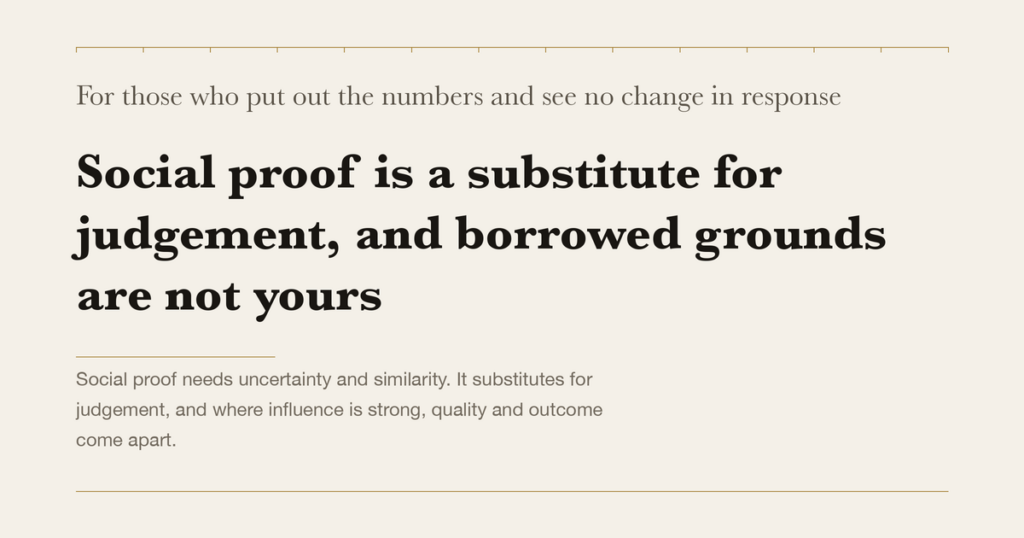
One property runs through the whole of this piece. Social proof is a substitute for judgement. Where you cannot decide for yourself, you borrow the result of someone else’s decision. A judgement passed on borrowed grounds is not that person’s own judgement. No amount of engineering the size of the number removes this property.
The damage is that neither party notices the substitution has happened. The reader feels they decided; the writer only sees that the number worked. And the information about what the reader valued in choosing remains in neither party’s hands. Since it does not remain, what to fix next is not settled either, and the only available move is to increase the number.
The two conditions bite before any number is put out. Unless it is settled who the number is for and what it counts, no figure becomes material for judgement however large it grows. What can be done while the numbers are small is not waiting for them to accumulate but deciding in advance how they will be counted.
📖 Contents
- What Gets Lined Up as Examples of Social Proof
- There Are Two Operating Conditions — Uncertainty and Similarity
- A Number Belonging to Somebody Unlike You Works in Reverse
- Social Proof Is a Substitute for Judgement
- Where It Works Strongly, the Correlation Between Quality and Outcome Weakens
- What Can Be Placed Instead at a Stage Where Numbers Cannot Be Put Out
- Customer Testimonials Are Weak as Social Proof
- What Awards and Qualifications Prove
- Can You State What the Number You Are Putting Out Counted
What Gets Lined Up as Examples of Social Proof
Social proof is the tendency by which people treat the judgement of those around them as more correct than their own and settle their behaviour accordingly. It is described as one of the six principles organised by the social psychologist Robert Cialdini in his book (Cialdini, R. B. Influence, 1984).
The examples given begin from everyday scenes. A queue outside a shop makes you want to go in. A shelf with only a few items left draws your hand. A notice reading “thank you for keeping this space clean” results in the space being kept clean.
Methods of application get listed. First, presenting numbers. Cumulative sales, the count of organisations that adopted it, the number of users, placed somewhere prominent.
Second, publishing user evaluations. Star ratings and counts, written impressions, with names and photographs where possible.
Third, introduction by an influential figure. It works in bulk on the layer of people watching that figure.
Fourth, presenting awards and qualifications. Evaluation by a third party is said to raise value and trust.
The ground offered is the property of using other people’s behaviour as a cue where a judgement is hard. Where information is short, what many people have chosen is presumably less likely to be a miss.
As observed facts, all of it is right. That presenting numbers changes the response has been observed repeatedly, and the same holds for publishing evaluations. As a description of technique, nothing is missing or excessive.
The premise these techniques share is one. Social proof is organised as a matter of quantity. More is stronger. So you put out the largest number you have.
There is a range in which quantity works. Between no track record at all and a thousand cases, the latter gets judged more readily. That much is fact.
What drops away is the conditions attached to the original principle. The source does write about the situations in which it operates. In the process of summarising into a list, only the conditions fail to survive. What remains looks as though it works identically anywhere.
The arrangement of the list erases something too. Numbers, user evaluations and awards all stand together as “social proof”. The three prove different objects. A number proves that many people chose. An evaluation proves how some of those who chose felt. An award proves that it came through a selection. Lined up, the difference disappears. Once it disappears, putting out any one of them looks as though it delivers the same effect.
There Are Two Operating Conditions — Uncertainty and Similarity
The first condition is that the judgement carries uncertainty. Where people can judge for themselves, other people’s behaviour is not consulted.
The social psychologist Muzafer Sherif showed the process by which judgements about an ambiguous stimulus converge on the judgements of others (Sherif, M. The Psychology of Social Norms, Harper, 1936). On the phenomenon of a point of light appearing to move in a dark room, judgements that scattered when made alone converge on a single value in a group.
This measured perceptual judgement, not the selection of products. What it indicates is a direction: where the correct answer cannot be confirmed, other people’s judgements become material for one’s own. That the stimulus was ambiguous is the very condition of the experiment.
The second condition is that the party being referred to resembles the reader. The judgement of someone unlike you does not become material for your judgement.
Learn that ten thousand people use a tool, and if those ten thousand work under conditions entirely unlike yours, it does not become material for judgement. It becomes information that the tool is not for you.
Where the number is large, surely someone similar is among them — that inference does operate. The inference weakens, though, as the number grows. That someone similar is among ten thousand is certain; what those ten thousand valued becomes unknowable. The larger the denominator, the thinner the information about its composition.
The two conditions are matters of degree. Neither a completely certain judgement nor a completely dissimilar party is common in practice. Treating the effect as varying continuously fits reality better.
And the two do not operate independently. The higher the uncertainty, the lower the demand for similarity. Where no judgement can be formed at all, anyone’s judgement is worth borrowing.
Conversely, where the reader can judge for themselves to some degree, the demand for similarity rises. Understanding their own situation, they become attentive to the conditions of the party referred to. In a business premised on continuing relationships, readers likely sit in the second case.
To make numbers work strongly, therefore, you place the reader in an uncertain state. Withholding material for judgement makes numbers work better. That relation collides head-on with a policy of handing over the judgement. The collision does not dissolve through refinements of writing. It becomes a choice of which to adopt.
Put numbers out without attending to the conditions and you lose the ability to narrow the audience by them. A number that applies to anyone is material for nobody’s judgement. What carries the effect of narrowing is a number with its audience restricted.
A Number Belonging to Somebody Unlike You Works in Reverse
“A thousand companies have adopted it” is sometimes read as information that the tool is for large organisations. For a reader working alone, it becomes evidence of being outside the intended audience.
Conversely, “thirty people running a business on their own use this” works powerfully on that layer despite being a small number. The party referred to resembles the reader.
The asymmetry changes the decision on the putting-out side. Rather than the largest number, you end up putting out the number for the layer most similar to your audience.
And narrowing the denominator makes the number smaller. Putting out a small number is usually avoided. The result of avoiding it is a lining up of large numbers that do not work.
A small number gives an impression of thin experience — the worry is reasonable, and it happens. What parts the cases is whether it is stated what the number counted. “Thirty” alone looks thin. “Restricted to people working in this form, thirty” becomes thirty as the result of a restriction.
What gets read is not the size of the number but the statement of how it was counted. A stated method of counting also carries information about who the business is for. Even a small number becomes material where the reader can place themselves inside its form.
There are stages, just after founding, where every figure is small. Here the choice of putting out no number holds. Putting out nothing is an accurate presentation within the range of not lying.
Put out nothing and the reader looks for material on the content side. If material is prepared there, that suffices. If it is not, the reader leaves without being able to judge. The choice of putting out no number holds only in combination with placing material on the content side.
The narrowing itself calls for care. Restricting a denominator can become arbitrary, since a slice that flatters the figure can always be found. The determination is whether that slice is a meaningful division for the reader. “Restricted to people in the Kanto region” is meaningless in most trades. “Restricted to people running the operation alone” carries meaning where the audience is sole operators.
Put out a number restricted to the audience and readers outside it leave. That is the intended effect, and the overall response falls by that amount. Watch the response rate alone and the decision looks like a failure. What to watch is not how many responded but what share of those who responded were the audience.
Social Proof Is a Substitute for Judgement
Where social proof is operating, judgement of the content is not happening on the reader’s side.
They are using the result of someone else’s judgement in place of their own.
In situations short of information this is rational. Scrutinising every option yourself costs something, so borrowing another’s judgement comes cheaper.
That said, a borrowed judgement has a property. It was not passed in the light of your situation. So the part where your situation differs from theirs remains unadjudicated.
And the unadjudicated part surfaces later, in the form of finding it did not suit. The reason it did not suit lies in the part specific to that person’s circumstances.
If many people are satisfied, most people will find it suits — as a statement about the average, that inference is right. What a business deals with, though, is not the average but individual parties. And a relationship with a party it did not suit can take more time than one with a party it did.
There are situations where substituting for judgement is appropriate. Where options are many, none differs much, and a mistake costs little. Most everyday goods fall here. Scrutinising each one would be the less rational course.
It is inappropriate in the reverse case. Where options are few, suitability differs by party, and a mistake costs time. Businesses premised on continuing relationships mostly belong here.
The property affects the work on your side too. Where you are being selected as a substitute for judgement, what the other party valued in selecting is unknown to you as well. However the number grows, the information about what worked does not.
Where you were selected by judgement, the reason for selecting has been put into words. Ask for the reason and it can be reflected in what you offer next. For the same count of cases, the second leaves more information in your hands.
The gap widens with time. The side collecting reasons can adjust what it offers on the basis of the reasons collected. The side that collects none has no means of improvement other than increasing the number. A state with a single available means becomes a dead end when that means stops working.
A party that came in on social proof also tends to leave on social proof. The ground of their judgement sits on someone else’s side, so when the outside evaluation changes, their evaluation changes even though your content has not. A relationship in which the grounds were never handed over moves with changes in those grounds.
A relationship that moves in that way cannot be supported from your side. Improve the content and they leave all the same once the grounds move. What can be supported is only a party you actually handed material to. That party, even when outside evaluations change, keeps their determination on the part they confirmed themselves.
Where It Works Strongly, the Correlation Between Quality and Outcome Weakens
There is an experiment on what happens where social influence is strong.
The sociologist Matthew Salganik and colleagues ran an experiment modelling a market for music (Salganik, Dodds & Watts, 2006, Science, 311(5762), 854–856). Participants listened to, rated and downloaded tracks in a mechanism run simultaneously as several independent markets.
In one condition, what other participants had chosen was not displayed. In the other, it was.
Two results emerged. First, in the condition where others’ choices were visible, success concentrated more strongly. The top grew extreme and the gap from the bottom widened.
Second, the same track produced widely different outcomes across markets. A track that reached the top in one market sank to the middle in another. In the condition without display, outcomes across markets were far more consistent.
This is an observation in a music-distribution setting built for the experiment, not a result generalised to every trade. What it indicates is a direction: where social influence is strong, the dependence of outcomes on early accident rises and the correspondence between the quality of the content and the outcome weakens.
Then build the numbers early and you win — that strategy holds. And in a setting where it holds, other participants tend to adopt it too. The cost of building early numbers is bid up, and the resources available for the content side fall.
The experiment models a domain with many options and small differences in quality. Where quality differences are large, correspondence survives. A further condition enters, though: whether the difference in quality is visible to the reader. A difference that cannot be seen is treated as a difference that does not exist.
A second implication is that rank is weak as information. In the experiment, the same track landed at entirely different ranks depending on the market. A rank is a record of what happened in that place at that time, not a record of a property of the content.
A presentation grounded on rank — “we took first place” — therefore conveys no information about the content. The information lies not in what rank it was but in what standard the rank was measured against.
State the standard alongside and the rank becomes material for judgement. Leave it unstated and the reader takes the rank as a number. The same shape as with numbers is happening here with rank.
The experiment carries an implication that is useful to the writer as well. Where outcomes depend on early accident, a poor outcome is not a refutation of the content. The same thing might have reached the top in a different setting. Fold an announcement that drew no response away as a failure of content, and you discard what was in fact a property of the setting. To separate the two, the only route is to place the same content twice under different conditions.
What Can Be Placed Instead at a Stage Where Numbers Cannot Be Put Out
Being unable to put out numbers does not mean being unable to prove.
What social proof substitutes for is the reader’s judgement. Hand over material they can judge by, directly, and the substitution becomes unnecessary.
The first thing that can be placed is the criterion itself. State plainly: it suits in these cases, it does not suit in these. The reader can determine which they are.
The second is disclosure of the process. What is done in what order, where each thing is settled. Show the procedure rather than the result and the reader can judge whether the procedure functions in their situation.
The third is the detail of a single case. At a stage with few cases, one case can be written deeply. Write the conditions, the course of it, and the parts that did not go well, and the reader can measure the distance from themselves.
These do not work as strongly as numbers — for immediate response, that is right, because judgement takes time. And a judgement passed over time tends to hold.
The three also carry a property numbers do not. Numbers can only be waited for, whereas the criterion, the process and the single case can all be written today. On that point alone they have value at a stage with no numbers.
Even with material handed over, there are cases where the reader lacks the capacity to judge. Too many options, no time, low interest. Here the material goes unread. In a business addressing readers without that capacity, this approach does not hold.
What these three have in common is that they can be verified on the reader’s side. The criterion can be applied to themselves, the process traced through their own situation, the single case set against their own conditions. Numbers cannot be verified.
What can be verified keeps working as time passes. What cannot weakens in relative terms the moment somebody else puts out a larger number.
And numbers carry meaning only relatively. Whether a thousand is large is settled by how many the others have. A criterion or a process gets read independently of the others. That difference survives after the numbers have accumulated.
Which of the three to place first varies with what you handle. Where the procedure is standardised, disclosure of the process works first; where the content changes by party, stating the criterion works first. The single case can be added later in either event. At a stage where only one case is available as material, writing that one deeply gets used in the reader’s determination more than three shallow items would.
State the criterion of judgement and unsuitable parties stop arriving. The total count of enquiries falls. The fall consists of enquiries that would not have lasted had they been taken. This determination, though, can only be made after the fact. At the moment of the fall, the enquiries lost and the enquiries avoided look identical.
Customer Testimonials Are Weak as Social Proof
Locate user evaluations.
A published evaluation was selected by the side publishing it. Readers know that selection occurred, so the content of the evaluation gets discounted as proof.
What gets discounted less is an evaluation placed in an external venue. What sits somewhere you cannot curate works as proof. It differs in property from an evaluation placed in your own venue.
That said, an evaluation in your own venue has a different working. Not proof, but the presentation of a concrete instance.
“It was very good” works neither as proof nor as a concrete instance. “Over three months, I cut two hours from a weekly task” is weak as proof but works as a concrete instance. The reader can set it against their own task hours.
What to ask at the collection stage therefore changes. Not whether they were satisfied, but what changed and how. How you ask settles the property of what you collect.
Publishing only favourable evaluations is unavoidable. What can be done instead is writing the account of where it did not suit yourself. Place “it did not suit people in this position” alongside the evaluations.
This does not solve the selection, but it produces a form that withstands a reading premised on selection. The reader can hold the selected evaluations and your own account of unsuitability side by side.
The choice of publishing no evaluations exists too. What is lost is the presentation of the concrete instance. In its place, you can write up cases from your own side.
Beyond that, evaluations in external venues are not wholly free of selection either. How you ask, and which point in time you pick to ask, move what gets collected. What differs is whether you can select after the fact.
Make collecting evaluations the objective and what you offer drifts towards being easy to evaluate. Where you know an impression will be requested, you become inclined to deliver in a form that makes impressions easy to give. The drift is hard for the supplying side to notice.
The drift becomes detectable when the collected evaluations start to look alike. Where similar phrasings line up, the manner of asking is producing the answers. Uniform evaluations are weak both as proof and as concrete instances, because what the reader takes as information is the uniformity itself.
There is a way to loosen the uniformity: open the question up. Not “were you satisfied” but “what changed”, and further, “was there anything that did not change”. An evaluation containing what did not change reads as though it escaped selection. It did not escape selection, so this comes close to managing an impression. Using it requires knowing that.
What Awards and Qualifications Prove
Both an award and a qualification prove something closed inside the institution that issued it.
What an award proves is that the standard of that award was met. Neither more nor less.
What a qualification proves is that the requirements of that qualification were met. For a reader who does not know what the requirements are, the information carries no content beyond “something was recognised”.
What is needed in presenting these, therefore, is an account of the standard. Write one line on what has to be satisfied to obtain it and the reader can use the information in judging. Leave it out and it works only as a cue of authority.
Where it works as a cue, judgement of the content does not take place. The same structure as with rank: what is read is the cue, not the content.
Explain the standard and the authority weakens — it does. What it weakens by becomes room for the reader to judge for themselves. The choice between handing over authority and handing over the judgement takes the form of whether the writer states the standard.
There are qualifications that cannot be assessed from outside the field. Medicine and law, where the requirements are themselves technical and the reader cannot evaluate them even when explained. Here, functioning as a substitute for judgement is legitimate for a qualification. The substitution is legitimate where the reader has no route to determine it themselves.
An account of the standard fits in one line. “A qualification obtained through three years of practice and a written examination.” That alone lets the reader settle the weight of the information for themselves.
Omit the account and what settles the weight is the reader’s guess. Guesses run larger the less familiar the reader is with the field. A presentation that works powerfully on the unfamiliar reader is working as a substitute for judgement.
The asymmetry serves as a gauge for inspection. Would that information be received with the same weight by a knowledgeable reader? If not, the presentation is exploiting unfamiliarity.
Line up awards and the other material for judgement stops being read. Where a strong cue comes first, subsequent information takes on the role of confirmation. Where you place it settles whether what follows gets read.
The decision on position is simple. Place material for judgement first and cues after. Reverse it and the material goes unread. And a cue placed after works as confirmation: a reader who has finished judging looks at it to back their judgement. In that order the cue is not substituting for judgement.
Change the order and the response falls — it does. Cues first give a stronger pull in the first few seconds. What falls is the portion that proceeded without judging. Those people stop at a later stage, so it can also be read as the drop-off having moved forward. Whether that reading is correct, though, cannot be confirmed from this side. What can be confirmed is only that you are now in a state where the people who stayed can be asked what they judged by.
Can You State What the Number You Are Putting Out Counted
To inspect the numbers you are putting out, look not at their size but at what is written around them.
See whether that number belongs to a layer resembling the audience. If it does not, the number is not material for judgement. Restrict the denominator and recount, and the number shrinks while becoming stronger as material. Stating the restricting condition alongside stops smallness from being a weakness.
Delete every number and evaluation, and see whether a piece capable of supporting judgement remains. If nothing remains, the piece is delegating judgement to other people. If something remains, the numbers are working as support. The determination takes a few minutes.
See whether the published evaluations let the reader measure the distance from themselves. “It was good” gives them nothing to measure. Conditions and change, and they can measure. A measurable evaluation works as a concrete instance; an unmeasurable one works as a number.
Not one of these looks at the size of the number presented. Size is neither the condition for working nor the evidence of it.
What the reader actually used as material will not emerge from these three. The route of judgement sits inside them.
There is a way to see it at a remove: read the enquiries. Where enquiries touching on numbers or evaluations predominate, those are serving as material. Where enquiries ask about the conditions of the content, the material for judgement is what is being read. The observation requires enough enquiries to accumulate first.
A lower bound for putting out a number, a count of evaluations to publish, a position for awards — no rules of thumb are offered here. They vary with the domain, with the time the reader can spend judging, and with how the relationship continues. Numbers of that kind are not offered because they would settle the judgement without the conditions being read.
What remains instead is that the choice between waiting for the numbers and making the figure look larger drops out of your hands. There is no need to wait for numbers to accumulate, and no need to engineer a denominator to make the figure look larger. Given two conditions, what works is the number for the layer resembling the audience, not the largest number available. If you can write thirty as thirty, what is usable is already in your hands.
How to write the single case that stands in place of a number is handled by customer testimonials, and the work of collecting that material by the customer interview. For how borrowing someone else’s judgement lines up against the other mechanisms, see psychological triggers before the list. The conditions under which borrowing someone else’s judgement works are settled apart from the quality of your own words. That the response turns on conditions outside the wording is in verbalisation and transmission.