What is happening at the moment a reader thinks yes, that is exactly me?
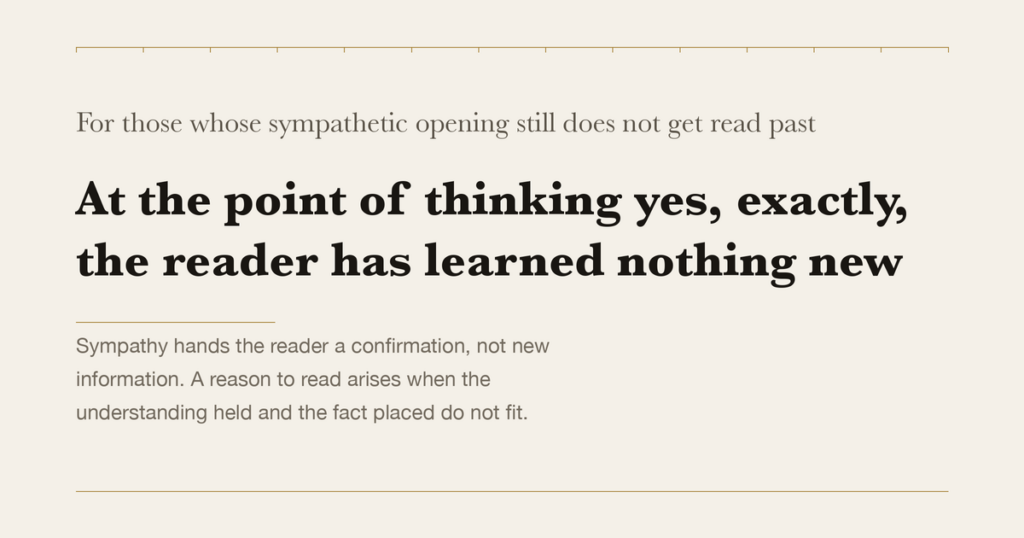
What is happening is confirmation. In most cases, nothing has yet been newly learned by that reader. They have merely been shown their own state in different words. The one exception is a reader who cannot yet put their own state into words. What they wanted confirming was already settled on the spot, so no reason to read on has arisen.
How to write a lead paragraph gets shared as a sequence of five steps. Write the reader’s trouble, draw close to it, introduce the article’s content, show what they will gain, and finish with a line that catches interest. At the centre of that sequence sits one assumption. A reader who has their own state named wants to read on.
A reason to read arises at a different moment: when what is written turns out to diverge from what they had assumed. A divergence carried around is not something you can stop reading on. A discrepancy is what builds a reason to read.
Three things get settled. First, what the sympathy step hands the reader and what it does not. Second, what separates a discrepancy from stoking, given that the two resemble each other from outside. Third, how to handle the fact that an opening is sorting its addressees.
What does not get settled is how many characters, how many steps to place, or how many lines of sympathy to include. Place figures here and the number of steps gets settled without the distance from the reader’s understanding being examined.
The response when sympathy works comes back clearly. That is exactly me is a legible signal of success for a writer. The signal coming back, you proceed in the direction of thickening that step. Meanwhile, the fact that nobody read on does not come back as a signal.
And the more the sympathy opening spreads, the more openings resemble each other. Resembling each other, readers start judging without reading them. Material for judgement disappears from the opening, so the next attempt needs stronger words. The same thing then happens to the strengthened version.
This is not an argument that showing what the piece is about at the opening is unnecessary. Place a good sentence without showing it and what that sentence is about never gets settled. What gets handled here is what to hand over after showing it.
One further thing keeps this state going. An opening that begins from sympathy does not become an opening that reads badly. The writing is in order and the content is on target. The result is a piece that reads but generates no reason to read on, so the opening never comes up as a candidate cause.
📖 Contents
- The Five Steps of an Opening — Trouble, Sympathy, Forecast, Gain, Hook
- Sympathy Is Not a Reason to Read
- A Reason to Read Arises When a Gap Becomes Visible
- A Discrepancy Is Not Manufactured but Pointed At Inside the Reader
- Stoking Is a Counterfeit Discrepancy
- The Opening Sorts Its Addressees
- Length Is Settled by What It Takes to Show the Discrepancy
- An Opening That Will Not Get Written Indicates the Absence of a Claim
- Writing Out, in One Word, What the Opening Hands Over — Before Publishing
The Five Steps of an Opening — Trouble, Sympathy, Forecast, Gain, Hook
Accounts of how to write an opening have settled, on the practical side, into more or less a single form.
A lead paragraph is the introductory part before entering the body. It is described as the few paragraphs that convey the outline of the article and let the reader judge there is value in reading further.
Two roles get raised. First, forecasting the article’s content. Second, getting the reader to read on. Get abandoned at the opening and the body goes unread, so effort belongs here — that is the observation.
The five-step sequence gets set out. Write out the trouble the reader carries. Show sympathy for that state. Introduce what gets covered. Show what things look like after reading. Finish with a line that makes them want to read on.
Advice gets appended too. Make the assumed reader concrete. Use the reader’s words. Avoid technical terms. Do not run too long. A figure of around three hundred characters sometimes appears as a rule of thumb.
Things not to do get listed as well. The conclusion is missing. It stokes excessively. The irrelevant preamble runs long. It begins from talking about yourself. Each gets accounted for as a cause of abandonment.
None of the five steps is off target. Abandonment at the opening is a fact, and using the reader’s words does make things land more readily. The observation that long preambles go unread is sound as practical observation.
The whole of this set stands on one premise. The role of a lead paragraph is organised as carrying the reader into the body. As means of carrying, sympathy, forecast, and gain sit side by side. A problem of transport.
Treat it wholly as a matter of transport and the means all get placed on the side of the reader’s emotions. Sympathise, build expectation, pull. Not one of them hands over something the reader does not yet know.
A view arises that moving the reader’s emotions is the power that gets things read. They do move. What separates the cases is what remains after the movement. What a reader whose state has been named carries away is confirmation of that state.
The newspaper lead stands in contrast to this arrangement. A newspaper lead compresses the key points of the story into the first few lines. Sympathy is not in it. It gets read on anyway because the key points are themselves information the reader does not hold. Less a difference of medium than a difference in what is being handed over.
That said, importing the newspaper lead wholesale does not settle the matter. That form compresses the key points of an event; what gets handed over here is a claim. Key points can be compressed; compress a claim and the grounds fall out. What the two share is one point only: placing what the reader does not hold at the front.
Sympathy Is Not a Reason to Read
A reader who reads busy every day, with only time passing already knows that state. It is the state of being shown, in different words, what you know. What occurs here is the judgement that this piece of writing is addressed to you. The judgement is necessary. Judged as not addressed to them, nothing further gets read.
The judgement is a separate thing from a reason to read, however. A reader who has worked out this is addressed to me does not necessarily hold a reason to read on. Being addressed and having something you want to know hold separately.
Suppose you read a piece that describes your symptoms accurately. Having thought that is right, what do you next want to know. Not the symptoms. You already hold the symptoms. What you want is why it is like that.
The longer the sympathy step, the later you arrive at that question. Spend three paragraphs describing the state and the reader spends three paragraphs reading known information.
Without sympathy, it gets said, a reader will not open up. Sometimes they do open up. The quantity required to open them, however, can be one sentence. That sentence conveys that the writer knows the state. From the second sentence onward, it is repetition of what is known.
The matter changes where the reader has not put their own state into words. When a vaguely uncomfortable state acquires a name, that in itself is new information. This is description rather than sympathy. Description hands over an outline the reader did not hold.
Telling them apart depends on whether the reader could say the sentence themselves. If they could, it is sympathy; if not, description. A step that wrote what they could say loses nothing on removal.
The sympathy step carries one further constraint of sequence. Describing a state accurately shows that the writer also knows that state. Knowing it and holding what comes next, however, are separate. Where description alone continues, the reader starts reading it as detailed, perhaps, but possibly holding no answer either.
And the work of thickening it has no upper bound. Symptoms can be written as finely as you like. A task with no upper bound and a task requiring one sentence are being called by the same name, sympathy.
There is a reason your hand reaches for the thickening side. Writing symptoms requires no material: your own symptoms, or symptoms you heard, will do. The material required for the next step — the account of why it is like that — cannot be written if it is not in hand. Only the side that can be written grows.
A Reason to Read Arises When a Gap Becomes Visible
A reader reads on when the understanding they hold and the fact placed before them do not agree.
This structure has an organisation in the research on curiosity. In 1994, Loewenstein organised curiosity as the recognition of a gap between what one knows and what one feels one wants to know (Loewenstein, 1994, Psychological Bulletin, 116(1), 75–98). Once the gap is recognised, a state of wanting to fill it arises.
This review integrates existing research rather than reporting a single experiment. It is not the kind of thing whose measured figures get carried away; it is usable as a framework.
Two points of the framework work in practice. First, a gap does not arise from not knowing alone. Without a state of knowing something, the missing part is invisible. Second, curiosity also falls where the gap is too large. Something too far away does not produce a state of wanting to fill it.
To a reader who arrived having heard a sales letter is better long, place length is not the writer’s skill. That sentence collides with the understanding the reader holds. A collided state cannot be left as it is.
A sentence that does not collide gets skipped. Let us write text that reaches the reader collides with nobody’s understanding, so no need to read on arises.
That colliding invites a backlash is a fair worry. Backlash does occur. Backlash is evidence of being read. Closed unread, no backlash occurs either. What separates the cases is whether grounds get placed after the collision. A collision without grounds becomes mere denial.
Collide with the wrong party and it does not work, because denying an understanding the reader does not hold produces no gap. Collecting the headings of ten top results does not produce a structure reaches only readers who have collected them.
What to place at the opening is therefore settled from the side of the understanding the reader holds. What they hold comes before what to deny.
Beginning from a discrepancy puts a burden on the writer, because it cannot be written without knowing what the reader holds. Beginning from sympathy carries no such burden: write your own symptoms and you will mostly be right. The difference in burden also bears on which form spreads. The easier one gets chosen, and the chosen form becomes standard.
A Discrepancy Is Not Manufactured but Pointed At Inside the Reader
A discrepancy is not invented by the writer. It is already inside the reader.
The state of having done exactly what you were told and finding the result unchanged is one not a few readers genuinely hold. They hold it, and it has no name.
What the opening does is give that state an outline. Assembled the structure with reference to the top results, and it goes unread. That sentence is a description of what the reader experienced, and simultaneously has the form of demanding an explanation.
Place began from sympathy, and nobody read on and the reader recalls that experience. At the moment of recall, the question of why stands up. The writer did not raise the question. The experience did.
This form carries a constraint on the writer’s side. What the reader has not experienced cannot be pointed at. The range you can point at is capped by the range of the reader’s experience.
Whether things the reader has not experienced can be handled at the opening has an answer. They can. In that case, an observation gets placed in place of experience. Everybody followed the same procedure, and as a result every article’s structure came out identical is an observation confirmable without the reader having experienced it. What is confirmable can build a gap.
Pointing requires material from the reader’s side. Without knowing what they have experienced, where to point does not get settled. This material does not emerge in a study. It comes from something actually heard, or from your own memory of standing in the same position.
How to obtain the material is treated in how to conduct a customer interview: the form of asking for observation rather than judgement. Ask for judgement and the interpretation the reader already holds comes back. An interpretation is not material for a discrepancy.
Pointing also carries a check. It points at the reader’s experience, so where you miss, I have no memory of that becomes available. A manufactured discrepancy has no such check. Whether it landed cannot be confirmed by writer or reader, and the piece proceeds anyway.
And the pointing form fits into a small space, because one or two sentences suffice. A short opening looks, to the writer, like cutting corners. Looking that way, you want to add explanation afterwards. What you added was material the body was going to handle. Returning it to the body settles the matter, and since it got written once before returning, a decision to cut is required. A decision to cut a sentence you wrote weighs more than a decision never to write it.
Stoking Is a Counterfeit Discrepancy
Stoking also puts the reader into an unsettled state. In that respect it performs the same operation as a discrepancy.
The difference is where the unsettledness comes from. A discrepancy arises from the disagreement between experience the reader already holds and the fact placed before them. Stoking arises from a forecast of loss appended by the writer.
Not knowing this will cost you dearly does not point at the reader’s experience. An event that might happen has been placed there by the writer. The reader has no material for confirming it.
The mechanism here got handled in do not turn loss aversion into stoking: loss can be defined only as a difference from a reference point, so writing you will lose out means the writer is simultaneously placing a reference point. A reference point placed at the opening becomes a premise of the reader’s judgement.
And stoking has a mechanical limit. Where the body does not match the forecast, the reader stops trusting your openings from the next one onward. Openings are not independent article by article. They get read cumulatively, as the openings of the same writer.
A reader who read a piece that entered on a strong forecast and turned out to hold ordinary content discounts the next article’s opening. Discounted, the same intensity no longer reaches them. Raise the intensity and the discount rate rises with it.
Whether real losses may be written has a condition. They may. The condition is that they take a form the reader can confirm. In a format where time is what gets sold, the ceiling on income is settled by hours worked is confirmable. Act now or it will be too late is not.
Where a deadline or a condition exists as fact, it is an announcement. A date, a number of seats, a change of price. What separates a factual announcement from manufactured pressure is whether a reason can be appended. If you can write in one line why that date, it is an announcement. If you cannot, that deadline was built on the side of the writing.
Stoking has an effect on the writer’s side too. An article entered on a strong forecast makes the body match that intensity. Matched, assertions increase and the specification of cases where it does not apply drops out. The intensity of the opening cuts the accuracy of the body.
Immediately after removing it, the figures fall. Rates of opening and figures on time spent come out higher with strong words. Look at the fallen figures and revert, and you are back where you were. What requires judgement is which figures to look at. The number who opened and the number who read to the end and reached a judgement are different things.
The Opening Sorts Its Addressees
The opening is choosing who reads. This operation mostly gets treated as something to avoid, because abandonment gets counted as loss. Break down the composition of the abandonment, however, and the handling changes.
Readers outside the target leaving at the opening saves expenditure on both sides. Those readers avoid five minutes of unsuitable text. The writer avoids collecting responses aimed at people it does not reach.
Readers inside the target leaving at the opening is a loss. That occurs where the opening failed to convey that it was addressed to them.
The two are mixed inside the same figure. The work of lowering the abandonment rate at the opening does not separate them. Without separating them, you proceed in the direction of retaining readers outside the target.
Make the opening apply to anybody and the abandonment rate falls. So does the proportion of remaining readers who are in the target. The figure improves. What has decreased is the people it reaches.
The sequence get them reading first and narrow afterwards also holds. The place of narrowing can be moved back. By the amount it moves, however, readers outside the target read for longer. And narrowing later means readers who read that far leave. Leaving early and leaving late produce the same number of leavers.
Placing the sorting at the opening is available only where the target has been settled. Unsettled, what to sort on is unsettled too. How to settle the target is treated in how to build a persona.
There is a range in how sorting gets written. One form names the target; another lets the level of the problem handled do the separating naturally. The latter works better in most cases. Naming takes the form of excluding those it does not fit, whereas the level of the problem takes the form of the uninterested leaving on their own.
And sorting operates whether it gets written or not. The level of the problem handled, the words used, what gets placed as a premise. These separate readers whether the writer is conscious of it or not. What changes with consciousness is only whether you get to choose how they separate.
Make it explicit and hesitation appears on the writer’s side, because the figures fall. Whether the fallen figure is the result of narrowing or the result of failing to convey is unavailable from the opening alone. The distinction being unavailable, the hesitation does not resolve while you are looking at figures. What is available is whether the remaining readers are reading to the end.
Length Is Settled by What It Takes to Show the Discrepancy
What settles the quantity of an opening is the number of steps required to show the discrepancy. The rule of thumb in characters carries conditions.
Place the understanding the reader holds in one sentence, and the fact that disagrees with it in one sentence. Where that suffices, the opening is two sentences.
Sometimes it does not suffice: where the reader holds several understandings, or where the disagreeing fact needs explanation. Here the steps increase.
This structure is the same as the form handled in the principles of article structure, where length gets settled by the gap in premises. At the opening, the gap appears between the reader’s understanding and the fact you place.
To a reader holding the understanding primary information means information you gathered yourself, place whether something is primary information is settled by the position you write from. Those two sentences alone leave the discrepancy too large to become a gap. A step is required in between: that writing after knowing the conclusion turns experience into summary.
Conversely, add too many steps and the body enters the opening. Content explained fully at the opening becomes a second pass in the body. A second pass gets skipped.
Writing the conclusion at the opening, it gets said, removes the reason to read the body. It does not. The conclusion side alone is unusable. Knowing length is the quantity of relationship missing does not settle how many steps to assemble your own letter in. Settling that requires how to build the list of confirmations. That is the body.
Where the content is complete in the conclusion alone, it does disappear. There, what disappeared is not the reason to read but the grounds for the article’s quantity. A claim finishing in one sentence does not require eight headings.
Compression is usable for adjudicating quantity. Compress each step of the opening into one sentence and lay them out. If the sentences laid out form an argument, the number of steps is the number required. Where there is repetition, that is what gets cut.
One further thing settles quantity: how long the reader stays in that place. A reader arriving from search adjudicates within the first few lines whether an answer is present. Without the material for that adjudication arriving first, they leave however many steps the opening has. Not a problem of step count but of order.
The price of shortness comes out on the side of getting started. Write long and you can think while writing. Placing it in two sentences requires the claim to have been settled before writing. Write short with nothing settled and those two sentences become inoffensive generalities. Shortness itself guarantees nothing about quality.
An Opening That Will Not Get Written Indicates the Absence of a Claim
An opening that will not get written is not a problem of words. In most cases, the claim has not been settled. With what to say settled, the opening assembles from nothing more than searching for an understanding that collides with it. Unsettled, there is nothing to search for.
This state hides behind a sentence that can be written. This article will explain how to write a lead paragraph. That sentence can be written with no claim settled. Being writable, you proceed into the body without noticing that nothing was settled.
Adjudicating it is simple. Write in one sentence what the article says. If you cannot, the opening cannot be written either. If you can, all that remains is finding one understanding that collides with that sentence.
Suppose sympathy is not a reason to read got written in one sentence. The colliding understanding is sympathise and it gets read. The opening becomes the form that lays those two side by side. The search finishes in minutes.
The sequence in which the claim gets settled while writing also holds. It happens. In that case the opening gets written last. Having finished, you reread what you said and put it into one sentence. As a sequence that is fine. What becomes a problem is writing the opening with nothing settled and proceeding into the body that way.
Even with the claim settled, the opening cannot be assembled without the addressee settled, because the understanding you collide with has to be one the reader holds. Which of the two is missing becomes available at the moment you try to write the opening.
The manner of becoming available differs. With no claim, everything you write feels thin. With no addressee, several openings hold at once and none can be chosen. The symptoms differ, so they can be told apart.
There is a third type of unwritable state: claim and addressee both settled, and which to enter from unsettled. Enter from the reader’s understanding, or from the fact that disagrees with it. Both hold, so neither can be chosen.
There is one way of choosing. The more strongly the reader holds that understanding, the more you enter from the understanding side. Where they hold it only weakly, enter from the fact and place this is what gets said, though afterwards. Postpone a strongly held understanding and the reader keeps reading in their own understanding until that step.
Writing it last carries a cost too: the body gets long, because you write on with what to say unsettled. Work of cutting after finishing arises, and the amount to cut is proportional to how much got written undecided.
Writing Out, in One Word, What the Opening Hands Over — Before Publishing
Three questions can be applied to an opening you wrote, before publishing.
The first confirmation is to write out, in one word, what a reader learned newly from the opening.
If you cannot write it out, that opening was assembled from known information alone. An opening built from the sympathy step alone catches here. If you can write it out, that one word is the reason to read on.
The second confirmation is to identify the understanding the opening collides with.
Can the reader thinks this be written in one sentence. If not, there is no collision. An opening with no collision is an opening that merely says something correct. Correctness is not a reason to read.
The third confirmation is to remove the opening and read the body alone.
If the body holds, the opening may have been a summary of the body. A summary builds a second reading. If it does not hold, the opening was placing the body’s premises, and it is doing its job.
Readability is not what any of the three looks at. Readability is a necessary condition, on a different axis from a reason to read.
One adjudication sits outside the three. It is whether the reader actually holds the understanding you collided with. Where the understanding you assumed and the understanding the reader holds diverge, the opening swings at air. That adjudication is not available on the side of the opening.
Characters, steps, lines of sympathy. Place figures and the number of steps gets settled before the distance ever gets measured. The distance is what settles the step count. Figures invert that order.
At the moment of that is exactly me, what happens is confirmation. Not the receipt of new information. Confirmation generates no gap, so no reason to read arises; building a gap requires an understanding the reader already holds; and without knowing that understanding, what to collide with does not get settled either. Sympathy, stoking, and sorting are all separate answers to that single point.
The next opening you write does not require a technique of writing. The party to collide with is not in your study. What the reader has been told, what they tried, and what failed to change. The material is nowhere else.
The sequence that follows the opening is treated in the principles of article structure, and how to raise the headings themselves in how to write headings. For the step where a reader does not begin reading at all, the three NOTs sits earlier in the sequence. That the counterpart to collide with sits only on the reader’s side is because the opening handles distinctions the reader already holds. The definition itself — restating into a form the other party can use — sits in the technique of verbalisation.