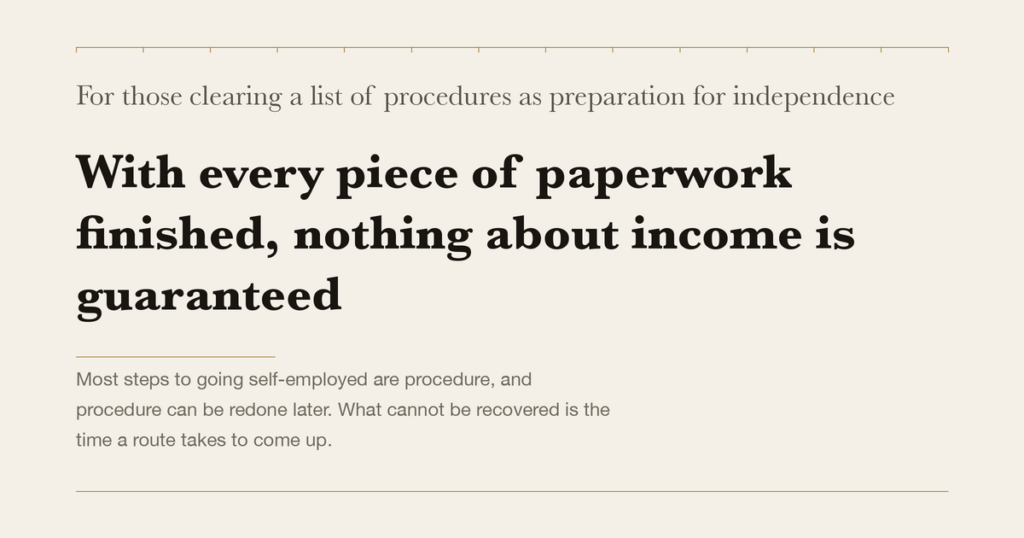
Almost everything offered as preparation for going self-employed is paperwork. Business registration. Tax elections. Switching health insurance. Changing your pension. A business bank account. Cards. A trading name. Accounting software. All of it has to be done, and some of it carries deadlines. The list is accurate, practical and useful.
But what the list answers is the question “what are the requirements for opening for business”. It does not answer the question “what decides whether income stands up after you leave”. These are two different questions, and their answers barely overlap.
What separates them is recoverability. Paperwork gets sorted out afterwards even when late. A route by which work reaches you, if you begin building it after leaving, gets built during a period with no income. What belongs first is the one that cannot be caught up on.
Three things get settled here. Why articles about preparation lean toward paperwork. What runs short a few months after leaving, when every piece of paperwork is already done. And why the sequence “once I have saved a bit more” never ends. None of the three is explained by degrees of caution.
Two things this article withholds. Neither the timing of leaving nor the amount of savings needed is settled here. With a different family to support and different housing costs, the same figure means something else. Nor does this cover trades that need licences or registered qualifications. There the paperwork itself takes months, so the centre of gravity of preparation sits elsewhere. The scope is limited to work that needs no licence and earns by supplying a skill.
Two preparations of different natures are called by one word, and that is where the damage sits. Someone who has finished the paperwork says “preparation is done”. Those around them check with the same word, and if the answer is that registration and the account are handled, the conversation closes. While the expression is the same, no occasion arises to put into words what is not finished. It gets noticed after the income side has thinned.
What follows establishes what is on the preparation list and what falls off it. It then places the reversibility of paperwork and identifies what runs short a few months after leaving. From there it looks at why the material for a route only flows while you are still employed, and at what savings actually buy. It then treats the mechanism by which “once things are ready” keeps moving, answers the objection about the weight of paperwork, and ends with a single question for judging readiness.
📖 Contents
- What Is On the Preparation List and What Falls Off It
- Paperwork Can Be Done Afterwards
- What Runs Short After the First Cycle
- The Material for a Route Only Flows While You Are Employed
- Savings Buy Time, Not What the Time Is Used For
- Why the Standard for “Once Things Are Ready” Keeps Moving
- This Is Not an Argument for Taking Paperwork Lightly
- What a Route Built While Employed Has to Satisfy
- One Question for Judging Whether You Are Ready
What Is On the Preparation List and What Falls Off It
What the list addresses is the conditions for operating, not the conditions for income standing up. The two sit in different layers.
The list comes to seven items. Filing the registration. Making the tax election. Switching insurance and pension. Opening a business account. Templates for invoices and contracts. Cards and a site. A working internet connection. What these have in common is that they all bear on whether you can exist as a trader after leaving. Without the filing, your tax treatment changes; without a separate account, the books get mixed; without templates, every transaction starts from scratch.
The distinction becomes clear when you listen to people who have gone self-employed. Getting stuck on paperwork is not something you hear about often. What gets stuck is the income side. After the continuing work from your former employer runs out, where the next one comes from is unclear. That phase arrives regardless of whether the registration was filed.
Even so, there is a reason talk of preparation leans toward paperwork. Paperwork has settled answers. Where do you file the registration. When is the deadline. How much is the deduction. Each has one correct answer and transmits precisely in writing. Whereas “how do I make work arrive” has only answers that differ by trade and situation. It is hard to write.
So the writable side accumulates. Not because anyone cut corners, but as the result of a bias: things with settled answers make workable articles.
The bias has a second route as well. Guidance on paperwork is often written by businesses that provide accounting and tax services. It is a natural subject for the writer and useful to the reader. What the writer has no reason to write about is what lies outside that subject.
Nobody ordered the imbalance. Each party wrote accurately about the range they handle, and the centre of gravity of the whole ended up on paperwork. Nobody wrote anything false, and a region remains that collecting every list will not fill.
The list is easy to handle from the reader’s side too. It has items, an order, and an end. The sense of having finished is reliably obtained. That sense is the awkward part. There is only one word for preparation, so the person who has finished the paperwork receives it as preparation completed.
Here is the problem this article addresses. Not that the paperwork is insufficient, but that even with every piece of paperwork perfectly finished, nothing is guaranteed about income after leaving.
Paperwork Can Be Done Afterwards
Most paperwork can be walked back, and only the time a route takes cannot be recovered. This asymmetry decides the order of preparation.
Business registration can be filed after you have started. The deadline is stated as within a month of starting, and a late filing is still accepted. A business account can be opened later, and cards can be printed when needed. Templates are enough if made at the first transaction. Tax elections do carry a firm deadline, but a year’s delay only means they apply from the following year; the business does not become unworkable.
The route by which work reaches you has no such property. Realising the month after leaving that you should have built one means starting from that point. From starting to the first enquiry takes time, and during that period there is no income. What cannot be recovered afterwards is the time the route takes.
From here comes one criterion about the order of preparation. Do not handle what can be caught up on and what cannot under the same word, “preparation”.
None of this argues for putting paperwork off. It finishes quickly. It is only that most of a preparation period should not go on work that takes hours or days. Separate what takes time from what does not. As a design for preparation, that single point is enough. And what follows from separating them is a reordering. Neither side has to be dropped.
The separation has a secondary effect too: what grounds the length of the preparation period changes.
With paperwork as the basis, the preparation period is “until every necessary filing is understood and executed”. That takes days, so it cannot ground a period. In practice, then, the amount of savings decides the length: wait until a figure decided in advance is reached.
With the route as the basis, the grounds change. The time until the route stands up becomes the length of the preparation period. And unlike a figure, this time does not advance by waiting. It counts from the day you start. Put the other way, a period in which you have not started does not count as preparation however long it runs.
So what you put at the base changes how the preparation period is spent. With a figure at the base, the period is time spent waiting. With a route at the base, it is time spent building. The same six months get used differently.
What Runs Short After the First Cycle
What runs short a few months after leaving is neither skill nor money but the channel by which new parties reach you. The channel was the company’s asset, so it cannot be brought along.
The first few months fill with relationships from the previous job and work that was continuing before you left. Income in this period has little to do with the event of going self-employed. Relationships that existed before you left are simply continuing. The problem appears after those have run their cycle.
Check what is short, in order. Skill? Usually not. If you could do the work inside the company, that skill remains afterwards. Money? With living costs secured it holds for a while. Paperwork? That is done.
This form was treated earlier in research on organisations. In 1965 the sociologist Arthur Stinchcombe called the tendency of newer organisations to disappear more readily the “liability of newness”, and put it down to having to learn roles from scratch and to not yet holding stable relationships with the parties one trades with (Stinchcombe, A. L. “Social Structure and Organizations”, in March, J. G. ed., Handbook of Organizations, Rand McNally, 1965). In 1983 John Freeman and colleagues measured death rates by age among labour unions, newspaper publishers and semiconductor firms, and found that younger organisations die at higher rates (Freeman, Carroll & Hannan, 1983, American Sociological Review, 48(5), 692–710).
Starting alone, the learning-roles half of that liability comes cheap, because you carry on with the work you were already doing. What does not come cheap is the relationships side. While you were inside, the company held them. There was a sales function, existing customers, a name over the door. You worked inside that channel, so no occasion arose to notice the channel itself. That its existence is invisible follows from its being outside you and always working.
A common first response is to register with a service that brokers work. It is available immediately and jobs genuinely arrive, so it is a sound choice.
What that response obtains, though, is not a route. It is the state of borrowing someone else’s route. The order of display is decided by whoever runs it, and if that changes, so does how work reaches you. It works while borrowed and does not become your asset.
Borrowing is reasonable, and as an entry point it is sound. What becomes a problem is only leaving it borrowed indefinitely so that the work of building your own route never starts. And there is a reason it does not start. The borrowed route genuinely works.
You look for a replacement for what is not working; for what is working, no motive to look arises. Jobs arrive, income stands, life runs. Thinking “I must build my own route” in that state is unnatural.
What makes the unnatural judgement necessary is one point only: whose decision can make that route disappear. When the operator changes how display works, the criterion is not your livelihood. Not malice, but the property of the position. So the period while the borrowed route works is also the period usable as grace for building your own. Start after it stops working and you build without income.
The Material for a Route Only Flows While You Are Employed
The part of route-building that can only be done while employed is a matter of material, not of scheduling. The material only comes out while you are working on jobs.
A route, pushed to its base, is a design for “who, with what business, reaches me”. Two materials are needed. One is being out there in a form that shows what you handle. The other is having confirmed that people with that business actually exist.
The second gathers while the work is happening. Questions asked repeatedly. Occasions where you explained the same thing again. What the other party was stuck on at the outset. None of them can be observed anywhere but where the work is actually running. Sitting at a desk after leaving does not produce them.
And while employed, this material flows most abundantly. There are jobs, there are people, the work is moving. Right after leaving, the flow thins. So the period when the material is richest and the period when it should be collected coincide.
The first material — being out there — can also be begun while employed. Writing, compiling and recording about the field you handle. Once made, these remain. And that property of remaining is decisive here. Start writing after leaving and it takes time before what you wrote gets read. Write while employed and that time is consumed during employment. The time for a route to stand up does not get laid on top of the income-free period after leaving.
What can be done while employed varies with your employer’s rules. Where there are restrictions on side work or publishing, you cannot exceed them. And putting what you learned through your duties straight out into the open can, depending on the content, become a confidentiality matter.
Even where there are restrictions, observing the material and recording it privately is possible. Separate what goes out from what accumulates in hand. A record touches nobody’s rules; the judgement about publication only arises at the point of putting it out after leaving.
Record it on the spot or the material does not survive. Questions asked repeatedly leave no impression while they are being asked, because you can answer them. What you can answer is obvious to you, so it does not catch in memory. The more obvious the content feels, the more likely the other party is hearing it for the first time — that asymmetry sits here.
So trying to recall it later produces nothing. What comes up is the memorable, exceptional job. The material for a route is not the exception but what repeats, because repeating means that people with the same business exist continuously.
The method of recording does not matter. Leave one line about what was asked each time a job ends, and in six months the material is lined up.
Savings Buy Time, Not What the Time Is Used For
Savings buy the time to pass through a period with no income. What that time gets used for has nothing to do with the amount.
A figure that comes up often in talk of preparation is savings. Three months of living costs, or six. The guideline has grounds and is genuinely useful. What it buys is time, working as grace until a route stands up.
What is worth establishing is how that time is used. With six months of living costs and route-building begun, the route grows for six months. With six months and nothing begun, the savings shrink for six months. Same six months, different result.
And where the use is undecided, the time tends to go into looking for work. With no income, the most pressing problem is income. Looking for work produces short-term income and does not, by itself, produce a route. The following month brings the same activity again.
So increasing the amount saved has this property. The grace lengthens, and if what to do inside the grace is undecided, the extension repeats the same activity for longer. Which is why the sequence “once I have saved a bit more” can fail to meet its condition. The problem is not the amount but that what the time bought with it will go to has not been decided.
The grace itself also tends to be underestimated. In 1994 the psychologist Roger Buehler and colleagues examined how people predict when their own tasks will be finished, and showed that the next prediction leans optimistic even for people who have experienced the same task running late (Buehler, Griffin & Ross, 1994, Journal of Personality and Social Psychology, 67(3), 366–381). When predicting someone else’s task, the bias gets smaller.
What was treated was student assignments and tax returns, not the launch of a business. The scope cannot simply be widened. But the form — estimating the duration of your own work yourself — is the same. The period until a route stands up is also your own estimate, so it is safer to assume the same bias applies. If estimates come out short, the grace needed is longer than the estimate.
One more thing. Savings can also be increased after leaving. Leave the route until later and you end up building it during a period with no income. There is an asymmetric answer to the question of which to finish while still employed.
The two also interact. The further a route has stood up, the less saving is needed. The grace required is set by the time until the route stands up. Begin while employed and part of that time is already consumed. By that much, the grace needed after leaving is shorter. Never having begun means counting the grace from zero. The same amount of savings becomes a different length of grace depending on whether you started.
So savings and route do not compete. It is not that taking one means giving up the other but that one reduces how much of the other is required. In sequence, the route comes first.
Why the Standard for “Once Things Are Ready” Keeps Moving
Judge by an amount and “enough” gets updated from wherever you have arrived. The standard itself moves, so the waiting has no end.
“I will start once I have saved this much” is a common way of putting it. What serves as the standard is the absolute value of the figure. Three million is enough; one million is not. The judgement feels natural, and looked at closely it is a little strange.
Compare another area. Someone training to lift a certain weight, who tries to lift something far beyond their present limit, will only injure themselves. There is no route other than going up gradually. And wherever the present limit sits, that in itself has nothing to do with shame. Everyone starts from some number.
As a statement about training, anyone agrees. Yet the same person cannot make the same judgement about money. A conversion operates by which a small figure is embarrassing and a large one creditable. The reading of absolute value that was not applied to the training number is applied to money.
Money has had an external yardstick attached to it for a long time. Low means inferior, high means superior. That reading has been internalised over years, and it reads out your present position as your worth.
The damage of that reading is not emotional. It is that action stops. Not wanting to show anyone your present scale, you run things within a range that need not be shown. Systems and facilities you could use go unused because they feel beyond your station. Things a question would settle get carried alone. And the standard for starting keeps rising. By the time three million has accumulated, five million is what looks necessary.
It cannot be said that waiting is itself an error. With a family to support, housing costs, and a life that stops working if income breaks, securing an amount is a correct judgement. This is not an argument for starting with the amount short.
What is addressed is only that the standard for the amount moves under the reading of absolute value. Separate the standard that moves from the standard that does not. The amount your life requires can be calculated. That does not move. “An amount I would not be ashamed to name” cannot be calculated. That moves.
Judge by the first and the waiting has an end. With the second mixed in, it does not. Whether it is mixed in becomes clear when you actually calculate the amount required. If the calculated figure and the felt figure differ, the difference is the second.
This Is Not an Argument for Taking Paperwork Lightly
Completing the paperwork is not completing the preparation, and this is also not an argument for not doing it. Mix the two and errors come out in both directions.
Put paperwork off and real disadvantages follow. Tax elections carry deadlines, and missing one costs you that year’s deduction. Leave the insurance switch and a period of no cover appears. Without a separate business account, private spending gets mixed in and the annual return takes longer. How benefits after leaving employment are handled also changes with the relation between when you leave and when you open. Each carries real harm, and sooner is better.
Only two things are being stated. First, the state of having every piece of paperwork done and the state of income standing up after leaving are separate sets. The former does not contain the latter; both are required. Second, paperwork does not take time. It is done in hours or days. With a six-month preparation period, paperwork occupies a few days of it.
Keeping the two apart matters in practice. Read as a rejection of the paperwork list, the conclusion “filing can wait” comes out. That is dangerous. No part of this article’s claim bears on it.
Read the other way, with paperwork at the centre of preparation, the allocation of the period goes wrong. Five of the six months go on gathering information and preparing documents, and you leave without having touched the route. The paperwork is perfect and only the outlook for income is missing.
That both are required looks obvious as a conclusion. Yet despite being obvious, actual preparation lists often carry only one of them. What is not on the list does not get done, however obvious it seems.
One qualification. The weight of paperwork differs by trade. Where a licence is required, a qualification must be registered, or capital equipment must come first, the paperwork itself can take months. There, paperwork sits at the centre of the preparation period.
The work addressed here earns by supplying a skill. No licence, almost no equipment, light paperwork. Precisely because the paperwork is light, where the centre of gravity of preparation sits becomes hard to see.
The asymmetry shows up in the guidance too. Articles for licensed trades can say “get the licence first”; for unlicensed ones, the order to write cannot be fixed. As a result, only the items common to every trade — filing, account, insurance — remain. That the common items remain is a sound editorial judgement, and it does not mean that the common items are the important ones.
What a Route Built While Employed Has to Satisfy
What counts as a route is something usable without anyone’s permission, that does not disappear on anyone else’s decision, and that remains when you stop working. Few things satisfy all three.
First, usable without anyone’s permission. A state in which nobody can stop your listing or change the order of display. Second, does not disappear on anyone else’s decision. Anything that vanishes when an operator’s policy changes fails this. Third, remains when you stop working. Anything that has to be maintained by doing something daily is the first thing to break during the unstable period right after leaving.
Measured by these three, many things turn out not to be routes. A rating on a brokerage service fails the second. Recognition inside a particular venue changes in effect when that venue’s mechanism changes.
What satisfies all three is a place you publish that you own, and a list of people you can contact directly. These two are the centre. What can be built while employed is mainly the first: writing about the field you handle, held in a place with your own name on it. Within what your employer’s rules allow, that accumulates while you are still there.
The second — a list of people you can contact directly — only stands once the first exists. Without a place people first arrive at, the list does not grow. So in sequence, the first comes first. And the material for both is the “questions asked repeatedly” and “explanations given many times” recorded on the spot as they came up. The material gathers while employed, and the place to put it can be built while employed. Neither has to be carried over into the income-free period.
What is needed at this stage is not size. Whether an enquiry has ever arrived via your own place, even once, is what judges the requirement. Increasing the count can wait until after leaving.
One is enough because what you want to confirm is not volume but whether the route is open. Put something in your place, and someone who saw it gets in touch. If that sequence has happened even once, the route exists. Thickening an existing route is work you can do with time after leaving. Opening a route that does not exist, from zero, takes time of a different order.
Conversely, where a lot has been put up and nothing has ever come through it, whether the route is open is unknown. Volume is not proof of being open. So the aim while employed is not to write a lot but to get one thing through. Thickness becomes the topic afterwards.
Something is given up too. Progressing this while employed reduces your disposable time. There is a job, there is the work, and this sits on top. What is lost is borrowed forward from the income-free period after leaving. The advantage of borrowing forward is only that there is income during it.
One Question for Judging Whether You Are Ready
One question is enough. If you left the company now, once the relationships from your former job have run their cycle, where does the next party come from?
If you can answer with the name of a specific route, the centre of gravity of preparation is satisfied. If the answer is “I will look”, there is no route yet. Every piece of paperwork done and savings sufficient do not change that answer.
Paperwork and savings extend your survival period after leaving; a route is the condition under which income arises. Extending survival is no substitute for meeting the condition. If the condition is unmet inside the extended period, the state at the end of the period is the same.
No amount enters this question. Judge by an amount and the standard keeps moving. A route is there or it is not. The standard does not move.
What to do if the answer is “I will look” cannot be decided here. What you stand as, where you put it and who you address differ by trade and experience. Figures such as how many pieces to write or how many people the list needs are not given either. Handing them over would be passing down the judgement in your place.
What is here instead is the question for judging, and why the question works. It works because what can be recovered later and what cannot are separate, and a route is the latter. Grasp that and you can decide for yourself what counts as a route in your own situation.
It is better not to use this question as the question of whether to go self-employed. Even with the answer “I will look”, it does not follow that you must not leave. Some people built the route after leaving. With living conditions in place and enough grace, that order works too.
What this question answers is the question of what to do during the preparation period. If you are still employed and considering when to leave, its answer decides how the remaining time gets used.
The question the preparation list answers and the question that decides income after leaving are different. What separates them is recoverability. Paperwork can, so it sits behind, as a few days of work. A route cannot, so it goes in front, while the material is still flowing.
And having handled the paperwork carefully was not wasted either. Without the conditions for operating in place, the transactions after a route opens do not run. What was mistaken was the premise that finishing the list is finishing the preparation. Separate the two and the same six months get used differently. The month your answer changes from “I will look” to the name of a specific route is the month the centre of gravity is satisfied. Unlike a savings balance, this judgement has no external yardstick attached. There is no room for comparison with others, so the standard does not move.
Why the form in which income is made does not change just because you went self-employed is broken down in what to know before earning on your own: the ceiling on selling time, and the phase of raising your rate afterwards is treated in before negotiating a rate rise, know how the amount is decided. Whether you hold a route is a dividing line that is not confined to going self-employed. How the same line works across the whole business of making income is addressed in getting out of labour-intensive form.