The things to be done do not decrease. As much as has been cleared away, that much comes in again. Trying at the end of the day to recall what the time went on, nothing with an outline comes out. Even so, tomorrow begins in the same shape.
The explanation first applied to this state tends to sit on the side of management. It is read as a problem of organisation, and the way of working is changed. That explanation is partly correct, and taking action on it does make things a little easier. So it does not come off readily.
Seen over a span of years, even so, the quantity of the pressure returns to the same place. It is not that the time is insufficient. As long as the income is tied to the hours, that time is spoken for in advance, as the thing being sold. What the techniques of management can handle is only what is left after the speaking-for. However well the remainder is allocated, the quantity spoken for does not move.
There are four things taken apart here. What the verdict of none is actually being compared against. What the widely circulated responses actually improve. Why a slot opened by efficiency returns to where it was. And what has to change for the quantity spoken for to move instead.
No procedures for time management appear. How to use the morning, how to choose tools — neither is the substance here. Those have been written in quantity already, and written well. What this article adds is the stage before them, the one deciding the quantity.
One more: a state in which sleep is being cut into sits outside the range. At a stage where recovery is required first, a discussion of format does not yet carry meaning. The same holds for the portion whose use is decided by the needs of others, as with raising children or caring for a relative. That portion is spoken for in a different way from income, so the analysis below does not apply to it as it stands. Nor are benchmark figures given, since the same number carries a different meaning according to the stage of the business and the composition of the income. And what the freed portion gets used for, once the quantity spoken for does move, is not covered either. Specifying the use as well would simply be another way of speaking for the time.
The subject here is a state in which all or part of the income is tied to your own hours. Work taken by the hour, a monthly retainer, a per-project fee — all of these are in that shape. Where a living is made entirely from income that moves independently of hours, on the other hand, what follows does not apply. Whether it applies is brought down to a one-line verdict later in the article.
After the four have been taken in order, three records are placed that can be drawn on afterwards to see whether anything has moved. What is handed over is not a procedure but an instrument for judging which of the two layers your own pressure is occurring in.
📖 Contents
- What Is the “None” in “No Time” Being Compared Against
- What the Responses Improve Is the Time That Remains
- When Income Is Tied to Hours, the Time Is Spoken For in Advance as Stock
- Why a Slot That Opens Gets Filled with Hours Worked
- Parkinson’s Law Explains Only This Far
- How Busyness Increases While the Volume of Work Stays the Same
- The Moment a Description of Structure Becomes a Description of Character
- Not Clearing Time, but Cutting It Loose
- Read the Progress by Amount, Ceiling, and Volume of Judgement
What Is the “None” in “No Time” Being Compared Against
What the verdict there is none compares against is not a total but something variable. So the verdict is not updated even when the situation genuinely improves.
There is no time looks at first like a report of quantity. As a report of quantity, however, it does not hold. A day is twenty-four hours for everyone, and this quantity neither rises nor falls.
What is commonly compared against is one of the following three.
First, the amount decided on. What was decided for today did not finish. Therefore the time was insufficient, runs the verdict.
Second, how others look. Someone whose workload looks about the same appears to have room. Therefore I have no time, runs the verdict.
Third, an earlier self. Before going independent, or in the early days of the business, there were stretches of time. Compared with that, there is none now, runs the verdict.
In all three, the party compared against is variable. The amount decided on is decided by you, how others look is only the part visible from outside, and the memory of an earlier self is compressed. Each of them moves for reasons of its own, unrelated to your state.
That whatever is said the time is physically insufficient, is a correct observation. It is insufficient. What is said here is not that the pressure is an illusion. The pressure is real, and how that reality is explained changes what is done next.
There are two candidate explanations. One is insufficient because the allocation is poor. The other is insufficient because most of it is already spoken for at a stage prior to allocation. The same pressure can be explained by either. Take the former and the response becomes a technique of management; take the latter and the response becomes the format of the income.
Proceed without settling which of the two is taken, and the unit of measurement stays vague. While the unit stays vague, whether the response succeeded cannot be judged either.
Handle no time as a word for a sensation, and whether it improved can also only be judged by sensation. And sensation falls with familiarity. Keep working at the same density and that density becomes ordinary, with only the feeling of pressure thinning out.
At this point a verdict of solved is issued while nothing outward has changed. Once the verdict is issued, the work of checking stops. Some months later the same sensation returns, and only then is it clear that it was not solved — and this back and forth can continue for years.
So what is required first is not the response but fixing the unit. Decide on one thing against which it is insufficient, and whether the subsequent response worked becomes something that can be judged.
What the Responses Improve Is the Time That Remains
Five responses are in wide circulation, and all five work. All five, though, treat the total time available as given, and what they move is the allocation of what remains.
Build a schedule for the day. Separate the urgent from the important and set the order. Do not take on work that runs without you. Record and make visible what is going where. Use the gaps — commutes, waiting time.
Not one of the five fails to work. The fourth in particular, making it visible, works, because until it is measured there is no knowing where it disappears to. A mix-up of the kind where there are too many meetings by sensation turns out in fact to be travel time is settled early once records are kept. The third, the choice not to take work on, also works. It is the only one of the five that touches the quantity spoken for. The range that can be left untaken has a structural limit, though.
The total is not among the things being moved in the first place.
A schedule is a plan of allocation. Priority is the order of allocation. Making it visible is the measurement of allocation. Using the gaps is a technique for making the grain of allocation finer. The choice not to take work on alone touches the total, and even that is reduce what comes in, not a touch on the mechanism by which it cannot but come in.
That if the allocation improves the total will increase as a result, holds in the short term. Improvement from a state with much waste in it genuinely produces stretches of time. The trouble is that the increment diminishes, and that what is produced does not remain.
The diminishing is a matter of course. Waste exists only in a finite quantity, so the more that is trimmed the less there is left to trim. A method that produced five hours a week in the first month produces thirty minutes a week six months on — that can happen. At this point, the explanation adopted tends to be the execution has gone slack. In fact the trimmable margin has simply run out as a result of the technique working correctly, but the shape of diminishing returns is indistinguishable from the effect has fallen off.
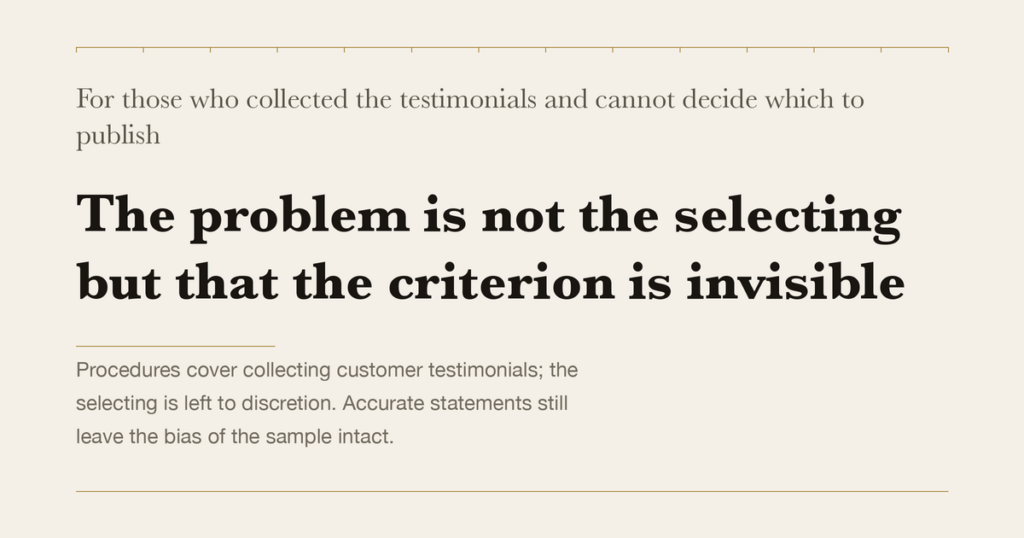
Where the pressure comes from has also been observed from the side of the workplace. Leslie Perlow, working in organisational behaviour, observed a team of software engineers over an extended period in 1999 and reported that pressure on time arose not from the individual skill of organising work but from a pattern of interaction — how interruptions occur (“The Time Famine: Toward a Sociology of Work Time,” Administrative Science Quarterly, 44(1), 57-81, doi:10.2307/2667031). The intervention that worked sat on the structural side as well, in placing a protected block of quiet hours as an institution, rather than on the side of the individual.
The subject being a team of engineers inside a company, it cannot be applied as it stands. Working alone, what produces the interruptions is not colleagues but clients and the format of the income. What carries across is only the direction — look at the structure — while the contents of the structure are exchanged.
And precisely because it is a response that works, it continues after it has stopped working. Something that did not work from the start would send you looking for another explanation early on. Because it works, when the effect falls off the direction taken is raise the precision. Try the next tool, try the next planner method, make the grain of the records finer. As a direction it is consistent, and what is being handled throughout is the allocation of the remainder.
The work of raising precision itself uses time as well. The finer the records, the longer the recording takes; the more precise the plan, the longer the planning takes. From some point on, the time for managing exceeds the time produced by managing. This point is passed quietly, so the passing is not noticed.
When Income Is Tied to Hours, the Time Is Spoken For in Advance as Stock
The target amount decides the required hours first, and what remains is what gets defined as free time. For as long as the subtraction runs this way round, no amount of work on the free-time side changes what gets taken out first.
Where the income of a business is tied to any of hours worked, job count, or units delivered, that business has its price set in units of time. An hourly rate, a monthly retainer, a per-project fee — all the same. If the figure is decided in a format of how much was done, time is the thing being sold.
Being the thing sold, it is handled like stock. An order arrives and it is supplied. What can be supplied sets the ceiling on revenue. Thus far this is unremarkable.
The trouble is next. Time handled as the thing being sold has already been spoken for, as an object to be spent at your own discretion.
Suppose a monthly target amount is set and that amount is proportional to hours worked. Then the hours required to reach the target amount are decided first. Those hours already have their use decided at the start of the month. What is left is the time available to your own judgement.
So the order is not free time is what remains when work is subtracted from twenty-four hours. It is the other way round: what is subtracted and what is left have swapped places. The same subtraction to look at, but what can be moved differs. In the former, reduce the volume of work and free time increases. In the latter, the required hours do not move unless the target amount comes down.
That spoken for is a metaphor, since in fact you decide for yourself and work — answering this means looking at the format of the contract. An hourly rate is written explicitly in units of time. A monthly retainer speaks for time too, in the form of a scope of response and an obligation to respond. A per-project fee translates, through the number of jobs needed to reach that figure, into the hours required. In every format there is a fixed rate of exchange between the figure and the hours.
This structure does not apply to the portion where income is cut loose from time. In a format where something made once sells repeatedly, or one that moves independently of your hours, the target amount does not decide required hours. The same person may hold both, and in that case only the former portion is spoken for.
Time that is spoken for looks, from outside, as though it could be cleared at your own discretion. For someone employed, working hours are fixed as an institution, immovable to anyone’s eye. For someone independent, however, no institution is there. On the calendar it can be cleared at any time. It has the shape of something clearable if you decide to clear it, and in practice it does not clear.
This difference pulls the explanation towards the side of character. If an institution is doing the speaking-for it is a matter of the institution, but where nothing clears in the absence of an institution, it looks like a problem of your own. And the explanation it does not clear because I am poor at this is partly correct, which makes it hard to deny.
Why a Slot That Opens Gets Filled with Hours Worked
Many people have had the experience of succeeding at making something more efficient. And not becoming any easier despite succeeding is not unusual either. The two do not contradict each other.
Suppose some task is made more efficient and three hours a week open up. Where do those three hours go?
If the target amount has not been reached, they go to hours worked. This is not weakness of will. Since the figure is tied to time, an open slot can be converted into additional revenue. To leave unconverted something that could be converted, a reason for not converting is required. And in a state where the target amount has not been reached, that reason cannot be produced.
Even where the target amount has been reached, they tend to go to hours worked. In a format where income varies, the surplus of a good month is assumed to fill a bad one. A verdict of this month is reached, so the rest is mine to use becomes structurally hard to issue. A target with no ceiling set on it has no attained state.
A target amount could then be decided, and work stopped once it is reached — and this genuinely works. It works, however, only where you are in a position to decide the target amount. In a state where the figure is not decided by your own judgement — where the unit price is set by the going rate on the other side, say, and a certain job count is required to reach the necessary living costs — the position at which to stop cannot be chosen by you. How the figure itself can be moved is handled in The one thing to look at first when you want to increase your income, which divides the question into quantity and format.
The more general mechanism, by which an open slot is filled from the side of demand, is handled on the economic side, and that dissection sits in Why raising productivity does not leave you with free time. What is being looked at here is only the point just before it. As long as a target with no decided stopping position is held, the route by which the slot fills stays open.
The slot sometimes stays open: where the proportion cut loose from time is high, or where there is ample room against the target amount. In such cases efficiency converts straightforwardly into free time. That is to say, this is not a difference in the quality of time-management technique but a difference in the format of the income.
Because it fills, the yield of the efficiency is invisible to the person. Where three hours are produced and those three hours go to hours worked, what appears outwardly is only revenue rose slightly. The pressure on time is unchanged. So the verdict issued is that the efficiency did not work. In fact it worked and what was produced went to another use, but that route is not visible from inside.
From here, a verdict of still not enough is issued, and the next efficiency is taken up. And the same thing happens. This back and forth does not stop however excellent the time-management technique is. The more excellent the technique, the larger the quantity produced, and the larger, therefore, the quantity going to hours worked.
Parkinson’s Law Explains Only This Far
This phenomenon has a famous name attached to it. What that name does not carry is the condition under which the expansion occurs.
C. Northcote Parkinson, in a piece published in The Economist in 1955, presented the observation that work expands so as to fill the time available for its completion. The experience of an open slot being filled is neatly caught by that one sentence.
Stopping here, however, leaves one explanation short. There are two reasons.
First, that sentence was not placed as Parkinson’s own discovery. At the opening of the piece he presents it as a commonplace observation. He then spends the bulk of what follows on a separate subject: that the staff numbers of administrative bodies go on rising independently of the volume of work. The famous sentence was a preliminary placed at the entrance to the main argument.
Second, that sentence does not contain why it expands. A statement that it expands is a description of the phenomenon, not a description of the mechanism. A description containing no mechanism has no answer when the cause is asked for.
That the mechanism must have been filled in by subsequent study, the name of a law having been given, is partly right. The effect by which concentration on a task rises as the deadline nears, and the effect by which the standard of quality rises as room increases, have each been handled. All of it, however, is handled as something occurring inside the individual. Degree of concentration, setting of standards, allocation of attention — all of it inside the person.
And as long as it is handled as a matter inside the person, the response is directed inside the person too. Concentrate harder, fix the standard in advance, set your own deadlines. The techniques of time management developed in exactly this direction.
The range in which that sentence applies is in fact narrow. Expansion occurs only where no other use enters that time. Where uses compete, the work does not expand; it is simply pushed out by another use. That is, the statement that it expands to fill the time available takes as a tacit premise that the time is not being demanded from elsewhere. The day of someone under pressure is precisely a state in which that premise does not hold.
When the explanation ends at a name, the structural term drops out of view. At the moment it is Parkinson’s law can be said, a sense of the explanation being complete arrives. And a completed explanation is not taken apart further. The property of expanding comes to reside on the human side, and managing that property comes to be the response.
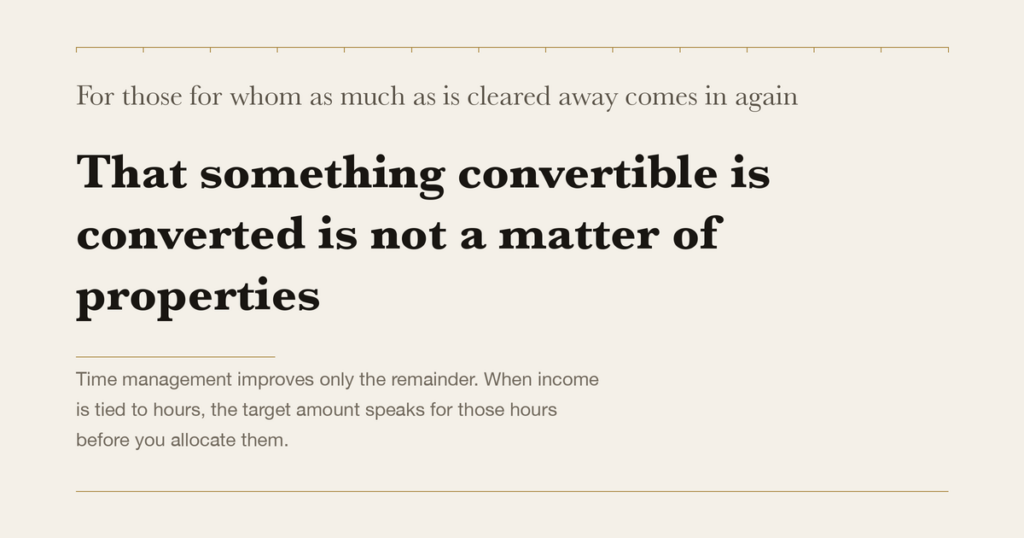
What is dropped here is the question of what is producing the room to expand into. In a structure where time is spoken for as the thing being sold, an open slot exists at all times as a convertible resource. That something convertible is converted is not a matter of properties. It is that the route is open.
How Busyness Increases While the Volume of Work Stays the Same
There is another phenomenon that management technique explains poorly: the volume of work being handled has not changed, and the busyness alone increases.
This phenomenon can appear after the unit price has risen.
Raise the unit price and the job count needed for the same income falls. Fewer jobs, so time opens — that is the prediction, and in practice it can fail to hold. Work at a high unit price demands judgement to match the price.
Concretely: the number of confirmations rises. The stages of proposal rise. Expectations on the other side being high, the range that can proceed without confirming narrows. The hours of execution have fallen, and the number of judgements has risen.
Judgement, unlike execution, does not accumulate. Even for judgements of the same kind, a different job means different premises, so it is built again from the start. And judgement runs during the hours in which it is not being executed. Thinking while travelling, thinking before sleep, thinking while doing another task. This time leaves no record.
Get used to it and judgement gets faster, surely — it does get faster. What is gained by the speed, however, goes into the complexity of jobs that can be handled. As judgement gets faster, more complex work can be taken on, and complex work carries a higher total number of judgements. The result is that judgement time per job falls and the total number of judgements rises.
This phenomenon does not occur in formats of work where judgement is not demanded. Where the procedure is fixed and only execution is required, unit price and judgement volume are not tied. Put the other way, the act of raising the unit price raises judgement volume where the height of the price is payment for judgement.
The increase in busyness occurs in a form that leaves no record. Making time visible measures the time in execution. Time in judgement is not measured. So a discrepancy appears: on the record the working hours have fallen, and the sensation is one of pressure.
This discrepancy tends to be processed by doubting the sensation, records being taken as objective and sensation as subjective. In this case, however, what is discrepant is not the sensation but the range of the measurement. A tool measuring execution time alone displays a state of rising judgement time as improvement.
And there is one stage further. Judgement time is drawn from the side of rest.
Execution time has a beginning and an end. Stop the task and it stops. Judgement has no such break. It runs while travelling, while eating, before sleep. So time that is rest on the record becomes, in fact, an extension of work.
This extension appears neither in labour statistics nor in your own records. What appears is only the outcome: having rested and not recovered. And a state of not having recovered tends to be explained as a matter of stamina or sleep quality. In fact what is unmeasured is simply working, but what is not measured does not come up as a candidate explanation.
Judgement continuing to run, and attention being broken into fragments that do not return, are separate axes. The latter arises from the side of messages and notifications, and is handled in The order for getting out of a way of working with no time of your own.
The Moment a Description of Structure Becomes a Description of Character
Time spoken for in advance, the route by which openings fill with hours worked, judgement moving outside the records — all of it sits outside the person. Yet the explanation people actually adopt tends to be placed inside the person. This shift has a distinct route.
The starting point is a description of state. There is not enough time now. This is a report of the outward, shaped so as to change if conditions change.
At the first stage, causes are sought. Among the candidate causes, only the one on your own side can be verified immediately. Verifying the structural side requires changing the format of the business, which is not something that can be tried from tomorrow. Your own side can be tried from tomorrow. A difference in verifiability biases the choice of explanation.
At the second stage, the response tried works partially. That it worked is read as evidence supporting the explanation that the cause lay on your side. In fact all that occurred may be the allocation of the remainder improved, and as evidence it has the same shape, so the two cannot be told apart.
At the third stage, the effect diminishes. Here, the explanation that the cause lies on your side having already been adopted, the diminishing is read as a shortfall on your side. It turns into the description I am poor at using time.
At the fourth stage, the description becomes a property. Poor at it is an expression allowing room for improvement, but let the same state continue for years and it turns into the kind of person I am. With poor at it a corrective move still follows; with the kind of person I am nothing follows.
That there genuinely are parts where your own management is poor, is correct. And they may be treated as fact. What is said is not that you are not poor at it, but that poorness alone does not account for the quantity of the pressure.
Suppose management were made perfect. Waste at zero, gaps used down to the last. Would the time spoken for have decreased? It would not. The relation by which the target amount decides required hours holds independently of skill at management.
Once described as a property, the work of checking stops. A property being treated as unchanging, it is not re-confirmed even when conditions change. The unit price rises, the composition of jobs changes, and the verdict I am poor at using time remains as it was. And the remaining verdict becomes an input to the next judgement. When deciding whether to try a new format, the premise I am poor at management anyway enters first.
Motivation has not dropped. What has dropped is how often the measuring gets redone.
This route itself has a range within which it holds. That the four stages were passed through is not proof that the cause lay on the structural side. The same route is travelled by someone whose organisation genuinely was the cause. It works, it diminishes, it turns into a description of a property — that far the shape is identical. What separates them is only the measurement of the quantity of time spoken for. What this section can show goes as far as one point: that once description as a property sets, measuring again is not carried out. It is not the claim that measuring again would produce a different answer.
Not Clearing Time, but Cutting It Loose
The quantity spoken for moves only when the rate of exchange sitting between income and time is cut. Once time is no longer the thing being sold, the target amount does not decide required hours.
This sounds abstract, and the verdict can be reached concretely. If today were worked at zero, would this month’s income change? That single point is what is looked at.
If the full amount changes, the income is entirely tied to time. If a portion changes, only that proportion is tied. The size of the part that does not change is the quantity that has been cut loose.
That cutting loose requires both capital and time, and that the difficulty is precisely the absence of time now, is a correct point — and the most troublesome part of this structure. The work of getting out of a state in which time is spoken for can only come out of time that is not spoken for. The greater the pressure, the harder it is to get out.
So an order is required. Not cutting loose first, but first producing time that is not spoken for. And what can be used for that is the management technique.
Here the position of management technique changes. As a means of solving the pressure itself it does not work; as a means of producing the funds to begin cutting loose, it does. The same technique carries a different meaning according to where the end is placed.
What has to be stacked for the rate of exchange to break, and how that format is built, is set out in Getting out of the labour-intensive form. What can be settled on this side is counting, before beginning, what proportion is currently tied. Start stacking without having counted, and whether anything has moved cannot be judged afterwards.
In the transitional period both are done. Drop the existing hours and income falls, so the new format is stacked without dropping them. During this period time is under more pressure than now. And the length of the period changes with the present proportion of hours worked and the character of what is being stacked.
Busyness can remain after cutting loose. Even once time is no longer the thing being sold, the volume of judgement may not fall, since judgement runs separately from execution. At this point a verdict of cut loose and no easier is issued, and this does not mean the cutting loose failed.
The two separate once they are counted apart. Look at the composition of the busyness, divided into hours worked and judgement. If hours worked have fallen and judgement remains, the cutting loose is working and what remains is a separate problem. If hours worked have not fallen, the cutting loose is not yet working as quantity. The two look the same by sensation, so they cannot be distinguished unless counted separately.
Read the Progress by Amount, Ceiling, and Volume of Judgement
There are three readings. No specific figures are given, because their meaning changes with the stage and format of the business, and to hand over a figure would be to make the judgement in your place.
First, look at the income of a day with zero hours worked. It reads, as a figure, the verdict of whether this month’s income would change if you did no work at all today. If this figure is rising, the cutting loose is progressing. If it sits where it was, the cutting loose is still stuck on the side of form.
This figure does not move in step with the feeling of pressure as that feeling thins. The sensation falls with familiarity, so a verdict of easier than before is issued while the state itself continues. The figure does not take that verdict in.
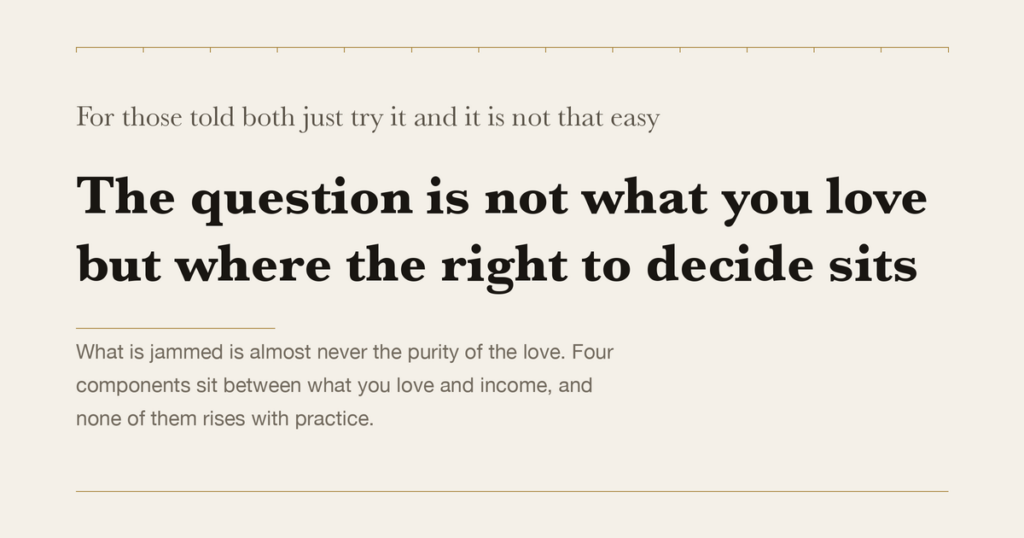
Second, look at whether the position at which to stop has been decided.
Can you write, at the start of the month, how much has to come in before you stop? If you can, the target holds an attained state. If you cannot, that target has no ceiling, and what opens flows to hours worked every time.
This is not a question of the size of the figure. The same amount sends the slack somewhere different according to whether it is placed as a ceiling or as a floor. What to doubt when it cannot be written is not the will but the composition of the income. Where the unit price is set by the going rate on the other side and only the job count can be adjusted, the material for writing a ceiling is not in your hands.
Third, look at the volume of judgement running outside the record.
Even where execution time is recorded, judgement is seldom recorded. Count, for one week only, the number of times work was thought about while travelling, while eating, before sleep, and a gap opens against the record of execution time. If that gap is narrowing, the cutting loose has reached as far as the side of rest. If execution time alone has fallen and the gap has widened, the shape of the work has changed while judgement runs at the same volume as before. At that point the sensation of no easier is the accurate one.
The three are drawn at different intervals. The first is enough once at the end of the month. The second once at the start of the month, and the third only before and after a change of format. The intervals differ because the speeds at which they move differ. And all three, so long as the records remain, can be read back afterwards. The feeling of pressure does not remain, so when conditions change there is nothing to compare it against.
That no outline comes out at the end of the day is not necessarily a matter of memory. Time that has been spoken for contains no act of deciding its use in the first place. The use was decided at the start of the month, so no occasion of deciding arises on the day itself. Where days without an outline continue, that can be read as a report on the proportion spoken for.
With that said, the technique of management and the format of the income are not opposed. One decides how the remaining time is used; the other decides the quantity that remains. Run only one of the two and what is working looks as though it is not, or the reverse. Once the two can be counted separately, the same pressure becomes readable as information in two layers.
What this analysis hands over is not the next move. Continuing in the present format is also a choice, once the proportion has been counted. Choosing while knowing the proportion spoken for, and continuing without knowing it, differ in substance even where they look identical from outside. Make one day of zero hours worked this month, and see how much the income moves on that day. That is where reading opens from.
How the ceiling is built into the format itself is handled in Getting out of the labour-intensive form, and what is called the rate of exchange here, seen from the side of a concrete figure — the unit price — is handled in Raising your hourly rate does not make you free. The phenomenon of efficiency being filled, dissected from the side of productivity, is in Why raising productivity does not leave you with free time.