When an explanation fails to land, something usually comes back. You get asked again. You get asked for the same thing in different words. The conversation stalls partway. Each of these is a signal reporting that nothing arrived.
The hard case is the one where no signal comes back. The other party nods, no question arrives, and the occasion closes having apparently worked. Yet the content received differs from the content you handed over.
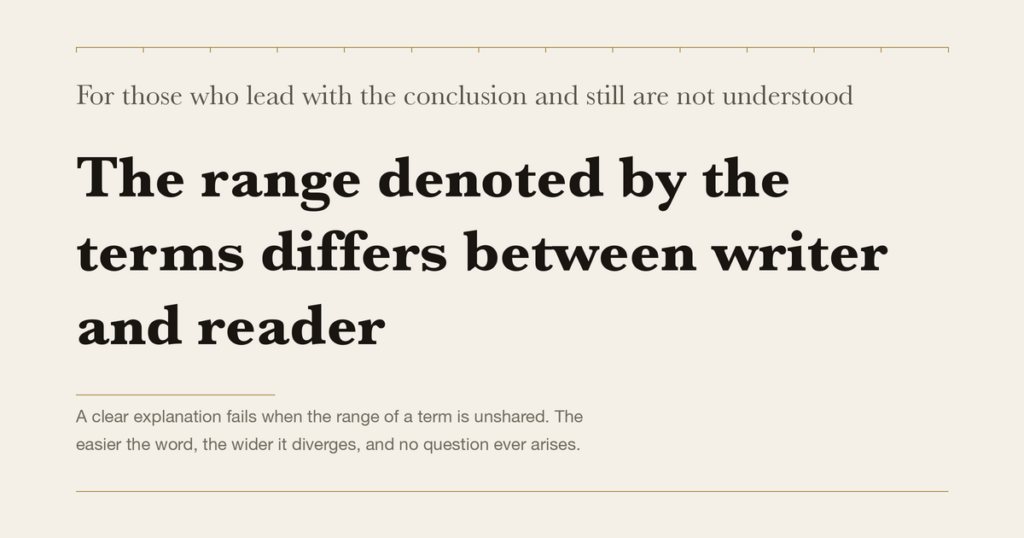
There is one condition under which this state arises. The range denoted by the terms you used inside the explanation differs between writer and reader. The reader is able to read the term in the meaning they already hold, so the sensation of not understanding never occurs. It not occurring, no question arrives either.
What gets shared as the way to improve at explanation is a set of prescriptions: lead with the conclusion, choose terms suited to the other party, cut the quantity of information. All three work, and all three genuinely lower the listener’s load. What all three leave untouched is the divergence of range. And the second of them — simplifying the words — works, because easy words differ in range from person to person, on the side of widening that divergence. Fix the sequence, simplify the words, and if the range stays different, the reader receives content that has been organised and made easy — in a meaning other than yours.
Three things get resolved from here on. First, why a writer cannot notice, unaided, that they forgot to hand over a range. Second, why easier terms produce the wider divergence of range. Third, what a single inversion — placing the definition first — removes from the length of an explanation.
What this piece does not hold answers to is worth stating first as well. How many definitions to place, how many characters a sentence should run to, how finely the steps should be cut. No figures get handed over for these. All three move with the complexity of the subject in hand and with how many premises the reader already carries.
A divergence of range does not appear as a loss at the time. What appears, later, is a request whose content differs from what was assumed, a conversation that fails to mesh, an expectation that turns out to have been for something else. By the time you are there, the fact that the cause sat in the first sentence can no longer be traced. The earlier a divergence occurs, the later it surfaces.
And an explanation that did not work gets attributed, as a rule, to something other than the explanation. The other party’s comprehension was lacking. My own delivery was poor. The fit was wrong. None of these attributions can be checked. Not being checkable, the same place diverges in the next explanation too.
The technique of explanation is not thereby made useless. Sequence, vocabulary, and quantity operate at a different layer, and each of them works. What gets handled here is the one layer that survives carrying out all three.
📖 Contents
- The Way to Improve at Explanation Comes Organised Into Seven Items
- Fixing the Sequence Still Leaves Things That Fail to Get Through
- The Side That Knows Cannot Estimate the State of the Side That Does Not
- The Easier the Term, the More Its Range Varies Between People
- Define Before Using — Invert a Single Step
- A Definition Is Not the Meaning of a Word but Its Range in the Piece You Are Writing
- Cutting the Quantity of Information and Skipping a Step Are Different Things
- Explanations Run Long Because Definitions Arrive Afterwards
- Washing Out the Places a Discrepancy Arises, Before Publishing
The Way to Improve at Explanation Comes Organised Into Seven Items
What is shared on the practical side fits into roughly seven items.
The first item raised is placing the conclusion or the purpose first. Show at the outset what the discussion is about and what you wish to convey. Begin from the background and the listener listens without knowing what the information is for — that is the observation.
The second is choosing words the other party can understand. Avoid technical terms, remove phrasings that pass only inside the industry. Match the range of the other party’s knowledge — that is the advice.
The third is cutting the quantity of information. There is a limit to what can be processed at once, so do not lay out everything you wish to convey. Assign priorities and cut — that is the procedure.
The fourth is the recommendation to use analogies matched to the other party’s territory. Substitute a field they know well and understanding comes faster — that is the account.
The fifth is repairing missing subjects. A sentence with who does what removed holds up inside the writer’s head and cannot be reconstructed by the reader — that is the observation.
The sixth is the recommendation to use templates. The representative form arranges claim, reason, concrete, and claim again. With a template in hand, the load of assembling while speaking falls.
The seventh sets out methods of practice. Summarise. Speak within a time limit. Review afterwards. Build the habit of confirming whether the sequence held and whether you began from the purpose.
All seven are on target. Place the conclusion first and the listener’s load falls; missing subjects genuinely do occur often. Templates lower the load of assembly reliably. With identical content, a different sequence changes how readily a reader proceeds, and so does the choice of vocabulary. Improvement at this layer works, reliably.
Underneath the seven, one shared way of seeing has been laid down. Explanation is organised as a problem of transmission. The content to be conveyed is already in hand, and the question is how to arrange and express it so that it arrives. A problem of delivery.
Organise it entirely as a matter of delivery and the discussion proceeds on the premise that the content side is already settled. The premise is that what to say has been determined and how to say it is the only remaining task.
In most cases it has not been determined. What the terms in use denote does not hold an outline inside the writer either. Improve only the delivery from that state and something without an outline arrives in good order, and the side it arrives on fills in that outline itself and reads.
This way of seeing also works on the unit by which improvement gets measured. What gets suspected when something failed to land is again the delivery side, and the suspicion gets absorbed into terms denoting a property of the person — communication skill, the way I talk. A problem absorbed into a term for a property turns into a question of practice volume, and at the moment it turns, the divergence of range drops out of what is under examination.
Fixing the Sequence Still Leaves Things That Fail to Get Through
Suppose somebody explains their work as follows.
I support businesses in building systems for acquiring customers. First I analyse the present situation, identify the problem, and design measures suited to it.
It begins from the conclusion. The subjects are present. There are no technical terms. The quantity of information has been cut. Every item on the list of seven is satisfied.
And the listener has received nothing. They cannot receive it because none of the terms in this passage holds a range.
What does acquiring customers denote. Gathering people. Building a state in which enquiries arrive. Not losing the people already arriving. The three are different things called by the same term.
What does system denote. A procedure. A tool. A state that keeps turning without a person operating it.
What does identify the problem consist of. Interviews. Analysis of figures. Comparison.
The listener supplements these from their own experience. An image forms as the result of that supplement, and the sense of having understood arrives. And that image differs from the speaker’s.
A view arises that speaking at greater length would resolve it. It is not a matter of quantity. Lengthen the explanation while keeping the same terms and information alone increases, with the difference in range preserved. The discrepancy widens in proportion to the detail. What diverged across ten minutes of explanation diverges across three times the volume in thirty.
There is a line around what needs handling. Not every term requires a range. Most everyday words do not affect the discussion when they slip somewhat. What requires handling is only the terms on whose range the success of the claim depends. In the sentence describing support for building customer acquisition systems, that is acquiring customers and system; support is a term that may be left alone.
Explanations of this kind survive a long time because they feel successful on the speaker’s side. The other party nods, and no questions arrive. The sensation of not understanding has not occurred, so the occasion for confirmation never comes.
The response not being bad, no need for correction is recognised either. The same explanation gets used many times, with a different image built inside the other party on each occasion. The more the count rises, the more that explanation sets inside you. A set explanation moves to the position furthest from anything under examination.
There is one route by which this does get detected, exceptionally: the moment the other party restates it in their own words. So you mean you handle the customer acquisition on their behalf? — the instant that comes back, the gap between your range and theirs is out in the open. This being an operation on their side, however, you cannot initiate it. What you can initiate is handing over the range in advance, in a form where the gap shows without anyone taking the trouble to restate.
The Side That Knows Cannot Estimate the State of the Side That Does Not
Why does definition get skipped. The structure is not deliberate omission but an inability to notice that omission is occurring.
A person holding information cannot accurately estimate the state of a person who does not hold it. This is called the curse of knowledge, and Camerer and colleagues formalised it in 1989 in the context of economic experiments (Camerer, Loewenstein & Weber, 1989, Journal of Political Economy, 97(5), 1232–1254). Subjects who had been given information produced predictions of an uninformed party’s judgement that were dragged towards the information they themselves held.
This experiment measured predictions of judgement in a setting modelled on market trading, not whether an explanation got through. What it indicated is the direction in which excluding your own information from a calculation is difficult independently of intent.
There is also an experiment that measured transmission itself. Keysar and Henly, in 2002, had speakers utter sentences readable two ways while intending one of the two meanings (Keysar & Henly, 2002, Psychological Science, 13(3), 207–212). Listeners were then asked which meaning they took, and speakers were asked to estimate whether their intent had come across. The speakers’ estimates ran higher than the proportion that actually came across. What went wrong was not capacity but a single thing: being unable to exclude your own intent from the calculation.
What was measured is ambiguity at the level of one sentence, not the composition of a whole explanation. What it indicated is the direction in which a speaker cannot occupy the position from which the success of their own transmission gets judged.
Inside the speaker’s head, only the intended meaning is sounding. The very fact that the sentence reads two ways does not appear there. What reaches the listener is the side of the sentence that reads two ways.
What occurs in explanation is the same arrangement. Inside the writer’s head, the range the term denotes exists with an outline. Placing the term therefore feels as though the range arrives along with it. What arrives is the term.
A view arises that care would prevent it. The curse of knowledge does not resolve in the form of forgetting what you know, because a thing once known cannot be returned to a state of not being known. Care shrinks it somewhat, and introspection on the writer’s side does not make it disappear.
What does resolve it is inserting a procedure mechanically. It gets handled not as introspection but as an operation performed on what has been written. An operation does not depend on how much attention you have that day.
The estimate does not go wrong entirely. The quantity of the other party’s knowledge can be guessed to some degree from experience. What goes wrong concerns the range that has become self-evident to you. Which is to say that what goes wrong most readily is the centre of your own speciality.
This arrangement has a direction in which it worsens as experience accumulates. The more somebody is described as good at explaining, the more prone they are to this problem, because long experience of explaining means long familiarity with the terms. The more familiar the term, the more the motive to confirm its range is lost.
Familiar terms sit at the centre of the explanation, being the concepts most often handled in that territory. The terms whose estimation goes most wrong coincide with the terms that most support the claim. The peripheral terms get confirmed and only the central ones pass through unchecked, which inverts the order you would want.
The Easier the Term, the More Its Range Varies Between People
The prescription avoid technical terms and use easy words has a limit.
Easy words are used by many people. Being used by many people means having been used in many contexts and in many meanings.
Value. Essence. Strategy. Design. System. Experience. All of them are easy words, and the range each denotes differs between people.
Technical terms have an aspect that makes this less likely. A reader who meets a term they do not know becomes aware of not knowing it. Aware of it, they look it up, ask, or attempt to infer it from context. In every case, an operation that fixes the range occurs.
With easy words, this operation does not occur. The term being known, the reader proceeds in the meaning they hold. There is no room for confirmation to enter.
Suppose a sentence reads this offering provides essential value. The reader does not stop. Ask ten people what they received from that sentence, however, and the chance of ten matching answers is low.
Lean towards preferring technical terms instead and the same thing happens on the other side. What should be used are terms whose range has been fixed. Use a technical term without defining it and the same problem occurs. What separates the two cases is not difficulty; it is whether a range has been supplied inside that piece of writing.
Nor does every abstract word need avoiding. An abstract word has the function of denoting several concretes at once. Where that function is wanted, it gets used after the range it gathers has been shown. Shown first, an abstract word operates as compression.
There is a further distinction. A reader who meets a term they do not know treats that term as the centre of the claim. Terms they do know get passed over. Which is to say that a claim written in easy words is sometimes read past without being recognised as a claim.
The passage reading essential value does not draw the reader’s attention. Not drawing it, it passes through even when the writer’s claim sits inside it. The cause of a claim failing to arrive lies on the side of easiness rather than difficulty.
And the work of rewriting in easier terms often conceals the problem of range. Replace a difficult word with an easy one and the motive to confirm falls by exactly the amount readability rose. The inversion occurs in which the easier piece of writing is the one whose discrepancies are harder to detect.
This inversion points the opposite way to the feedback you get from rewriting. What comes back when you make something easier is this reads better, and that is a real event. The loss of detection power that occurred at the same moment does not come back as a response.
Define Before Using — Invert a Single Step
The prescription is simple. For the terms supporting the claim inside that piece of writing, place a range before using them.
The form does not matter. One sentence suffices. What is called acquiring customers here is an increase in the number of people this side can make contact with. That alone gives every subsequent appearance of acquiring customers a range.
What is doing the work is the order. Place the definition first and argue after. Reverse it and the reader first reads an argument assembled out of terms whose range is unfixed, then gets told the range afterwards. At that point the reader must correct an understanding already assembled in their own meaning, and in most cases the correction does not happen.
Adjudicating which terms to define is easy. Swap the meaning of the term for something else and see whether the claim changes. If it changes, a definition is required. If it does not, the term may be left alone.
In the customer-acquisition example, swapping acquiring customers from gathering people to building a state in which enquiries arrive changes everything that follows. A definition is therefore required. Support leaves the claim unchanged when its meaning slips somewhat. It is therefore unnecessary.
A worry arises that beginning from definitions would make the explanation stiff. Write in the manner of a dictionary and it becomes stiff. Use instead the form what is meant here by or this is being used in the sense of, and it enters naturally even in speech. Stiffness is a matter of form, not a matter of definition itself.
The number of definitions has a limit too. Line up definition after definition inside a single explanation and the reader enters the work of memorising definitions and can no longer follow the argument. What gets defined is the few terms supporting the claim. When you want to add more, look first at the possibility that the explanation contains two claims.
And the position for placing a definition is not necessarily the opening. It is immediately before the first use of that term. Handed over at the point where it becomes necessary, the reader can receive it as information.
Attempting to define sometimes reveals that you cannot. This is the case where what you were denoting by that term was not settled inside you either. That is not a fault in the explanation but an indication that the content side was unsettled. What has been found is a problem that was hidden.
This manner of finding has an advantage. Being unsettled is not ordinarily visible from a finished piece of writing, because the writing itself is complete. It surfaces, in the form of not being able to write, only at the moment of attempting to write the definition. And the result that nothing settled is itself information: it shows that you do not yet hold a position on that term.
A Definition Is Not the Meaning of a Word but Its Range in the Piece You Are Writing
A misunderstanding travels with the term definition. It tends to be received as showing the correct meaning, which it is not.
What is required is a declaration of how that term is used inside this piece of writing. Not what it means in general.
In one piece of writing the term strategy is used as settling what will not be done, and in another as the route to a goal. Neither is wrong. What is required is that the reader knows which of the two is in use here.
This distinction works because it avoids entering an argument about correctness. The argument the correct meaning of that term is such and such does not settle. The declaration in this piece of writing it is used this way is neither correct nor incorrect.
As a result, load drops out of the work of defining. There is no need to consult a dictionary and no need to cite an authority. Writing how you use it suffices.
The worry that using a term differently from its general meaning would cause confusion carries a condition. Where the divergence is large, it would, and there the difference from the general meaning gets stated explicitly. It generally denotes such and such; here it is used in a restricted sense. Show the difference and the reader can suspend the meaning they hold.
The meaning of an already established term cannot be changed without notice. Change it and the reader receives different content. It may be changed only where the change has been made explicit. A redefinition without notice holds up inside that piece of writing while becoming a different piece of writing on the reader’s side.
A further advantage is that the reader becomes able to disagree. Shown in this piece of writing it is used this way, the reader can accept that range and then judge whether they agree with the conclusion.
Without a range shown, this judgement cannot be made, because neither agreement nor objection has a fixed object. A definition is also the footing from which a reader hands down a judgement.
Put the other way round, writing that shows no range strips the reader of any purchase for objecting. A claim left ambiguous can be neither agreed with nor opposed. What remains is the sensation of having been vaguely convinced.
Place definitions in this form and your own habits of usage become visible too. It gets found that the same term was used with a different range in the first half and the second half. This is a fault the reader cannot detect, and it surfaces only when the definition is written. From the reader’s side it registers as nothing more than the discussion subtly failing to mesh in the later part.
Cutting the Quantity of Information and Skipping a Step Are Different Things
The advice to cut the quantity of information works when used correctly and works in reverse when mistaken.
What may be cut is information not participating in the argument. Background, surrounding circumstances, the fine detail of exceptions. Remove these and the route of the claim remains.
What must not be cut are the steps. In the sequence A therefore B, B therefore C, this is the form that skips B and jumps from A to C. The steps most self-evident to the writer are the ones that get skipped.
Suppose you write the reason enquiries do not arrive despite continued publishing is that you hold no list. Inside the writer there are steps in between. Publishing has its range of reach settled on the side of the venue. Without the range of reach on your own side, contact cannot be made when it is needed. Without contact, you are not recalled at the moment the other party needs you. These three steps have been omitted.
Omitted, they arrive at the reader as a leap. And a leap is processed either as an objection or as something to ignore. It is seldom accepted.
A worry arises that writing every step out would make things too long. Adding steps does add that much length. What makes the whole long, however, is often the parts other than the steps. Cut the surrounding explanation, the preamble, and the repetition, and writing every step out does not increase the quantity.
A step can be written in one sentence. Without the range of reach on your own side, contact cannot be made when it is needed. One sentence per step suffices, so three steps take three sentences. What makes things long is not the steps but the explanation attached around them.
Steps the reader already holds need not be written. With somebody working in the same territory, some steps are self-evident. The adjudication is made on whether people who do not hold that step will read this piece of writing.
There is a marker that assists the adjudication: passages joined by in other words, in short, and which is precisely why. These connectives sometimes present the appearance of a step while the writing has in fact jumped. Whether a connective is standing in for a step can be seen by deleting the word. If it no longer joins up once deleted, a step has been omitted. A connective is a sign indicating the presence of a step, not the step itself.
Writing the steps out also reveals that your own claim is short of steps. The jump from A to C was not an omission but a consequence of not holding B. Here the problem is not one of explanation: the claim side was unfinished.
The two cannot be distinguished by symptom. Both get read as the explanation jumps. The distinction becomes available only when the writer actually attempts to write B. If it can be written, it was an omission; if not, the claim was unfinished.
Explanations Run Long Because Definitions Arrive Afterwards
The cause of a long explanation frequently lies in the sequence rather than the quantity.
Begin arguing without placing a definition and explanation becomes necessary midway. The supplement what is meant here by acquiring customers is in fact gets inserted. A supplement breaks the flow of the argument, so a sentence is required to rejoin what was broken.
The rejoining does not end at one. The same thing happens with other terms, so supplement and rejoining enter repeatedly. As a result, a large part of the explanation gets occupied by supplement and recovery.
Place the definition first and this shuttling disappears. The argument does not break, and no need for supplement arises. In exchange for the few dozen characters spent on a definition, several hundred characters of shuttling are gone.
A worry arises that placing definitions first would bore the reader. Boredom arises where the definition is severed from the claim. Laying out a glossary before entering the subject does indeed give no reason to read on. Place it instead immediately before the first use of the term and the reader receives the definition as necessary information.
Handing it over at the point where it becomes necessary is the crux. Gathering definitions at the opening is the form of a dictionary, not the form of an explanation.
The moment at which the reader needs that term is immediately before its first use. Hand it over there and the definition becomes a tool for reading on rather than a preamble.
A term positioned at the centre of the claim is sometimes better placed at the opening — where the piece of writing as a whole takes the redefinition of that term as its subject. Here the definition is itself the claim, so there is no reason to place it later.
On that basis, the shuttling does not disappear entirely. Unanticipated questions arising on the reader’s side cannot be avoided, and supplements are required there. What disappears is only the shuttling that derives from the writer not having settled a range.
Acquire the habit of placing definitions first and the order of writing changes as well. Before beginning, you end up settling which terms this piece of writing will supply with a range. That work becomes part of the composition, and as a result the time spent hesitating while writing falls.
And not being able to write becomes apparent early. If nothing settles at the stage of settling ranges, that piece of writing is not yet in a state where it can be written. Stopping earlier costs less than pressing on and running aground.
The difference in cost is visible as expenditure. The decision to discard a draft you ran aground on carries resistance proportional to the volume already written. The decision to stop at a stage where not one line exists carries none of that resistance.
There is a price as well. Settling ranges first cuts away the room to think while writing. In the kinds of writing where the subject moves as you go, that room is sometimes the thing you need. What separates the two cases is whether the piece hands over a judgement or records an exploration. To hand over a judgement, the ranges must have been settled beforehand.
Washing Out the Places a Discrepancy Arises, Before Publishing
Three hands are available. The first and second take little time with the draft in front of you.
The first confirmation is to pick three terms supporting the claim and see whether each has been supplied with a range.
Those that have not are candidates for discrepancy. Not all of them require one, but for the terms left unsupplied you can confirm how the claim changes if the reader reads them in a different meaning. If it changes, place a range.
The second confirmation is to write out the sequence of claims in the form A therefore B, with numbers.
The places where numbers jump are the omitted steps. The passages you thought self-evident while writing them out are precisely the ones that become objects of confirmation, since feeling something to be self-evident means you already know it.
The third confirmation is to have somebody outside the territory read the explanation and summarise the content.
Do not ask for impressions; ask for a summary. Impressions end at it was easy to follow, whereas a summary exhibits what was received. Where the summary differs from your intent, the term at which the discrepancy occurred can be identified.
Skill of expression enters none of the three. A discrepancy is not a problem of expression but a problem of range and steps.
There is a range the three do not reach. The third requires another person, and the first and second retain a part that depends on your own introspection, because there is a principled upper bound on the work of doubting, by yourself, the passages you felt to be self-evident. One hand lowers that bound: rereading after an interval. Immediately after writing, the content is still sounding inside your head. Leave it for a few days and the sounding weakens, and only what was written remains.
So how many definitions, how many characters to a sentence, how finely to cut the steps? These questions get no answer here. They vary with the complexity of the subject being handled and with the quantity of premises the reader already holds. Handing over a figure would settle that allocation without looking at those conditions.
In a diverged state no questions arrive. No questions arrive because the reader is able to read the term in their own meaning, and they can do so because the range of that term exists only inside the writer’s head. The side that knows cannot estimate the side that does not; the easier the term, the more its range splits; and the later the definition sits, the more shuttling accumulates. The three are not separate matters. They are separate appearances of one thing: where the range has been placed.
The question to put to the range side is therefore one, and one is enough. If the reader read this term in a different meaning, would the claim change? If it would, that is where the range goes.
The method of bridging to the reader’s memory to hand over a range is treated in the technique of analogy, and the method of presenting your own experience in a form that carries a range in how to write primary information. How an explanation gets arranged as a whole piece is taken up by the principles of article structure. Where the range of a word gets placed is settled when the distinction is already at hand first. Which stage of the work handing over a range belongs to is treated in the technique of verbalisation.