This month’s payments are fine. Next month’s outlook is roughly in place. Even so, what gets thought about on waking in the middle of the night is always the same thing.
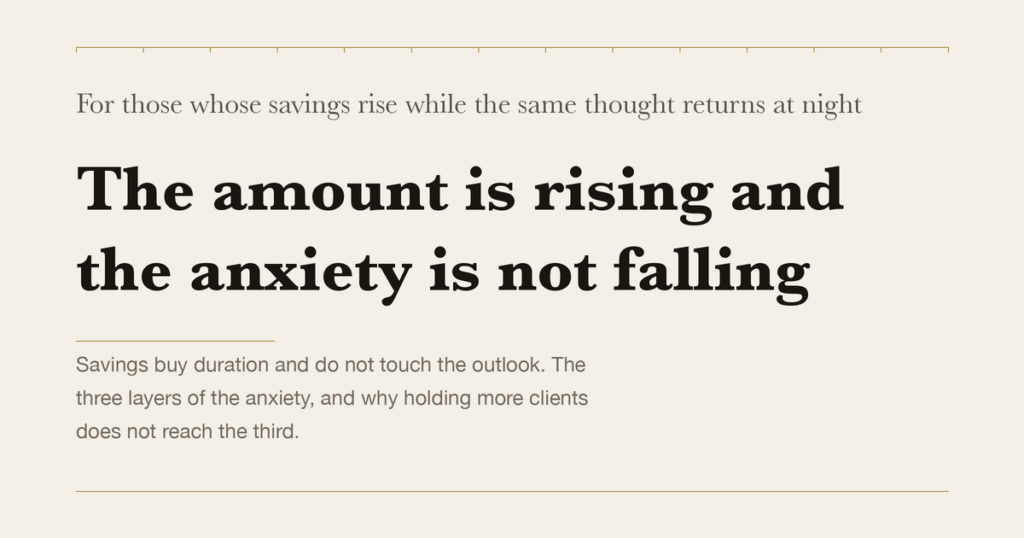
And with savings past one million, past three million, that thought remains in the same shape. The amount is rising and it is not falling. This is the strangest thing about the symptom.
Answers to this symptom already exist. The responses that come up in a search fall roughly into three directions: put money by, spread the risk, prepare for later. And as practical advice they are accurate. What most of them answer is the question of how long you can hold out when income stops. The time you can hold out extends in proportion to what has been put by, and there is no room for doubt about that.
The thought in the middle of the night, though, is usually not that question. It is not I will be unable to live but I do not know what next month will be. And the latter does not change shape however much is put by. The time you can hold out extends, and the property of next month not being settled remains exactly as it was. A target that is revised upward — three million, then five, then a full year of expenses — is one of the shapes this mismatch takes when it surfaces.
This is why the symptom does not decrease while the responses continue. What is being moved is the amount, and what produces the symptom is the settledness. They are separate variables, so moving the amount does not mean the settledness moves in the same direction. And what sets the settledness is a single point: whose judgement settles next month’s income. Where an order comes first, that judgement does not sit on your side. The amount rises and the position of the judgement has not moved.
What follows first separates what the standard resolutions tell on from what they do not. Then it looks at the state of anxiety itself from the side of uncertainty, and takes out what keeps that state in place. On that basis it divides the symptom into three layers — duration, outlook, and the position of the origin — and goes as far as judging which layer you are currently jammed at.
This applies to someone for whom some duration is already secured. With savings at zero and next month’s living costs themselves not covered, what is needed first is not the judging of layers but the duration itself. In order, that comes first.
Methods for increasing the amount are not covered. Negotiating rates, winning work: both are already covered in detail elsewhere. What is looked at here is the side of what remains after all of that has been done. If something does remain, it is not because the responses were insufficient.
📖 Contents
- What Gets Listed as a Remedy, and Where Each One Lands
- What Savings Reduce and What They Do Not
- At the Core of the Anxiety Is Uncertainty, Not the Amount
- What Tells Is Not the Width of the Variation but Whether It Can Be Controlled
- Dividing the Freelancer’s Anxiety into Three Layers
- The Structure in Which Every Commissioning Decision Sits on Their Side
- Spreading Works on the First and Second Layers, Not the Third
- The Condition Under Which Anxiety Falls Is the Position of the Origin, Not the Amount
- Whose Decision Settles Next Month’s Income
What Gets Listed as a Remedy, and Where Each One Lands
Search for freelance anxiety and a list of anxieties comes up first. Unstable income, work drying up, skills going out of date, everything stopping if health fails, no provision for later life.
Then the resolutions follow. Draw up a plan for the future, increase savings, start investing, hold several clients, make occasions to talk to people. Some articles finish by offering staffing agencies as an option.
The writers are publications whose business is brokering work or supplying staff. So the terminus of the resolutions being a stable supply of work is natural.
And these resolutions do work. What they work on, though, is fixed.
Savings raise the capacity to get through a month with no payment in. More clients make the blow of one being cut smaller. Investment tells on long-term asset formation. All are practically correct responses.
Yet it is rare for someone who has done all of them to say the anxiety has gone. If anything, the story often heard is that the more the savings grow, the more the thought even this may not be enough appears.
The response is working and the symptom is not decreasing. When this shape is observed, what to suspect is not the quantity of the response but what the response is hitting.
And this state carries a particular wear. Because the responses are being carried out, there is an awareness of doing what should be done. So the explanation for the lack of decrease leans towards your own side. You worry too much; it is your temperament.
The list articles reinforce this reading, because the resolutions end with items like try not to overthink and talk to people. The items up to there are structural responses and only the last is a matter of state of mind. There is no reason anywhere to think that what structural responses failed to shift would shift with a state of mind. Yet the ordering of the list does not show that discontinuity.
The list shares a premise: that the cause of the anxiety is the variability of income. So the responses run in two directions — reduce the variability, or increase the capacity to withstand it.
The writer’s position is reflected in this premise. Seen from a business supplying work, variability appears as a break in supply. So stabilising supply becomes the solution. From the supplying side, that solution is accurate.
Supply becoming stable, though, also means dependence on the supplier deepening. A state in which work from one company fills the schedule is minimal in variability and maximal in dependence. Small variability and deep dependence move in the same direction.
So the list of resolutions holds items pointing in different directions. Holding several clients and obtaining a stable supply face opposite ways when seen from the side of dependence. Both appear on the list, and they cannot be maximised at once.
What Savings Reduce and What They Do Not
Let me divide what actually changes when savings increase.
Something changes. Whether life can continue through a month with zero coming in. This changes plainly. Three months’ worth gives three months, a year’s worth gives a year, and life continues without income.
There is no doubting this. Savings buy duration for when things break off.
Something does not change. The outlook on whether money will come in next month. With three million saved, a state in which next month’s work is unsettled is the same as with zero saved. The duration has lengthened; the outlook has not moved a millimetre.
And what gets thought about in the middle of the night is generally the latter, the outlook.
This distinction explains why the response does not mesh. Savings tell on duration and not on outlook. The response is being piled onto something it does not hit, so however much is piled, the symptom does not decrease.
And the fact of its not decreasing is generally read as the amount is still short. If three million does not do it, five; if five does not, a year’s worth. The monetary target gets revised upwards.
The continuing upward revision is itself a sign that the object has been missed. A response that hits should tell in proportion to its quantity.
Savings have a side effect too. During the period of building them, that money cannot be used for anything else — in particular, not for the time or the cost of building a route that reaches. The relation holds in which a strong method of improving the outlook is postponed by a response that does not touch the outlook.
The other responses take the same shape.
Raising skill. This slightly raises the probability of winning work and does nothing to whether commissioning occurs. Investment. This tells on assets over a decade and not at all on next month’s outlook. Making occasions to talk to people. This tells on isolation and not on payments in.
Of the responses on the list, the only one that moves the side of the outlook is increasing the number of clients. And that too has a limited range in which it can move.
The list, in other words, is ample in the number of responses and skewed in what it hits. The number being large, there is always something to do. There always being something to do, the occasion to notice the miss never comes.
This is not a claim that savings are unnecessary. Without duration, the time to build a route that reaches people cannot be taken at all. They are necessary. What is necessary and what reaches the symptom, though, are separate things.
At the Core of the Anxiety Is Uncertainty, Not the Amount
Anxiety and fear are often treated as one thing, and the character of their objects differs. Fear has a definite object. Anxiety has an unsettled future.
A review in neuroscience organising this difference appeared in 2013 (Grupe & Nitschke, 2013, Nature Reviews Neuroscience, 14(7), 488–501). At the centre of it is the account that what constitutes the core of anxiety is a response to uncertainty. A state in which what will happen is unknown, and in which preparation is not possible, sustains anxiety.
Apply this view and the freelance state is well explained.
For an employee, next month’s income is known. Large or small aside, it is known — that is the difference. So even where living on that amount is hard, it is experienced as dissatisfaction rather than anxiety. Dissatisfaction and anxiety are different things.
For a freelancer, next month’s amount is unknown. Not large or small, but unsettled. And the unsettled state continues whatever the amount.
One consequence follows. Average income rising does not lower the uncertainty. Whether monthly income goes from three hundred thousand to a million, the property of next month being unsettled is the same. So someone whose income has risen greatly can say the anxiety is unchanged.
This is not a luxury of a complaint. The variable is a different one, so it has simply not moved. What rose was the amount; what has not moved is the settledness.
And the general resolutions are almost all responses to the amount. Savings, investment, rate negotiation all move the side of the amount. Almost nothing on the list moves settledness.
And these two variables can move in opposite directions.
Higher-rate work generally comes in fewer pieces, so the weight of each is larger. A state in which seven tenths of monthly income comes from one piece is good as an amount and bad as settledness. If that piece does not come, seven tenths disappear.
So the further a response raising the amount is pushed, the more settledness can fall. The premise that both improve at once does not hold in the first place.
Without seeing this relation, judgement becomes hard. The experience of raising the rate and still not settling is not a matter of feeling. It is an accurate observation that one variable improved and the other worsened.
What Tells Is Not the Width of the Variation but Whether It Can Be Controlled
Within uncertainty there is one condition that tells especially: whether the result can be changed by your own behaviour.
Psychology has a classic body of work on this point. In the research on learned helplessness gathered in 1976 (Maier & Seligman, 1976, Journal of Experimental Psychology: General, 105(1), 3–46), it was repeatedly confirmed that with unpleasant stimuli of the same intensity, subsequent behaviour differs greatly between a condition in which one’s own behaviour can stop it and a condition in which nothing stops it. What made the difference was not the strength of the stimulus but controllability.
Transpose this to income.
Income varying does not by itself create anxiety. Even varying, if it can be moved by your behaviour, the variation can be handled as a task. It can be processed in the form this month was low, so next month I will do this.
The trouble starts where the connection between your behaviour and the result is not visible.
This is the state most freelancers are placed in. Whether work comes is settled by their budget, by a transfer of their contact, by their business plan. Whatever is done here, that decision does not move.
Last year there was plenty of work and this year there is little. The reason was neither your skill nor your selling but their budget. Continue this and the connection between behaviour and result is cut.
And in a state where the connection is cut, applying yourself stops telling. Raise the skill, respond faster, and the relation to the result is invisible. Applying yourself with no visible relation becomes hard to sustain.
This is what sits at the centre of freelance anxiety. Not the variation of the amount but the structure in which the causes of the variation are entirely outside you.
And this structure is self-reinforcing.
With the connection between behaviour and result invisible, no judgement about what to do stands. With no judgement standing, practice leans towards the passive one of accepting what comes. Continue passive practice and the result becomes even more unrelated to your behaviour. Feeling more uncertainty than a year ago can be the result of this cycle having advanced.
In this structure, the good months cannot be explained either. In a month with plenty of enquiries, what you did that produced them is unknown. So it cannot be reproduced.
This is a loss easily overlooked. Not only can nothing be learnt from the bad months; nothing can be learnt from the good ones. Observations do not accumulate, so the material for judgement does not grow with the years. Someone in their fifth year sitting inside the same uncertainty as someone in their first is not short of experience; they are in a form that does not convert experience into material.
Dividing the Freelancer’s Anxiety into Three Layers
Organised, the symptom has three layers.
The first layer is duration. When payments break off, how many months can life continue? Savings solve this. It is measurable in figures and the response is clear.
The second layer is outlook. Is it known whether money will come in next month and the month after? Savings do not solve this. Holding work with a long contract term, or agreeing terms for continuation, partly tells.
The third layer is the position of the origin. Is the origin at which income arises on your side or theirs? The form of the contract does not solve this. As long as the shape is one of receiving a commission and handing something over, the origin is on their side.
The three run deeper the further down, and the further down the less the response is spoken about. The general resolutions are mostly for the first layer.
And what tends to remain as a symptom is the third layer. With the first and second satisfied, if the third has not moved, the middle-of-the-night thought remains.
Handling the three mixed under the single word anxiety carries a practical disadvantage. Mixed, which response worked cannot be judged.
Suppose someone increases savings, increases clients, and starts placing something at the same time, and feels a little easier six months later. What worked cannot be known, because three things were moved together.
Knowing, the order of moving can be chosen. If the first is blank, from there. If the first is filled and the symptom remains, on to the second or the third. The layers being separated itself settles what to do next.
Which layer it is divides on the next question. If next month’s payment amount were fixed, would this sensation go?
If it would, it is the second layer. Being a problem of outlook, it can be handled with the form of the contract.
If it would not, it is the third layer, because what was fixed was fixed this once, and the one who fixed it was them. What happens next is again settled by them.
The three layers also differ in the speed of the response.
The first moves in months. Tighten outgoings, accumulate payments, and duration lengthens visibly.
The second depends on the contract. Where continuation terms can be agreed, it can change in weeks. Whether they can be agreed, though, is settled by them.
The third is a matter of years, because what is placed takes time to reach.
This difference in speed distorts the order of starting, because it is natural to begin with what tells fastest. And the first layer can be piled indefinitely, so it becomes possible to stop there.
In sequence it is more advantageous to start one line in the third layer early. What takes time begins to tell earlier the earlier it is begun. Piling the first layer while running one line of the third in parallel is in fact an allocation that keeps waste down.
The Structure in Which Every Commissioning Decision Sits on Their Side
For the third layer, count the judgements involved.
In the form of receiving a commission and handing something over, four decisions are needed for income to arise, and three of them sit on their side.
First, the decision whether to commission. This is entirely theirs.
Second, the decision whom to commission. Also theirs. However high the skill, without being on their list of candidates you are not an object of the decision.
Third, the decision at what figure to commission. Their budget sets the ceiling.
Fourth, the decision whether to accept. Only this sits on your side.
What you hold, then, is a right of refusal alone. And a right of refusal cannot be used in the direction of producing income. Declining is possible; producing an enquiry is not.
This asymmetry is the structure of the anxiety itself. You hold not one operation in the direction of increasing income. What can be done is to accept what comes and to arrange your conduct so that it comes more readily.
There is the answer do some selling. Selling is an act working on the second decision — whom to commission. The probability of getting onto the candidate list can be raised.
Selling does not move the first decision, though. Against a party where no commissioning is occurring at all, selling produces nothing. Sell to a company with no budget and no work is born.
Trying to reduce anxiety inside this structure, what can be done is to raise the accuracy of prediction about their decisions. Grasp their budget cycle, watch the movements of their contacts, read the trade’s conditions. Experienced people do in fact do this.
Raising the accuracy of prediction, however, is not regaining control. To the extent that prediction becomes more accurate, bad outlooks also come into accurate view. This is why higher accuracy does not necessarily reduce anxiety.
The asymmetry of the four decisions changes shape plainly when circumstances such as health or accident enter.
Where illness makes two weeks impossible, even the right of refusal, the one you hold, becomes unusable. The one remaining move disappears too. And the enquiries that would have arisen in those two weeks go to someone else.
This is the fragility peculiar to this form. Hours worked and income ride the same single line, so cut the line and everything stops at once. Savings support the stopped period; they cannot prevent the stopping.
The list item everything stops if health fails points here. The list, though, handles it as a matter of managing health. In fact the structure sits beyond the range that managing health can address. However healthy, as long as hours worked and income ride one line, the line stays single.
Spreading Works on the First and Second Layers, Not the Third
Let me answer the objection. Hold several clients and one being cut does not take the whole to zero. Would this not reduce the anxiety?
This response works on the first and second layers. A state of one client is extremely dangerous, so there is ample reason to increase them.
It does not work on the third layer, though. The reason is simple. With three clients, the origin sits on their side in all three.
Structurally it is the same thing set out three times. The probability of one being cut falls, and all three are dependencies of the same character. And being of the same character also means they can thin at once for the same reason. If conditions worsen, all three cut budgets.
Distribution, then, protects only against individual circumstances. Against a common circumstance, distribution does not tell.
There is a practical side effect too. More clients means more hours worked. Maintaining three requires three sets of correspondence, coordination and invoicing. And to the extent hours rise, time for the work of moving the origin to your side falls.
So this response has a ceiling. Increase them and it becomes safer, and the more they increase the less time there is to change the structure. Past a certain number, safety and freedom of movement face opposite ways.
This inversion appears often in people some years past independence. Clients have increased, the schedule is full, income is stable. And the time available for the work of changing the structure has reached zero. The operation that produced the stability is blocking the exit.
And this state looks fine from outside. As an amount it is in fact fine. So those around say it seems to be going well, and there are no words to answer with. Unable to explain, the reading settles that the sensation is the thing in error.
Distribution has one further ceiling that is hard to see. As the number of clients rises, the weight of each falls, and so does your standing with them.
Concentrated on one, you are an important counterparty to that one. Distributed across five, you are a fifth of a counterparty to each. Negotiations over the figure and discussions of terms pass less readily the smaller the weight.
Distribution, then, lowers the blow when something is cut and lowers the power to keep it from being cut. The two effects facing opposite ways, the relation is not the simple one of more being better.
This is not to say clients should not be increased. It is only that it does not tell on the third layer. It genuinely tells on the first and second, so there is reason to do it. When it has been done and the middle-of-the-night thought does not go, though, the reason for that can be sought here.
The Condition Under Which Anxiety Falls Is the Position of the Origin, Not the Amount
What, then, does moving the third layer consist of?
Moving the origin to your side means holding a line of income that can begin without waiting for a commission.
Make something and leave it in place. Whether to buy is decided by them; whether to make it, when to put it out, and what to charge are decided by you.
In this form three of the four decisions move to you. The decision corresponding to commissioning — what to make and put out — is yours. Who to direct it at is yours. The figure is yours. What they hold is the single decision of whether to buy.
Here the condition of whether behaviour can change the result connects. The connection between behaviour and result becomes visible in this form, because the number placed, the number reached and the number bought line up as functions of your behaviour.
With the connection visible, the quality of the uncertainty changes. The state of not knowing what will happen remains, and it becomes a state in which there are moves available against what is unknown. As the learned-helplessness research showed, what made the difference was not uncertainty itself but controllability.
The word stable does not apply to this form, at least at the start. It is plainly unstable at first. Whether what is placed gets bought is harder to read than a commission.
What changes is whose judgement settles next month’s income. Hard to read as it is, that difficulty arises on your side. It is settled not in their budget meeting but by what you placed.
And this difference grows with time. What is placed remains, so as the number placed rises, part of next month’s payments comes to be settled by your own past behaviour. Your own past behaviour is a settled fact. The larger the share of income occupied by settled facts, the more the side of the outlook changes too.
One further point: the meaning of failure differs in this form.
In the form of receiving commissions, almost no information is obtained from the fact that no enquiry came. The reason sits on their side and is invisible from here.
In the form of placing, the fact of not being bought carries information. Who looked, and where they left, is legible. What missed can be reflected in the next one. The number of misses becomes material as it stands, so failure functions as accumulation.
Time gets used differently as a result. In the form of receiving commissions, observations do not accumulate, so nothing can be learnt from good months or bad. In the form of placing, both can be learnt from. Spend the same year and the quantity of material remaining differs.
Whose Decision Settles Next Month’s Income
Finally, how to check where you are.
The proportion already fixed. Of the expected payments next month, what proportion is already fixed by contract? This measures the second layer. Near zero, and you are jammed at the layer of outlook.
The side that settled it. Who settled that fixed portion? If it is fixed because they decided to commission, the origin is theirs. If it is fixed because something you put out sold, the origin is yours.
The part cut loose from hours worked. How much income arrives next month if you do nothing? Zero, and income is wholly tied to hours worked. Not zero, and that amount is the portion by which the origin has moved to your side.
Not one of the three is about the size of savings. None is about the level of skill. What they ask about is only where the origin of the income sits.
And answering them gives the breakdown of the anxiety. Jammed at the first layer, the second, or the third.
This sensation is not a matter of temperament. It is not from being over-cautious, nor from being a worrier. In a structure where three of the four decisions needed for income to arise sit on their side, there are hardly any moves here that make income arise. Thinking ahead with so few moves available makes anxiety a normal response.
What is called for is not a change in the sensation. It is to build one move. And at the point one move exists, the character of the sensation changes.
The single word anxiety calls two separate variables at once. That the thought stayed in the same shape past one million and past three million saved is not because the amount was short. It is because the savings being put by never once touched the side of settledness. The amount that grew became duration, and duration does not move the position of the origin. While the two go by one word, one of them failing to move can only read as still not enough.
Where the responses that build the amount reached was the first layer. There they told, exactly as intended. The time spent building savings has turned into duration and is still in your hands. What has not gone is the symptom, not what was built. And the three layers are not something to be stacked in order. Piling the first while running one line of the third alongside it is the answer this whole piece arrives at.
The sentence currently in hand is I do not know what next month will be. Nowhere in it is there a place to touch. Rewrite it as of next month’s income, the portion settled by my own judgement is currently zero and one place to touch appears. Whether a hand goes to that one place is, at the point of rewriting, still open.
What moving the origin of income to your side concretely means in terms of what you hold is handled as a whole structure in Getting out of the labour-intensive form, and the ceiling on selling time, with how to judge which form you are in, is in What to know before earning on your own: the ceiling on selling time. The mechanism by which the figure is settled in advance by their budget is in Before you negotiate a higher rate, look at who is setting the figure; to look at this anxiety before going independent, Being unable to move towards independence is not a matter of resolve and Preparing to go independent; and for the same structure handled from the side of not wanting to be employed, Restating the reason for not wanting to be employed from the structure sits close by.