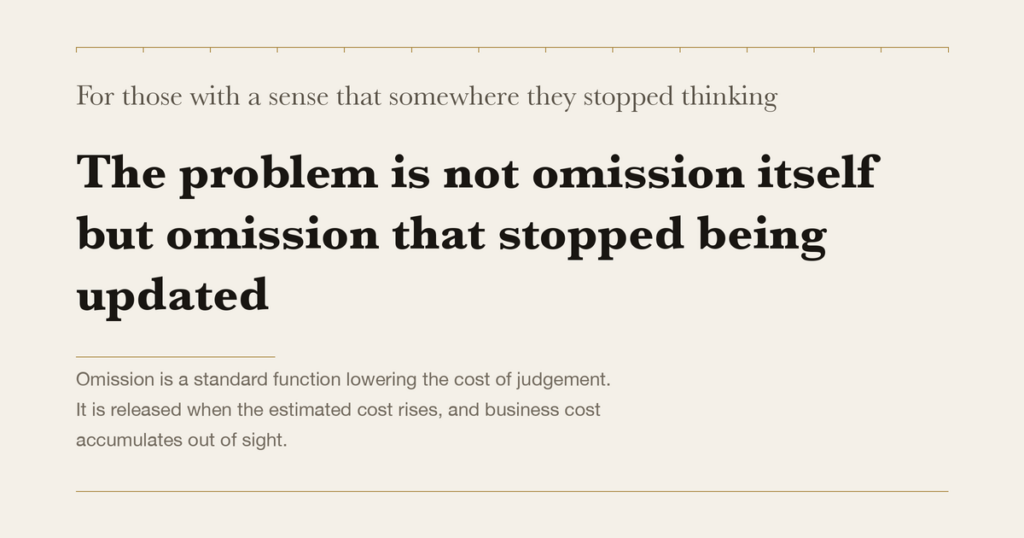
You do as you were told and no question surfaces. You pick the same approach as last time and cannot explain why you picked it. Someone says you ought to think harder, and you do not know what to think about. You have your own sense that somewhere along the line you stopped.
The position of this article, stated first. Omission is a standard function that saves you from assembling every judgement from nothing. The problem is not omission itself but omission that stays fixed without ever being reviewed. The advertised responses — hold questions, repeat “why” — work correctly, and where they work is only the territory in which a question already stands.
What gets examined here is the condition under which omission is updated and the condition under which it is not. Omission is not something to reduce, so this article does not write about reducing it. It writes about the side that decides which omissions to leave open.
That difference looks minor and reverses the direction of the prescription. Think in terms of reducing, and the work turns inward. Be more careful, hold more questions, spend more time. Think in terms of selecting what to open, and the work turns toward the shape surrounding the judgement. What decides which omissions occur is not carefulness but the conditions of the place where the judgement sits. Work on those conditions does not depend on the state of your attention that day. And what does not depend on that survives a busy stretch.
The range this article leaves out is worth stating. Procedures for training the faculty of thought are not included. Neither are concentration or willpower. Not because they fail, but because this article does not place the cause on the side of the person’s attitude. Setting judgement itself back on your own side belongs to Being unable to decide is not character but the consequence of a structure in which judgement has been handed over, and separating received material from your own judgement is handled in What thinking for yourself actually contains.
Omission gets updated only where the consequence of getting it wrong comes back to you. Where nothing comes back, the omission keeps its shape however many times it repeats. What governs updating is therefore not the amount of experience but the form in which that experience returns. Working alone, judgements with slow returns and judgements with fast returns sit in the same schedule, so only the omissions on the slow side pile up unrevised. That accumulation is what reads from outside as thought shutdown.
📖 Contents
- What “A Shutdown of Thinking” Points At Is Not One Phenomenon
- The Shared Responses Gather on the Side of the Count of Thinking
- Omission Is Not a Defect but a Standard Function Lowering the Cost of Judgement
- Omission Is Released When Cost Rises — but an Estimate Is Required
- Omitting a Conclusion and Omitting a Question Are Different Things
- Whether Omission Gets Updated Is Settled by How Experience Comes Back
- Being Told to Think, and Being Unable To, Comes From the Content of the Omission Being Invisible
- Deciding Alone, Omission Gathers in Four Decisions
- Confirming in Three Places That the Update Has Happened
What “A Shutdown of Thinking” Points At Is Not One Phenomenon
At least three separate forms sit under this single phrase.
The first is judgement left with someone else. When a moment to decide arrives, you align with a superior or with the majority around you. A judgement does occur; you are not the one handing it down.
The second is a conclusion being reused. An answer worked out once remains available, and it gets applied again. The stage of thinking is skipped, and the content of the answer has grounds behind it.
The third is a question that never stands. Not even the sense that something is off comes up, so no object of thought appears.
The three look identical from outside. All of them appear as not thinking for yourself. What is missing sits in a different place in each. The first is where judgement sits, the second how often it is updated, the third the range of recognition.
Separating them changes nothing about the fact that no thinking occurred. That does change. Take the prescription of placing the criterion of judgement on your own side. It works on the shape where the answer is being handed to someone else. Carry it into territory where no question stands, however, and the object on which a criterion would sit is not visible. A criterion with nowhere to sit cannot be checked for having been placed. The same happens with the prescription of touching material from a different field. It adds material for the side that raises questions, and applied to the handing-over shape, it adds one more party to hand things to.
The two taken on here are the second and the third. The first is a matter of where judgement sits, so it goes to Being unable to decide is not character but the consequence of a structure in which judgement has been handed over. The remaining two are two appearances of one function, so they can be handled in one place.
The three also occur together. When judgement stays with someone else, the experience of deciding shrinks, reuse of prior conclusions increases, and eventually questions can stop standing. Where it runs in this order, the later forms are harder to notice.
One question tells the three apart. Ask whether a different answer could have applied to that judgement. For the first form, the answer is “because that is what I was told.” For the second, “because that is what I did last time.” Only the third cannot take the question. The supposition that another answer could exist has not been established.
The phrase folds three things into one and then places the cause on the side of the person’s attitude. Treated as a matter of attitude, the prescription becomes “change your mindset.” And since the third form does not move when the mindset changes, only the experience of failure accumulates. Failure then gets read as evidence that the attitude is still insufficient. The account reinforces itself, so no counter-evidence enters from outside.
The Shared Responses Gather on the Side of the Count of Thinking
Five widely shared responses exist for this state. Their content is copied here without cuts.
Hold questions constantly. Lay “why” over the information you receive and follow the chain of causation. Avoid confusing gathering information with thinking, and make the time spent thinking visible and larger. Train yourself to look critically at your own view. Doubt your premises.
All five have situations in which they genuinely work. The demarcation that gathering information is not thinking is particularly accurate, and it fits the question of how a shortcut gets opened.
Their point of action is a single place. Repeating “why,” looking critically, doubting premises. All of these operate on something already recognised as an object. Visibility and secured time allocate resources to the stage of thinking.
Where they gather is the side after a question stands. Nothing in the design is wrong. Territory where no question stands lies outside their reach.
Since they say to doubt premises, unrecognised territory appears to be included. It is not. Doubting requires being able to name what you are doubting. What can be recognised as a premise is already an object. A premise that is not recognised does not become an input to the operation of doubting.
The five are not ineffective. In territory where a question stands, the depth of thought genuinely changes. Their reach is fixed, that is all. And the third form — where no question stands — sits outside that reach.
The prescription of increasing thinking time also has a ceiling. Objects of judgement arise dozens of times a day, so time cannot go to all of them. Once reducing omission becomes the goal in itself, daily judgements stop moving.
The ceiling rebounds onto the prescription as well. Since time is finite, a judgement about which judgements deserve time becomes necessary one level up. None of the five prescriptions addresses how that allocation is decided. You are told to hold questions; which questions to hold goes unspecified.
And when this prescription is tried and nothing comes out, the candidate left standing for why it missed tends to be the side that carried it out, since the prescription is known to be sound. “If I cannot manage even this simple question, my capacity to think must be lacking.” The soundness of the prescription strengthens the misattribution of cause.
Omission Is Not a Defect but a Standard Function Lowering the Cost of Judgement
Now to omission itself. Omission is not a failure of thought. It is a function operating at all times to lower the cost of judgement.
Judgement costs something. Time, attention, and the effort of giving up the options not taken. Pay that cost on every judgement arising in a day and none of them get settled. So most judgements get routed into processing patterns built earlier.
The strength of this function has been measured. The psychologists Ellen Langer, Arthur Blank and Benzion Chanowitz published an experiment in the Journal of Personality and Social Psychology in 1978 (volume 36, number 6, pages 635–642) 10.1037/0022-3514.36.6.635.
People queuing at a university photocopier were asked to give up their place. The request came in three forms. No reason (“I have five pages. May I use the machine?”), a real reason (“because I’m in a rush”), and a reason with no content (“because I have to make copies”). The third has the shape of a reason while adding no information. Everyone at a photocopier is there to make copies.
Compliance came out at 60% with no reason, 93% with the contentless reason, and 94% with the real reason.
The contentless reason worked almost as well as the real one. Participants were not examining the content of the reason. They responded to whether the utterance matched the pattern of a request plus a reason.
This result can be explained as participants simply being inattentive. That it was not is shown in the second half of the same experiment. Raise the size of the request and the omission releases automatically. Inattention would not vary with size. That it varied means the omission was being adjusted according to size.
What this experiment measures is a situation of complying with someone else’s request. Whether the same mechanism operates when you decide something yourself cannot be established from this study alone. What can be said is that a complex social judgement can be processed on pattern alone, without examination of content.
Cost is not the only reason omission works. The psychologists Gerd Gigerenzer and Daniel Goldstein published a study in Psychological Review in 1996 showing that a method of judging that looks at one cue and ignores the rest can match or exceed a method that weights and integrates every cue (volume 103, number 4, pages 650–669) 10.1037/0033-295X.103.4.650. Conditions genuinely exist in which discarding information raises accuracy.
Reducing omission is therefore not a goal. A large amount of omission does not indicate low quality of judgement. The problem lies not in the quantity but in which omissions are open.
And because omission produces speed, a state of heavy omission looks competent from outside. People who answer immediately, who do not waver, who move quickly. Such assessments are given to speed rather than to the quality of judgement. The more that assessment returns, the more the omission reads as having been correct. Reducing omission moves the short-term assessment downward.
Omission Is Released When Cost Rises — but an Estimate Is Required
The photocopier-queue experiment had one further condition: raising the request from five pages to twenty.
Compliance came out at 24% with no reason, 24% with the contentless reason, and 42% with the real reason.
The effect of the contentless reason has vanished entirely. Phrasing that at five pages worked as well as a real reason becomes, at twenty, indistinguishable from giving no reason at all.
What the result suggests is that omission releases when the cost being paid rises. Giving up five pages is cheap, so pattern processing suffices. Giving up twenty is expensive, so the content of the reason gets examined.
Omission is not idleness, then, but a switch keyed to cost. A state of constant full-effort thinking is not a rational allocation of resources. Small judgements run on pattern precisely so that resources remain for large ones.
If so, large judgements ought to trigger thinking on their own. Not necessarily. What triggers the switch is not the actual cost but the estimate of the cost. If twenty pages register as twenty, the switch flips. If they do not register, it does not.
And in business, costs take a shape that is hard to see. What to set as your rate, which requests to take, what to work on. In the moment these look like small judgements. The cost accumulates over years, so at the point of judgement it looks like five pages.
Estimating cost accurately every time is impossible. The size of an accumulation is knowable only after it accumulates. What is available is naming a few kinds of judgement that grow later and inserting the switch manually just there.
One criterion can be placed for that naming. Whether that judgement becomes the premise of the next one. Set a rate and the range of requests you next accept is set. Set the range of requests and the record you next accumulate is set. A judgement that becomes a premise does not end once; it governs what follows, so it is the origin of an accumulation. A judgement that governs nothing downstream costs one instance when it is wrong.
This criterion also misfires. Whether something governs what follows is sometimes unknowable in advance. A job taken as a small one often ends up setting the character of the requests that follow. No method exists for identifying premises perfectly, so the naming is placed on the assumption of misfiring. The loss from a misfire is the extra deliberation time. The loss in the other direction — processing a premise-setting judgement on pattern — falls on everything downstream. The misfires are asymmetric, so doubt tips toward naming.
Inserting the switch manually slows processing around that judgement. To others in the room, that reads as slowness in deciding. “Why agonise over that” comes back from them. The reaction is a real cost, so the number of manual switches tends to fall on its own.
Omitting a Conclusion and Omitting a Question Are Different Things
Omission comes in two kinds. Without separating them, no response lands.
The first is omitting the conclusion. An answer worked out once gets applied again. The process that produced the answer is one you once went through yourself.
The second is omitting the question. No question of the form “how does this actually work” ever stands. It is not that the answer is missing; the question is missing.
The two differ greatly in how they are noticed. Omitting a conclusion is noticeable. Asked, you can say “because that is what I did before.” Omitting a question is hard to notice. What was omitted does not appear in the output, so from inside nothing seems to be missing.
Suppose you set the price of what you sell by matching the going rate in your field. That is omitting a conclusion. The judgement of matching the rate stays in awareness, so it can be reopened later. By contrast, the format of selling that thing by units of time is, in most cases, never judged at all. No question arises that another format could exist. Here there is not even a memory of having decided.
If the question simply never stands, adding knowledge looks like the fix. Half of it is. Learn another format and the question stands. Knowledge, however, only increases the pool of candidate questions; which ones become questions is not settled by it. Things known and never made into questions are many for everyone.
Releasing every omitted question is also impossible. Candidate questions are unlimited, so most must remain omitted. What can be handled is the small number of places that fix the shape of your own business.
One way of finding them. Write out a description of your work and pick out the words you left unexplained. Client work, engagement, utilisation. Words like these get used on the assumption that their content is already shared. A word usable on that assumption marks a place whose inside has never been opened.
This method has a limit too. Not every unexplained word is a place worth opening. Shared words can be kept short precisely because they land, and opening the inside of each one would stall both conversation and design. The mark holds only where the word fixes the shape of the business. Whether to open engagement depends on whether receiving work in units of engagements is what fixes the shape of your income.
Omitting a question also produces strong resistance when someone points it out. When an omitted conclusion is pointed out, explaining the grounds settles it. When an omitted question is pointed out, no grounds exist to explain. You are placed in a state of having nothing to answer, so the remark itself lands as an attack. That resistance is one reason updates do not arrive from outside.
Whether Omission Gets Updated Is Settled by How Experience Comes Back
Omission itself is a healthy function. So what separates the places where updating occurs from the places where it does not? It is settled on the side of how experience comes back, not on the side of the person’s attitude.
The psychologists Robin Hogarth, Tomás Lejarraga and Emre Soyer published a framework in Current Directions in Psychological Science in 2015 (volume 24, number 5, pages 379–385) 10.1177/0963721415591878. It separates environments in which experience teaches from environments in which experience misleads.
In the teaching kind, results return after a judgement, and those results accurately reflect whether the judgement was sound. In the misleading kind, the information returning is skewed. The point of the framework is that in the second kind, accumulating experience does not raise accuracy, and wrong lessons can be learned.
The skew enters mainly in two forms. One is the sample being produced by the judgement itself. What became of the candidates you did not adopt is unobservable. What became of the requests you declined, and what happened in the price band you did not take, leave no record. What returns is the result on the side you chose.
The other is a long delay before return. When the soundness of a judgement is unknowable for months or years, causes and effects stop lining up. Conditions move in the meantime, so by the time a result returns, what produced it can no longer be isolated.
Where you judge alone, both apply at once. Results on the side not chosen are unobservable in principle, and returns run in years. Accumulating experience therefore does little to update the omission. Confidence tends to accumulate instead.
If results are bad, surely the review happens. It does, and the object under review shifts. When results are bad, what tends to be doubted is the volume of execution. Not enough publishing, not enough outreach. The format of the judgement is not recognised as something to doubt.
And the scarcity of returning information itself pushes confidence upward. If only a few pieces of evidence appear per year, one that happened to land gets used as grounds justifying the whole format of judgement. A small sample tends to surface as strength of conviction rather than weakness of it.
The prescription this framework yields is not changing your mindset. It is building the return side. Write down the candidates you did not take and one record from the unchosen side survives. Fix the date of the verdict in advance and the point at which a result returns becomes definite. Both touch the shape surrounding the judgement rather than its content.
A fixed omission is also stable in terms of comfort. No hesitation in judgement, fast processing, no friction with those around you. No signal of distress is emitted, so no information arrives from anywhere that a problem sits there.
Being Told to Think, and Being Unable To, Comes From the Content of the Omission Being Invisible
Not knowing what to think about is a state with contents.
No object of thought has been specified. An omitted place does not appear in the output, so neither the person pointing nor the person pointed at can see where the omission occurred. What is visible is only that the result is thin.
The person pointing is usually working from a place they themselves have not omitted. A premise is in play that what constitutes a question for them constitutes a question for the other person too. Where that premise fails, “think harder” does not function as an instruction.
One handle exists for making omission visible. The time it takes for a judgement to emerge. The faster the answer, the more omission was operating. This is a separate quantity from the quality of the judgement. High quality can also be fast; speed marks the possibility of pattern processing.
Consider being asked “will you take this job” and answering yes in one second. The conclusion may well be correct. In that one second, however, declining was not examined as an option.
Experience makes judgement fast and accurate, so doubting speed is wrong. That objection is accurate. The cognitive scientist Gary Klein and colleagues, studying fireground commanders, reported that experts in many cases were not comparing multiple options (originally 1986; the full study was reprinted in 2010 in the Journal of Cognitive Engineering and Decision Making, volume 4, number 3, pages 186–209) 10.1518/155534310X12844000801203. The commanders recognised the situation as an instance of a prior type, checked the first response that came to mind, and executed it if nothing failed. Comparison was omitted and the judgement still held.
What separates the two is whether the judgement can be explained afterwards. What Klein’s commanders could explain was which type they saw the situation as, and why that response fitted. Expert speed can put its grounds into words when asked. Pattern speed produces nothing beyond “it just felt right.”
Slowing is not required of every judgement. What needs slowing is the kind whose cost accumulates later. Specifically: price, subject matter, who you sell to, and the format of how time is used. These four tend to be where accumulation begins in a business.
Slowing down and not deciding are different. Deliberation goes in before the judgement, not in place of it. Let it stay suspended and the deadline routes it into the default pattern, so the most heavily omitted answer tends to get adopted after all.
Making omission visible temporarily disables judgement. What was previously processed automatically stands up all at once as an object for examination. From outside this looks like a loss of decisiveness. What has actually happened is that the entrances to judgement have multiplied, and no one but the person involved can see that difference.
Deciding Alone, Omission Gathers in Four Decisions
Where it gathers: price, whether to take a request, what you handle, and the form in which time is used.
First, how price is set. The going rate, the previous figure, the client’s budget. Each of these is a correct answer supplied from outside, and why that figure is that figure goes unexamined. This structure is handled in Not starting pricing from cost.
Second, whether to take a request. A pattern operates: take it if your hands are free. Having no reason to decline is different from having a reason to accept, and as a judgement they produce the same outcome.
Third, subject matter. The pattern is: do what you can do. The range of what you can do was set by past experience, so this pattern keeps selecting the extension of the past automatically.
Fourth, the format of how time is used. The format of selling time for payment sits as a premise without ever being judged. Unless a question stands against the format itself, movement tends to be possible only in the direction of raising the rate inside it. The format itself is dissected squarely in Why raising your hourly rate does not make you free.
The four are alike in one respect: none carries a memory of having been decided. What you do not remember deciding does not become something to decide again.
All four are what the situation imposes, leaving no room for judgement. Sometimes that is genuinely the case. Having no room and not seeing the room look identical from outside. What separates them is whether you can say what you would do if that condition changed. If you can, the judgement is being held. If you cannot, the condition is standing in for the judgement.
The four cannot be reopened in one go. Four entrances to judgement opening together stops daily processing. Taking one at a time, starting with whichever returns results fastest, is what works. The basis for that ordering is the property that whether a shortcut gets updated turns on how fast the return comes. Open the fast-returning ones first and the effect of opening them is itself observable.
Reopening any one of the four breaks its fit with the other three. Reopen price and the basis for accepting requests changes. Reopen subject matter and the grounds for price change. The four support one another, so moving one sets off a chain. The load of that chain is often the real reason reopening gets deferred.
The chain itself is not something to avoid. That the four support one another shows they hold together as one design. Moving one breaking the others is a sign of interlocking rather than of sloppiness. The problem arises only when you have no memory of having placed that design. With the memory, what breaks can be rebuilt. Without it, there is no place to return to when it breaks.
Confirming in Three Places That the Update Has Happened
The update surfaces in the following three places.
First, look at the number of questions rather than at changes in the answer. Whether omission was updated cannot be measured by whether the conclusion changed. Reopening and arriving back at the same conclusion is ordinary. What to measure is whether questions that did not stand before now stand about the same matter.
Second, look at whether you can state grounds for judgements made instantly. Fast judgement is not itself the problem. The problem is how many of the fast judgements have grounds you cannot put into words afterwards. Pick a few from the week and write why each was decided as it was; the pattern-processed ones will often not write.
Third, look at the reaction to being challenged. If an explanation rather than resistance emerges when a premise is questioned, that place is being held as a judgement. If no explanation emerges and only pushback does, that is likely where the question has been omitted. Pushback reads as a signal that no referable grounds exist, rather than as a rejection of the content.
None of the three verdicts touches the quantity of thought. What they look at is the range of questions, whether grounds can be verbalised, and the response to challenge. Omission is not something to reduce, so whether it decreased is not the object of the verdict.
The sense of having stopped somewhere along the line implies a point at which stopping occurred. Go looking for it and it is often not there. Omission was operating from the start, releases when cost rises, and updates when experience returns. What stopped was not the thinking but the updating.
Explaining this state has not used a quantity of capacity at any point. What it used was the shape surrounding the judgement. Where the unchosen side leaves no record and results take years to return, little material for updating reaches whoever is placed there. Change the conditions of return and room for updating opens up around the same omission.
Selecting what to open therefore becomes the work. Not everything needs opening, and nothing needs to stay open. For the small number of judgements that govern what follows, write down one unchosen candidate and set one date for the verdict. Which judgements fall into that small number differs with the shape of the business.
Where the patterns of omission came from, and what a framework that tries to correct them overlooks, is handled in Patterns of thought are not something to be corrected. What occurs in the places where omission becomes fixed, seen from the side of the range of recognition, is handled in Reading “unable to change” through cognitive science. Articles on what happens next door are elsewhere. The mechanism by which choices align with those around you is in What is occurring inside someone easily influenced by others, and the structure in which no judgement to decline can stand in Being unable to say no is neither kindness nor weakness.