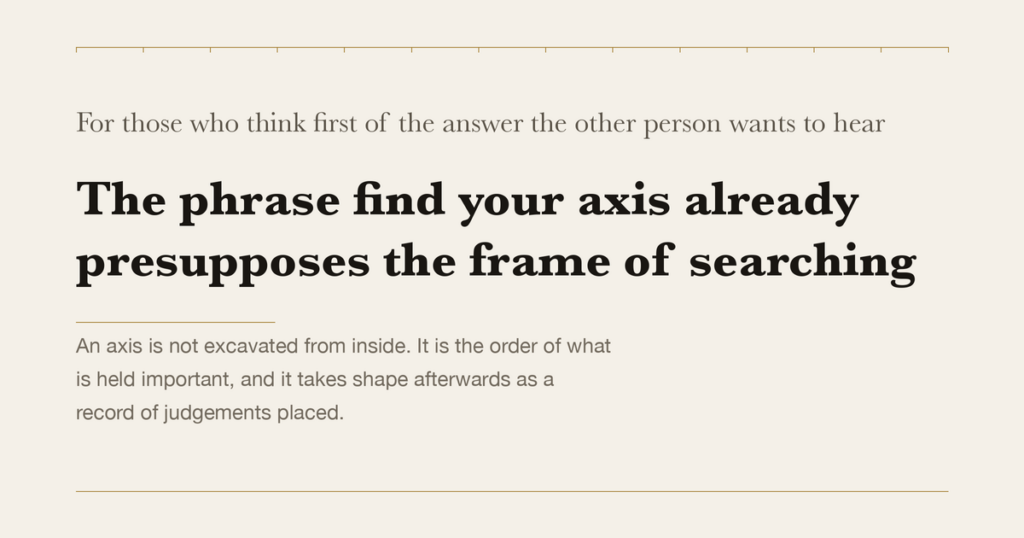
A commitment made to fit somebody else feels heavy later. You knew you should have declined, and in the moment it did not come out. Asked what you actually want to do, you work out what answer the other person is hoping for before you answer. States like these get described as having no axis of your own.
What this article removes is not the axis but the framing of searching that the phrase find your axis presupposes. No method for finding one appears.
The advertised procedures are almost all inward observation. Look back at the past, put your likes and dislikes into words, record how your feelings moved. Each is organised as work for locating something that already exists somewhere.
Whether what is being searched for has a findable shape cannot be tested from inside that framing. Three months with nothing to show becomes my method is wrong, and six months yields the same conclusion. And while the search runs, judgement is held over. Under the sequence decide once the axis is settled, the occasions for deciding get pushed back one by one.
What this article places is a different definition. What an axis actually is amounts not to a property buried inside you but to an order: what you treat as important and what you do not. And that order has an observable location. It appears in what you did not take, rather than in the words you profess. With nothing at all on the not-taken side, the order is likely not yet working.
Where the order comes from also runs opposite to observation. Where inner cues are unclear, people infer their own attitudes afterwards from the choices they made. In which case, however much you observe your interior during a period with no choosing, the material to read from hardly increases.
What is not handled here is the stage of putting a placed order into practice. Once an order is settled, a separate mechanism governs whether it becomes daily behaviour. The reach of this article ends where the order takes shape.
An order is not something you can set out to place. It takes shape afterwards, from an accumulated record of what was taken and what was left. So the state of feeling you have no order is mostly not an absence of character but an absence of record. And the record is missing not because you failed to look inward but because you have not yet been through the occasions of choosing. How the criterion of a decision accumulates is handled by Being unable to decide is not a personality trait.
📖 Contents
- What the Phrase “Find Your Axis” Presupposes
- The Widely Taught Procedures Take Past Reactions as Their Material
- What an Axis Actually Is Appears in What You Did Not Take
- The Order Does Not Come Out of Inward Observation
- What Diagnostic Labels Return Is a Description, Not an Order
- “Having No Self” Is Not an Absence of Order but an Absence of Record
- The Opposite of Somebody Else’s Axis Is Not Your Own
- The Axis Reaches Judgement Before It Is Ever Declared
- Whether the Axis Has Been Placed Again Can Be Judged Before Its Content Is Settled
What the Phrase “Find Your Axis” Presupposes
The phrase carries the premise that what is to be found already exists.
An axis usually appears alongside the verbs find, search for, recover. These verbs presuppose that the object already exists somewhere. It is the grammar of a lost possession. And not finding it means the search was insufficient or conducted in the wrong place.
That premise settles everything that follows. With searching as the premise, what there is to do becomes inward observation. Look back at the past. Record how feelings moved. Put the reasons for likes and dislikes into words. All three are shaped as digging up something that has been put somewhere.
The sense that looking back does reveal your tendencies is real. It does. What is revealed, though, is a tendency and not an order. Which situations drain you, which work you sustain — looking back shows these. Which of A and B takes precedence rarely comes out of looking back. What looking back mainly returns is a record of reactions; a record of judgements does not come out unless deliberately picked up.
Nor is looking back useless. A record of reactions is material for placing a judgement. Keep the material and the judgement itself distinct, and it is a valid input. The marker for distinguishing them is whether what came out is an adjective or a choice. “I prefer a quiet environment” is a description of a reaction; “I gave up part of the income to keep the quiet” is a record of a judgement.
The premise carries a further, less visible implication. In the searching framing, an axis is treated as settling into one, because a lost possession is one thing. In practice, what goes on top differs by territory and swaps around over time. The observation that it does not settle into one gets read, inside the framing, as evidence that it has not yet been found.
The framing is not always wrong either. In territories where strong preferences are already clear, searching does turn things up. Places you will not go, work you have decided never to repeat again. Looking back produces these. The framing runs aground only in territories where both sides have merit and neither can be discarded. Those are the territories where business decisions tend to gather.
And the searching framing makes a period without results read as not yet enough. Month after month with nothing, the conclusion tends to land on my method is wrong. Six months in, that conclusion hardly changes. The branch where the object has no findable shape to begin with never stands up inside this framing. A hold is inconspicuous as behaviour, so what remains afterwards is only that time passed.
The Widely Taught Procedures Take Past Reactions as Their Material
Six procedures are advertised, and most of them try to extract an order out of past reactions.
Look back at why you joined and why you left. Put your likes and dislikes into words. Record how you felt after acting. Keep a one-line diary. Stop saying anything is fine and decide for yourself. Measure where you stand with a diagnostic checklist.
Each of the six works somewhere. The fifth in particular — refusing anything is fine — is, as shown below, the work of building an order itself.
Leaving that one out, look at where the six get their material. The first four all take past reactions as their material. Not what you chose but how you felt about it. And reactions are heavily shaped by the environment of the time.
Concretely: the assessment criteria of that workplace, what those around you counted as good, who served as the point of comparison. Change these and how the same event feels changes with them. A record of reactions retrieved by looking back has the environment’s influence mixed in from the start.
Is what recurs despite the mixing not the tendency? Recurrence is indeed a strong clue. Where you stayed long in one environment, though, what recurs may be the conditions that recurred in that environment. A further step is needed to separate the source of the recurrence into your side and the environment’s side.
That separation cannot be completed. What you feel to be important is partly built from words you received. This is handled directly by Habits of thought are not something to be fixed. Not complete separation but using it while knowing that it is mixed is the practical handling.
The sixth item, the diagnostic, takes its material from somewhere else: not past reactions but present answers. That much makes it less subject to the past environment’s influence, and what it returns is a different kind of thing. That is handled separately.
Taking only the past as material has a further consequence. The axis that comes out is one fitted to the past environment. The longer the fit with an environment, the richer the record of reactions. An axis built from a rich record is an axis that works in that environment. And where the environment you now want out of is that one, what the search returns tends to be the shape best fitted to the place you are leaving.
This consequence also arrives with a sense of recognition. Built from records of the past, it naturally matches your past self closely. A match gets read as evidence of correctness. What tends to end up in your hands, as the most plausible answer, is the answer most at home in the structure you are trying to leave.
What an Axis Actually Is Appears in What You Did Not Take
Drop the searching framing and an axis stops being something findable somewhere and becomes an order that is placed, appearing in what was not taken.
An axis is the order of what you treat as important and what you do not. It is not a list of things you like. A list is parallel; an order is not. A state in which both A and B matter contains no axis. Only once it is settled which comes first does the choice get settled.
The definition fixes the place of observation. An order appears not through what you take but through what you do not take.
While everything matters, the order cannot be observed. The moment something not taken appears, the order shows itself. Work declined, territories ruled out, subjects you decided not to handle. These are what an axis actually consists of, rather than the words of a professed value.
None of that makes professed values meaningless. Words work as an instrument for confirming an order afterwards. Rather than the words coming first and the order following, though, the order comes first and the words catch up. Reverse the sequence and the professed words diverge from the actual choices, and that divergence is often visible to others before it is visible to you.
Nor is an order required in every territory. What to have for lunch needs none. What needs one is only a territory where the choice is exclusive. Only where the structure says both are not available does an order do any work.
Reading what was not taken also comes with a condition. It has to be something you could have taken and did not, rather than something you were spared. What you declined for lack of time is a record of capacity, not of order. Both remain as declined work, so the reason has to be kept alongside for later reading. A record without a reason yields a count and not an order.
Nor is an order fixed once placed. Watch how a placed order actually works and it sometimes swaps around. A swap is an update rather than a wobble. What distinguishes them is whether you can state the reason for the swap yourself. Swapping without being able to state it means external pressure is doing the moving.
And holding an order always costs something. Placing an order means letting go of whatever did not go on top, to that extent. What you let go of is visible in the hands of others. Seeing it, placing the order at all begins to feel like the error. Conversely, a state in which nothing has been let go is fairly reliable evidence that no order is yet at work. How an order functions as a worldview is handled by How to build a worldview.
The Order Does Not Come Out of Inward Observation
So where does an order come from? This is the largest divergence from the searching framing.
Self-perception theory, as the psychologist Daryl Bem set it out in 1972, bears directly on the point. People come to know their own attitudes and preferences not by reading an internal state directly but by inferring them from the behaviour they engaged in and the circumstances in which it occurred (Bem, 1972, Advances in Experimental Social Psychology 6). The weaker or less interpretable the internal cues, the more this inferential route gets used.
Apply the account to the question of an axis and it runs like this. What you place on top rarely comes out of looking inside. It comes out of looking at what you have chosen. And where nothing has been chosen, there is nothing to look at. Continued inward observation fails to increase the material not because the observing is insufficient but because the object of observation has not been produced.
There is a limit here. Bem’s account does not state that internal states do not exist. What it states is that where internal cues are weak, behaviour gets used as the material for inference. In territories where strong preferences are clear, looking inside does produce an answer. The search runs aground, usually, only where that is not clear.
The structure also carries an implication in reverse. A choice somebody else made for you still remains, outwardly, as your behaviour. The inference operates then, and what it refers to is not an order you placed. So the more choices were delegated across a period, the more the material for inference grows without the order taking shape. What gives the order its shape is not the volume of behaviour but the volume of choices you placed yourself.
The structure is also not proportional to the weight of the judgement. A small choice counts as one unit of material. So raising the number of small choices you decide yourself tends to build the order more readily than making one large decision. That is why the item about refusing anything is fine works. It is not a correction of character but an operation that raises the rate at which material is generated.
And choices that turned out wrong function as material too. What is needed is not correctness but the fact that you placed it. A wrong choice returns the information that what you put on top was not, in fact, on top. That is directly usable for updating the order.
What Diagnostic Labels Return Is a Description, Not an Order
In the course of searching for an axis, many people arrive at diagnostics. Personality tests, aptitude assessments, typologies. What comes back is a description of tendencies, not an order of what goes on top.
What a diagnostic returns is a description of tendencies. Habits in how you gather information, situations that drain you, default settings for dealing with people. These are descriptions built from observation, and they are valid as material.
With that said, there is something descriptions cannot answer. What you treat as important. A description returns how things are now. An order is a choice about what to put on top from here. The latter cannot be derived from the former, because whatever tendencies somebody has, the order can be chosen.
Why not place an order that suits the tendencies? That is one way of placing it. It does mean letting the tendencies decide the order, though, so the party placing the order is no longer you. The diagnostic result has moved to the top.
At the same time, an order that ignores tendencies holds poorly at the stage of execution. Put a draining form on top and it tends not to continue. Tendencies are handled accurately as a constraint on implementing an order, not as authority over what the order is. For the same order, several implementations exist. What the constraint settles is the shape, not what goes on top.
Diagnostics have a further property: they produce a strong sense of accuracy. The classroom demonstration conducted by the psychologist Bertram Forer in 1949 shows where that sense comes from. Handed a vague personality description applicable to anyone, people received it as having described them well (Forer, 1949, The Journal of Abnormal and Social Psychology 44(1)). The sense of accuracy can arise apart from the precision of the description, from the recipient fitting their own experience to it. This later came to be called the Barnum effect.
And the sense of accuracy produces conviction, and conviction functions as the end of the search. Once the phrase this is the kind of person I am is in hand, the work of placing an order appears to have become unnecessary. Diagnostics are not harmful; inside the searching framing, they function as a terminus.
Labels then start being used as explanations as well. Unable to decline because of this type; unable to decide because of that tendency. Once an explanation is in hand, the state stops being something to change and gets handled as a property held. What was a description ends up sitting in the place of the judgement.
“Having No Self” Is Not an Absence of Order but an Absence of Record
The stronger form of having no axis is having no self. You cannot say what you like, what you want to do, or what angers you.
The sense gets discussed as an inner blank. The capacity to build an order has not been lost, though. Place a judgement and material starts accumulating from that moment. What looks like a blank is the fact that the record available for reference is thin.
Put another way, “having no self” is not a description of a state but a report about the stock of material. As a question of stock, a procedure for increasing it can be written. Turn it into a question of properties and no procedure can be written. From the same observation, which of these two conclusions is drawn changes what becomes possible afterwards.
One condition that tends to thin the record is a long period in a place where correct answers were supplied. Schools, large organisations, roles with explicit assessment criteria. In those places most choosing takes the form of matching from options that were presented. The matching looks like judging, and its reference point sits outside. Skill at matching remains; the order does not.
The objection that you did not fail to choose anything in that period holds. You chose. Much of what you chose, though, took the form of choices where not choosing produced a penalty. Choices that avoid a penalty require no order, because what is to be avoided has been specified from outside.
A thin record does not mean an absence of capacity. What is thin is the experience rather than the property, and experience can be increased from now. Only one condition is needed: deciding for yourself the choices whose results come back to you. Choices that do not come back — where deciding changes nothing for anyone — hardly become a record however many you stack up.
Thin stock and zero stock are also different. Across a period of delegated judgement, some things were decided by you. Where to live, who to spend time with, the job you left. The number is small and the record available for reference already exists. What to count first is not what you will add but what is already there.
And once having no self settles in as a self-description, it becomes a reason for judgements in its own right. The explanation I cannot decide because I have no self justifies the choice not to decide, every time. The record does not grow while nothing is decided, so the explanation stays true indefinitely. The explanation maintains itself, so no counter-evidence enters from outside. It also takes the form of modesty. Phrased as an understatement of yourself, it is unlikely to be corrected by those around you either.
The Opposite of Somebody Else’s Axis Is Not Your Own
An axis of your own is usually explained by contrast with somebody else’s. The contrast creates a misreading in exactly one place.
Take the contrast at face value and the conclusion is that not admitting other people’s opinions constitutes an axis of your own. That is not accurate. Using somebody’s opinion as material and handing the verdict over to them are different things.
The basis here is not the number: whether you decide, about an opinion received, to take it or not. Deciding means the axis sits on your side however many opinions you gather. Not deciding means it sits outside even if you heard only one. It is not the count but the location of the deciding. The line separating a reaction as information from a reaction as verdict is handled directly by The mechanism behind minding other people’s assessment.
The experience of being pulled along by opinions you hear is real. You are pulled. Where you tend to be pulled is the territories where no order of your own has been placed. In territories where one has, an opposing opinion gets processed as information. How easily you are pulled depends less on strength of will than on whether a record exists in that territory.
Even with an order placed, in territories where the other party holds more information, following their opinion is the correct judgement. Following and handing over are different. When you follow, the judgement to follow remains as a record.
The contrast itself carries a limit as well. The phrase somebody else’s axis bundles other people into a single sheet. In practice the people offering opinions are several, each saying different things for different reasons. Bundled together, opinions usable as material and opinions that merely state somebody’s convenience receive the same treatment. Taken individually the acceptance decision is available; bundled, it becomes hard to make.
The contrast does work in one place. Where somebody is coming to recognise that they have handed the verdict over, the phrase reaches them quickly. Being coarse as a term and being effective as an entrance are compatible. Keep using it coarsely and all that happens is that the next step — deciding acceptance yourself — never arrives.
And building an axis by negating somebody else’s produces somebody else’s axis in reverse. The choice they are doing it, so I will not still has its reference point outside, because a negation cannot be constituted without referring to its object. A reversed external axis also tends to resist correction, since it appears to hold an order. From outside it reads as a strong will, and from inside it saves the judgement, so it is reinforced from both sides.
The Axis Reaches Judgement Before It Is Ever Declared
An order appears directly inside business decisions. Three of them: work declined, pricing, and who the writing is addressed to.
Work declined. Not on price or schedule but declined because the content does not fit. This is where the order shows most sharply. Where the only reason for declining is being busy, what is at work is capacity rather than order.
Pricing. What you attach what figure to is a statement of what you count as value. Where the same volume of work carries different figures, an order is in there. How a figure gets settled is handled by Do not start pricing from cost.
Who you are writing for. Where the addressee of your publishing has become many people, an order is likely not working. An addressee of many people holds neither a top nor a bottom.
Does producing an order not reduce the work? It does. More precisely, work that does not fit falls away and the proportion of work that fits rises. A temporary drop in the total is the result of producing an order rather than a failure. Produce the order first without a route to restore the lost total, though, and all that happens is the reduction.
The timing of producing it can be chosen. Where the route is thin, holding the order internally while deferring any external statement of it is a viable form. Holding and professing are separate pieces of work. And a held order shows up in the declining even while unprofessed. What works first is how you decline, not what you announce.
Their observability also comes in a fixed order. Declining can be produced today; pricing waits for the next quote and the addressee for the next thing you write. So what to look at first is the reason for a decline, and the other two follow. Attempt to settle all three at once and none of them gets settled.
When the order becomes visible from outside, the people who come and the people who do not divide. This functions as a filter. A filter, immediately after starting, is observable only as loss. Those who stopped coming can be counted; those who came because of the order do not state their reason. Only one side is observable, so the judgement tends to tilt towards better stop.
The asymmetry can reverse over time. Work with parties who do not fit surfaces its mismatches after starting, and takes time later. Parties who came because the order fitted require no explaining of premises. So the effect of producing an order appears first in the time per job rather than in the number of jobs. Watch only the count and the reversal goes unobserved.
Whether the Axis Has Been Placed Again Can Be Judged Before Its Content Is Settled
Whether the axis has been placed again can be confirmed in three records. Not by feel but in a form confirmable as a record.
What you declined yourself over a recent period. Not the count but the reason for declining. One reason other than capacity means the order is working. Zero means it has not yet reached the choices. This is not a judgement of capability but of whether the record is being used.
The time to deciding. For choices of the same kind, whether the time spent hesitating has shortened. In territories where an order is placed, judgement tends to get faster. Not because information increased but because the reference point sits on your side, so the number of comparisons falls. Conversely, a state in which gathering more information settles nothing means the reference point is still outside.
What you did after hearing an opinion. Have you heard an opinion and not taken it? Having not taken one means the deciding sits on your side. Taking in every opinion you hear means what you are gathering is verdicts rather than material.
None of the three asks about the content of the axis. What you treat as important is not measured. What is measured is only whether traces of an order at work remain as a record. Try to settle the content first and you are back inside the searching framing.
The question the searching framing could not answer was why is it not being found. Under the definition placed here, the question changes shape. An order is not read out from inside; it takes shape from looking afterwards at what was chosen. In which case, what a state of not-finding indicates is not insufficient searching but a shortage of choices available for reference. From the same I still cannot tell, both a hand that keeps searching and a hand that starts choosing are available.
Inward observation holds work of its own, outside the framing dropped here. Observation teaches the constraints for implementing an order. Where you drain, which forms you sustain. These are needed when a placed order gets brought down into an executable shape. What observation does not answer is one thing only: what goes on top. Keep constraint and choice apart and neither cancels the other.
And what goes on top does not have to be settled today. What can be left unsettled and what stops things while unsettled are different. Take one of the second kind and write down one thing you will not take. Write the not-taken side and the order is, at that point, recorded by one unit.
Once an order is placed, whether it stays in daily behaviour is settled by a separate mechanism, and what happens on that side is carried by Reading unable to change through cognitive science. What happens when you measure yourself against others with no order in place is handled by The mechanism by which you compare yourself with others, the state of having handed the verdict itself over by Being preoccupied with other people’s eyes comes from leaving the verdict on their side, and what happens after an order is placed by Where the wish to be recognised is headed.