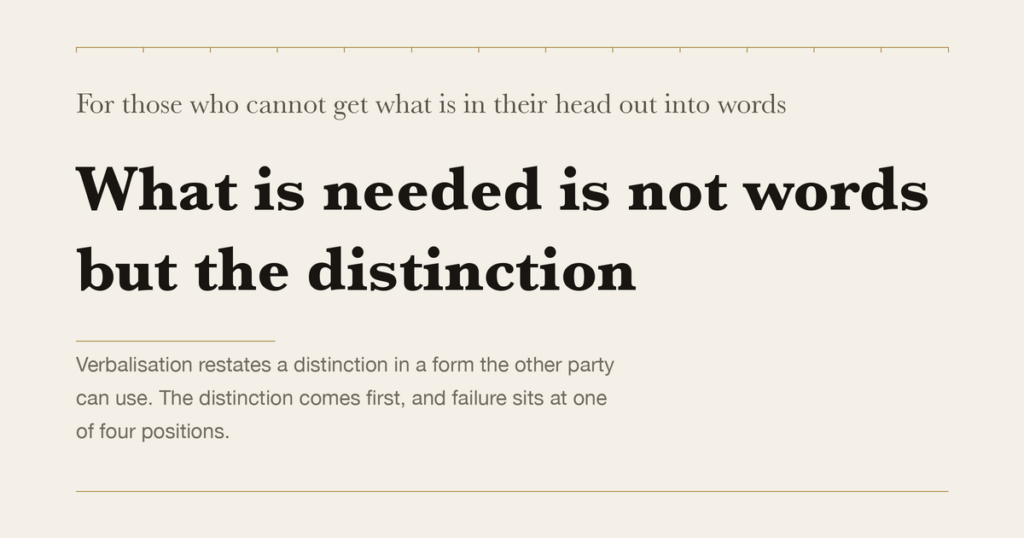
Verbalisation is the work of restating a distinction inside you in a form the other party can use. It is not a matter of putting the contents of your head outside as they are. What goes out is the distinction rather than a conclusion or an impression. A distinction is a matter of what divides from what, and under which condition.
The definition carries an instruction about location. Since the place it gets restated into sits on the other party’s side, the adjudication of completion does not close on your own side. Not the quantity written, not the size of the vocabulary, not the writer’s own sense of satisfaction. Completion is adjudicated by whether the other party has become able to use the distinction. Progress can be measured on your own side, and that is a different quantity from completion.
Being unable to verbalise gets explained, most often, as shallowness of thought. It does not become words because you have not thought deeply. So you increase the quantity of thinking and the quantity of writing. As practical advice this is not wrong, and quantity does work. The trouble is that the cause the thinking was shallow is read off the result it did not become words, so no counterexample can emerge. When something fails, the only cause left standing is not yet enough. One cause leaves one move.
What is actually happening is sometimes something else. The distinction exists inside you and no word denotes it. Or the word exists and the other party does not use it across the same range. Both sit somewhere other than the depth of thought, and neither moves easily with quantity. The first calls for the work of finding a word. The second calls for the work of specifying a range. Writing more does little to bring on either.
Verbalisation here does not mean converting what you felt into expression. Skill at expression sits outside this definition. What is handled is the work of moving a distinction you use in judging into a form another person can use to make the same judgement. Poems and soliloquies, which do not aim at transmission, therefore fall outside. Applied to them, the definition reads a working piece of writing as defective.
Some things are not handled here either. The individual techniques — how to set a heading, how to build an analogy, how to open — live in their own articles. What this page takes on is how the seventeen articles on verbalisation stand in relation to one another, and the frame for adjudicating where you are presently stuck. Read a technique first and, with no place settled to apply it, you cannot confirm whether it worked.
The state of not becoming words divides into three. The causes of not getting through, once it has become words, divide into a further four positions. The seventeen stand in five layers along those four positions. Three and four are different cuts: the first belongs before writing, the second after.
📖 Contents
- Being Unable to Verbalise Has Been Explained as a Deficit of Skill
- The State of Not Becoming Words Divides Into Three
- Verbalisation Is Restating a Distinction in a Form the Other Party Can Use
- The Distinction Comes First and the Word Attaches Afterwards
- Verbalising Something Does Not Mean It Gets Through
- The First Layer — Four Articles That Settle What to Write
- The Second Layer — Five Articles Handling the Side of Understanding
- The Third Layer — Four Articles Handling the Mechanism of Response
- The Fourth Layer — Two Articles Handling the Form of Handing Over Judgement
- The Fifth Layer — Two Articles Handling Experience as Material
- Which of the Five Layers to Begin Reading From
- As Verbalisation Proceeds, What Was Never Settled Surfaces
- There Is an Upper Bound on What Can Be Put Into Words
- Progress Can Be Measured in Four Ways
Being Unable to Verbalise Has Been Explained as a Deficit of Skill
The widely shared account organises verbalisation as a capacity on the writer’s side. Something trainable; and it does not become words because the training has not gone far enough.
The account is consistent from source to source. Verbalisation is described as putting what is in your head into words. What you feel, what you think, what you have experienced — made into a form that reaches another person. The causes offered are that you have not thought deeply, that your output is insufficient, that your vocabulary is small, that you lack the habit of organising your thoughts.
Prescriptions follow in step. Write every day. Note things down on the spot. Read to enlarge your vocabulary. Talk to people to sort things out. Write to a template. The effects listed are that your thinking gets organised, that you become able to get through, that explaining your work gets faster, that you find out what you hold important. The training methods are specific too. Summarise. Explain in one minute. Move between the abstract and the concrete. Practise framing questions.
Taken as a description of practice, the set holds up. Write more and the words do come more readily; a larger vocabulary does widen the range of expression; talking to someone does sort things out, exactly as observed. What is off is not the individual prescriptions but the place the cause has been put.
Put the cause only on the side of capacity and one explanation remains whenever something fails: not yet enough. That explanation holds against any result. Holding always, it admits no disconfirmation.
In most cases the quantity really is short, and that objection lands. But the account has no explanation for the person whose quantity is sufficient and who still does not get through. Having none, it produces no move other than increasing quantity. With one move available, you cannot tell on your own whether you are repeating a move that does not work or simply have not done enough of it.
The account also carries no test of success. Whether verbalisation has happened cannot be confirmed from the writer’s side at all. What can be confirmed is whether the other party has become able to use the words. That the test sits on the other side drops out of view the moment the matter is organised as capacity.
Something else follows from that. Treated as a matter of capacity, a failure to get through sends you to inspect only your own side. What the other party holds, and across what range they use which words, never enters the inspection. When the cause sits in the uninspected place, increasing quantity reproduces the same outcome — and since the quantity has genuinely gone up, it looks like progress.
None of this says training fails to work. Quantity of writing and quantity of speaking work, and that stands as a premise. What moves is the breakdown of what that quantity works on and what it leaves untouched.
The State of Not Becoming Words Divides Into Three
Under the single symptom I cannot get this into words sit at least three separate states. The symptom is the same and the work required differs in each.
The first is the state where the distinction itself is absent. Two things look the same, so no word is needed to divide them. What is short here is not a word but the distinction.
In the second, the distinction is there and no word denotes it. You know the two differ and cannot say what differs how. This state tends to arrive for people who have accumulated experience in the field. As the count of judgements rises, the distinctions in hand outrun the words available.
In the third, the word is there and the range does not match the other party’s. They receive the word you used in another sense. Nothing got through, and both sides finish believing it did.
The work required differs across all three. The first needs the work of building a distinction, the second the work of finding a word, the third the work of specifying a range. The move therefore cannot be chosen from the symptom.
Something feels different, I cannot say what belongs to the second. The difference has been caught, so the distinction exists. Increasing the quantity of writing will not produce the word for it. What it produces is a heap of unfinished sentences reaching for the difference. Keep writing them and you will eventually land on it — that is worth granting, and sometimes you do. But there is no regularity to the landing, so you cannot reproduce it the next time the same state arrives. What cannot be reproduced does not become a technique.
Against the first, quantity works. Where the distinction is absent, the only route is more material. What works is less the quantity of writing than the quantity of judging in that field. On this one state the standard prescription lands exactly.
One question separates the first from the second. Can you show the difference with an example rather than a word? If you can, the distinction is there and you are in the second. If you cannot, you are in the first. The question works because giving an example demands no vocabulary, which isolates the presence or absence of the distinction on its own.
The third surfaces through a different symptom: it feels understood while you are talking, and the mismatch appears afterwards. It feels understood because both sides are using the same word. Where the word is shared and the range is not, nothing collides at the time. The third is therefore the hardest to notice. The first and second come with the awareness this is not becoming words; the third comes with no awareness at all. You notice when a result diverges later.
Splitting into three complicates the prescription, since no single piece of advice covers all of them. In exchange, the stretch during which you repeat a move that does not work gets shorter. Which of the two you prefer depends on how many months you have already spent in the state.
Verbalisation Is Restating a Distinction in a Form the Other Party Can Use
The substance of verbalisation is the transport of a distinction. What moves is not the conclusion but the dividing line used to reach it.
What goes out is a distinction you hold. What differs from what. Under which condition the two separate. Where what crossed was a distinction, the other party can bring it to the situations in front of them.
This differs in kind from handing over an impression or a conclusion. That method is no good is a conclusion. Work with a long feedback interval and work with a short one continue differently is a distinction. The second can be applied by the other party to their own work. The first has nowhere on their side to be applied.
And whether a distinction crossed can be tested. Can the other party produce an example you did not give? If they can, the distinction crossed. If they cannot, what crossed was a sentence.
The definition yields two consequences. First, the completion of verbalisation is confirmed on the other party’s side. Second, until the recipient is settled, how far to restate is not settled either.
Handing the same distinction to someone inside the same field takes one sentence. Handing it to someone outside means building up from premises. The difference in workload comes not from the complexity of the distinction but from the gap in shared premises. Part of I cannot explain this well is therefore caused by the audience having changed. It shows up as the same explanation landing last year and failing this year.
Verbalising for yourself also happens. In that case the recipient is your later self. A self at a distance in time does not hold your present premises and stands close to another person. The structure requiring the restatement is unchanged.
Not everything has to become words. What falls in scope is only the part of the distinctions used in judging that has to reach someone else. Try to word what does not need to reach anyone and the work never finishes. Whether something needs to reach anyone is settled by the situation: when you want others to make the same judgement, when you have to account for a judgement of yours, when it goes on record. Outside those, it functions unworded.
A direction is built into the definition. What crosses is a distinction, not a conclusion. Hand over a conclusion and the other party cannot adjudicate for themselves the situations in which it applies. Hand over a distinction and the adjudication stays on their side.
The burden on the sending side is heavier with a distinction, because the conditions have to be written out. Handing over a conclusion is shorter and faster. Shortness and usability sit on separate axes. When speed is wanted the conclusion form gets chosen, and the reason for choosing it usually sits on the writer’s side of the table.
There is a price. Adopt this definition and the success of verbalisation depends on someone else. It does not complete on your side. Without a means of confirmation, you cannot tell whether you are making progress either. How to build that means is taken up by the four confirmations of progress.
The Distinction Comes First and the Word Attaches Afterwards
Distinction and word run in an order. In the basic order, the distinction forms first and the word attaches afterwards.
Accumulate judgements in a field and the distinctions multiply. Words attach to those among them that have had to reach someone else. The order is judgement, distinction, word.
Research on expertise carries an experiment showing this order. In 1981 Chi and colleagues had novices and experts sort physics problems into categories (Chi, Feltovich & Glaser, 1981, Cognitive Science, 5(2), 121–152). The novices sorted by surface features present in the diagram: problems with an inclined plane, problems with a spring. The experts sorted by the principle used to solve them: problems solvable by conservation of energy, problems solvable by Newton’s second law.
The scope of what was measured should be marked accurately. This measured the categorisation of physics problems, not the work of verbalisation. What it showed is a direction: looking at the same objects, the unit by which they get cut varies with experience.
Two implications reach practice. First, distinctions arise from the side of experience, so enlarging a vocabulary alone does little to enlarge them. Second, as distinctions multiply, things that had looked identical come apart.
As a writer accumulates experience, writing nobody reads separates into several kinds: writing judged as not addressed to them, writing read and not believed, writing read with no reason to move. The names attach after the separation becomes visible. The names did not come first and cause the split.
The order also runs the other way at times: learning a word first makes a distinction visible. That is the form where a distinction someone else built gets borrowed along with its word. A borrowed distinction becomes usable only once it has been applied to your own experience. Use the word without applying it and it circulates with no range fixed to it.
None of this makes borrowing an inferior method. Most distinctions begin as borrowed ones. What separates them is whether you checked afterwards in a situation of your own. The check is simple: take the distinction and split two things you have actually experienced. If they split, the distinction is usable. If they do not, you are still holding only the word.
Adopt this order and training in verbalisation stops being training in writing alone, because a quantity of judgements is required. You can increase the quantity of writing yourself; the quantity of judgements arrives from the side of the work. And when the quantity of writing rises while the quantity of judgements does not, you spend the time rephrasing the distinctions you already hold. The output grows and the distinctions hardly do.
Verbalising Something Does Not Mean It Gets Through
A state of not getting through remains even after a distinction has become words. Being in words and reaching the other party are settled by different conditions.
When something written does not get through, the cause sits at one of four positions.
The first position is material. What to write has not been settled. Or the material is in hand and is not visible as material.
The second position is the side of understanding. The material is there and is not in a form the other party can receive: the range of a word is not shared, the order is not built, the question is not framed.
The third position is the mechanism of response. Under what conditions people read, believe, and move. Write without knowing those conditions and accurate writing ends up unread.
The fourth position is the form of handing over judgement. What gets handed to a reader who has been persuaded. Do you move them, or hand them the reason to move.
The four stack in order. With no material there is no form to build; with no form the mechanism has nothing to work on; without the mechanism there is nothing to hand over. Inspection therefore runs from the bottom.
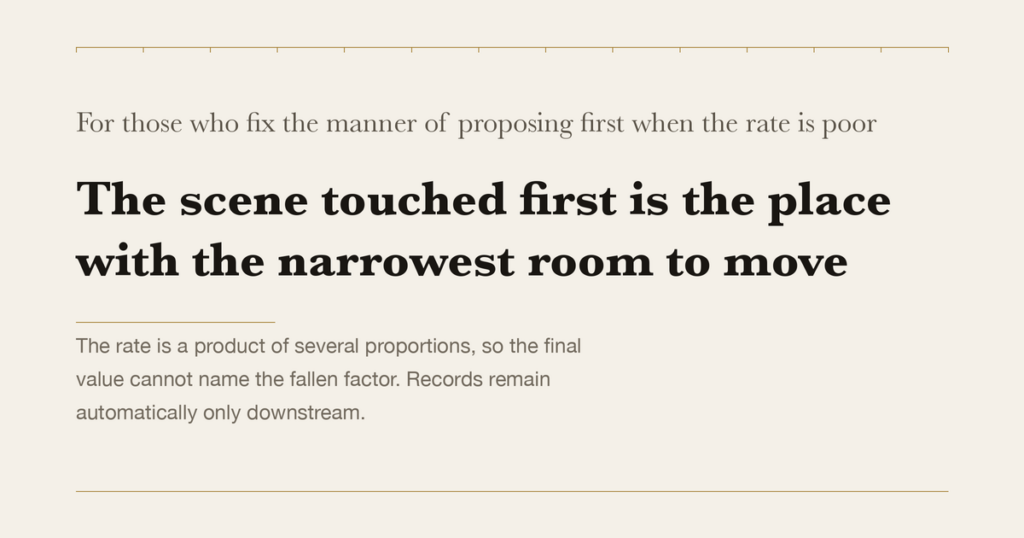
Fixing the wording of your closing sentences when responses do not come is touching the fourth position. Where the cause sits at the first — the material is unsettled — work on the fourth changes little. Little changes, so the next round goes into finer work on the wording.
In practice, causes do span several positions at once. But a problem at a lower position cancels the effect of the higher ones. Writing whose material is unsettled produces no content however well the form is arranged. Looking from the bottom therefore has a point.
Repairing from the top leaves the lower problem in place while work piles on top of it. Once the cause is identified, most of the piled work becomes a rewrite. Suppose you tidy your wording and your register, and afterwards find the material was never settled. Most of the tidied sentences are now candidates for rewriting. Look from the bottom up and that rework shrinks.
The four positions are not an order of work. You go back and forth while writing. They are split for the sake of inspection, and the split becomes usable exactly when you cannot decide what to repair.
Splitting by position increases the number of problems that one article does not resolve, since a problem spanning positions means reading several articles. In exchange, which ones to read becomes decidable. The five layers correspond to these four positions: four articles at the first, five at the second, four at the third, two at the fourth. Two more, handling one’s own and other people’s experience as material, bear on the whole from the side of material.
The First Layer — Four Articles That Settle What to Write
Four articles that meet material and audience. They belong to the stage before writing begins.
What to do when you do not know what to write separates the state of having no subject into three: no material, material not visible as material, and knowing something matters without being able to word it. The three share a symptom and take different moves. A subject is not chosen; it is what is left over once the criterion of value has been settled.
How to conduct a customer interview is about taking material from people. Ask about behaviour is widely shared advice, yet asking about habits returns a summary. What is available in askable form is the single most recent occasion. What happens when you ask for reasons, and the structure by which the heavier information sits with the people you cannot reach, are here too.
How to write primary information puts your own experience to work as material. Whether something is primary depends not on holding the information but on the position it is written from. Summarised from the position of already knowing the conclusion, an experience turns into content anyone could have written. The discipline of separating observation from evaluation lives here.
Settling the recipient is handled in how to build a persona. Under the method of stacking attributes, each attribute added lowers the probability that the person exists. It traces back to the origin why narrowing is not the entry point of a design but its output.
Where the material is, in what to do when you do not know what to write; how to take it from others, in how to conduct a customer interview; how to take it from yourself, in how to write primary information; how to settle the destination, in how to build a persona.
What is unsettled at this layer cannot be solved at the layers above. Writing whose material is unsettled cannot be rescued by form or by mechanism.
Two structures run through the four. One is the order by which audience and subject alike are not chosen but left over once the criterion of value has been settled. The other is the separation of observation from evaluation: an evaluative word can only be written after the result is known, and carries an interpretation the moment it is written. The first is taken on by how to build a persona, the second by how to write primary information; the remaining articles refer back rather than restate.
This layer alone does not show its effect straight away. Even when the location of your material changes, whether the next thing you write improves cannot be known until you have written it. A layer whose effect arrives late sits in the position most easily deferred.
The Second Layer — Five Articles Handling the Side of Understanding
Five articles on restating material into a form the other party can receive. They belong to the stage after the material is settled.
The order in which explanation improves is the foundation of this layer. Correcting order and vocabulary still fails to get through because the range a word denotes is not shared. The easier the word, the more separately each person holds its meaning, so no act of checking is ever triggered. The prescription is one: define before using.
The technique of analogy works through the other party’s memory. What is copied is the relation and not the appearance, and the more familiar the vehicle, the more surplus implication travels with it. Quality is settled not by familiarity but by whether the writer has a hold on what travelled along.
What the principles of article structure assembles is order. A list of items contains no principle for ordering them. Structure is one claim decomposed into an order the reader can receive. How length is settled by the gap in premises with the reader lives here too.
How to write headings sits at the level of partition. A heading does more than point at the body; it places a frame of understanding before reading begins. The form of the question settles the range of that section’s answer. The hierarchy of headings is also a relation of containment.
Handling the opening paragraph is how to write a lead paragraph. Sympathy confirms what the reader already knows and does not constitute a reason to read on. A reason to read arises where the reader’s understanding and the fact placed before them fail to agree.
The five line up from large to small. The order of the whole piece in the principles of article structure, the level of the section in how to write headings, the opening in how to write a lead paragraph. The level of the word is carried by the order in which explanation improves and the method of bridging by the technique of analogy.
What runs through the five is the structure by which form is a function of the shortfall in the relation. Length, the fineness of the order, the quantity of premises stacked — all are settled by the gap between writer and reader. The principles of article structure takes this structure on and the other four apply it at their own level.
Unlike the layer below, this one shows its effect immediately. Specify the range of a word and readability changes on the spot. Being visible, it invites you to work here and nowhere else. Before working here, you end up confirming that the layer below has been settled.
Whether it has can be told by one question. Can the content you are about to write be listed in bullets without any arrangement of form? If it can, the material is there and the work belongs to this layer. If it cannot, the side of material is still unsettled.
The Third Layer — Four Articles Handling the Mechanism of Response
Four articles that unpick the conditions under which people read, believe, and move. At the centre sits not a list held as knowledge but the boundary between mechanism and prescription.
Before reaching for a list of psychological triggers is the entrance to this layer. What a list records is how people respond, not an instruction to induce that response. Erase the boundary and the description gets read straight through as a prescription. Why a judgement that passed on a peripheral cue does not hold follows from there.
Do not use loss aversion to stoke urgency dissects one individual mechanism. A loss can be defined only as a deviation from a reference point, so in writing you will lose out the writer is simultaneously placing that point. Whether the loss had already occurred before the reading is the line between making it visible and creating it.
Where social proof applies opens a second mechanism. It works under two conditions, and the conditions drop out in the course of being listed. Numbers belonging to people unlike the reader work in the opposite direction. In strongly influenced settings, the correspondence between quality and result weakens.
The three NOTs stands ahead of the three. Ahead of will not read, will not believe, will not act sits an adjudication of whether the writing is addressed to them at all. Devices for getting over the walls strengthen the walls the more widely they are shared.
The boundary itself is placed by before reaching for a list of psychological triggers; the individual mechanisms are taken by do not use loss aversion to stoke urgency and where social proof applies; the stage before being read is carried by the three NOTs.
Across the four sits one shared boundary: description against instruction. People respond like this and therefore induce it are different things. A judgement of the writer’s enters at the step from the description to the instruction. Unnoticed, what reaches the reader is the instruction alone.
Hold the boundary in view and the same knowledge splits into two uses: an instrument for inspecting your own writing, or an instrument for moving someone. The former use is rarely presented to the person reading the list.
You cannot read this as saying that not knowing lets you avoid using it. Writing produced in ignorance sometimes takes the shape of stoking anyway. Not knowing is the state of lacking the premise for choosing not to use something. Choosing requires knowing first.
This layer has a property the others lack: its effect is measurable. Response counts can be taken, so raising the intensity moves the numbers. The numbers that move do not distinguish between a judgement cut short and a judgement assisted. That distinction is the business of the next layer.
The Fourth Layer — Two Articles Handling the Form of Handing Over Judgement
Two articles about what gets handed to the reader. They centre on sales writing, and the structure they handle reaches writing in general.
The structure of a sales letter has form and length as its subject. Length is settled not by the size of the subject but by the number of confirmations still outstanding between writer and reader. What a template lines up is not components but the order in which the reader passes through those confirmations. Being able to write short means the confirmations were completed outside the letter.
The principles of sales copy drops to the level of the sentence and the word. Moving someone and handing over the reason to move are different operations. Room to judge means a state in which the reader is not disadvantaged by stepping away partway. Writing that raises response and writing that sustains a relationship frequently point opposite ways.
What separates the two is level: form and length in the structure of a sales letter, sentence and word in the principles of sales copy. Both presuppose the boundary from the layer below.
Reading this layer alone does nothing. It is the stage of settling what to hand over, once the material is settled, the form can be built, and the mechanism is known.
This layer also carries an aspect the others do not. Writing that cuts a judgement short and writing that leaves the judgement standing cannot be told apart by the response of the moment. The difference appears much later, at the stage of whether the product actually got used, and how the next message is received.
There are only two because the object is narrow. Sales writing is written rarely. It sits in a layer of its own because the judgement made here is hard to recover from.
The irrecoverability has two parts. First, someone who moved before their judgement completed often cannot be reached in time by material handed over afterwards. Second, intensity once used remains as a coefficient on how the next piece gets read, since the reader reads the same writer’s next piece through the aftertaste of the last one.
To someone who does not write sales copy, the layer looks unnecessary. Yet the structure reaches beyond sales. That length is settled by the residue of confirmation, and that the boundary runs between leaving a judgement standing and cutting it short, apply directly to announcements and explanations. Sales is simply where the structure shows most sharply.
That said, at a stage where what you are writing is unsettled, this layer has no place to be applied, because there is no object to apply it to. Reading it can wait.
The Fifth Layer — Two Articles Handling Experience as Material
Two articles on the discipline for putting your own and other people’s experience out as material. They adjoin the first layer and are placed separately because the problem they handle spans a different axis.
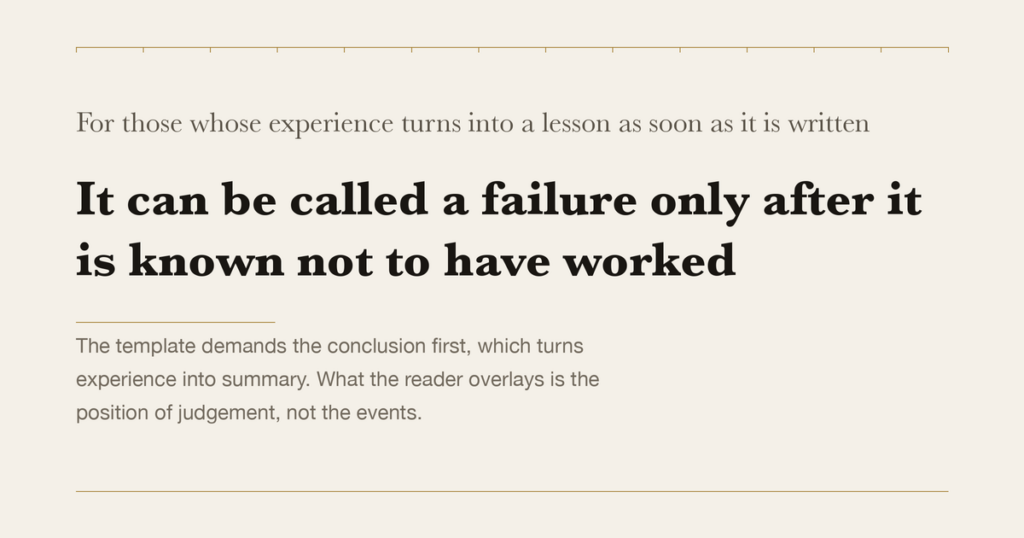
Your own is handled in writing from personal experience. The failure-lesson-change template looks chronological and cannot be assembled without knowing the conclusion in advance. At the moment of assembly, the field of view of the time has gone. What the reader overlays is not the events but the position of judgement, and a single case can show existence rather than a general rule.
Customer testimonials takes other people’s. Collection has a procedure; the judgements concentrate at the stage of selecting and the stage of cropping. Without a single false word being written, selection and cropping alone shift what the reader receives. Consent to publication is also consent to a range.
The two divide by the source of the material: your own in writing from personal experience, someone else’s in customer testimonials. Both take the discipline of separating observation from evaluation from how to write primary information.
The layer stands on its own because handling it wrongly is hard to recover from. A failure of form can be rewritten. The handling of another person’s words does not come back with a rewrite.
A second range runs through both. What a single case can show is that the thing can happen, not that it happens generally. Writing from personal experience carries that range, and customer testimonials handles the same problem from the side of sampling.
And in both, the judgements gather at the stage of selecting. Which experience to write, which testimonial to publish, where to crop. Collection has a procedure; the criterion at the stage of selecting is, in most cases, left to the writer’s discretion.
Selecting is not itself the problem. Almost no medium publishes everything. The problem is that the criterion of selection is invisible to the reader. Being invisible, the reader reads what is lined up as the shape of the whole.
The criterion cannot be written out in full. What can be written reaches as far as what you are aware of. Adding one line covering that much lets the reader discount on their own. Handing over a discountable state is the minimum this layer can say.
Which of the Five Layers to Begin Reading From
The seventeen have a reading order, and there is no need to read from the top. What settles the entrance is not the arrangement of the articles but the position where you are presently stuck.
If the position is known, read from that layer. Subject unsettled, the first layer; able to write and not getting through, the second; not being read, the third; being read and nobody moving, the fourth.
If it is not known, look from the bottom. Among the four in the first layer, what to do when you do not know what to write sits furthest forward. It lets you adjudicate which of the three states you are in.
The order in which explanation improves, in the second layer, works regardless of position. The problem of an unshared word range arises at every layer. That one article, read first, changes how the others read.
Some can be deferred instead. The two in the fourth layer have no place to be applied at a stage where what you sell is unsettled. Suppose you begin from the fourth layer while what you write is not being read. What is written there concerns the stage after being read. It does not apply, so little changes.
Reading all of them at once looks faster and is not. Read seventeen in a row and the distinctions are too many to apply any of them easily to a situation of your own. Read one, apply it to something you wrote, look at whether anything changed. That circuit turns out faster in the end.
Some problems straddle layers. The material is there and the audience is unsettled straddles two articles inside the first layer, and both get read.
The two in the fifth layer have a second entrance: the case where your own experience or someone else’s words are already published. Then they read as an inspection of what is up. Inspection is one of the few pieces of work available after writing rather than before.
Self-adjudication also misses. A state that feels like not being read often turns out to be a problem on the side of material — nobody read it because the content applied to nobody. In that case the third layer changes little. Whether the adjudication missed shows in the result of reading one article and applying it. If no place to apply it turns up, the reading of the position is the thing that is off.
Showing an order makes it look as though it has to be followed. In practice you may begin anywhere. The reason for showing one is that reading an article with no object to apply it to costs time. And whether the object exists sits on the side of the reader, not the article.
As Verbalisation Proceeds, What Was Never Settled Surfaces
As verbalisation proceeds, places you cannot write appear. What appears is not a shortfall of words but the things that were never settled.
Putting something into words is also the work of fixing a range. Try to fix it and you stop at the places that are not fixed. The places you stop are the things that were never settled.
The places where you tend to stop are, specifically, three. Whom it is addressed to. How far it covers and where it stops covering. What you hold to be important. In all three you believe, before writing, that the matter is settled. Whether it is cannot be confirmed until you try to write. Being unable to write is the result of that confirmation.
Suppose you try to explain your work in one sentence and stop. The reason for stopping is not the technique of explanation but an unsettled range. Settle whose, and what, does this cover and the sentence comes.
The structure has a use. The work of verbalising can serve as a detector for the places that are unsettled. Count the places you cannot write and you have a list of what has to be decided.
Settling things while writing is one way to proceed, and it partly works. But what gets settled while writing remains only inside what was written. Writing something else next time means settling it again. Put what has been settled outside and the judgements that follow go faster.
Settling everything ahead of time is not available. What can be settled concerns only fields where judgements have already accumulated. In a field with no judgements there is no material for settling anything.
And what has been settled changes. Keep writing and range and criterion alike grow more specific. Changing is not the same as never having been settled. The two can be told apart. Where it changed, you can write both the earlier version and the later one. Where it was never settled, only the later version can be written. If you cannot say what the earlier one was, it was not settled.
The unsettled things that surface get settled somewhere other than the work of writing. Audience, range, criterion — none of them are settled inside the prose. Settling takes time, so the pace of writing drops once.
The number of returns is high at first and falls off. It falls because settled things accumulate, and the accumulation serves as a premise the next time you write. The stretch in which the pace has dropped is therefore not a stretch in which the work has stopped but one in which the premises are being built.
There Is an Upper Bound on What Can Be Put Into Words
Not every distinction becomes words. The bound sits not on the side of vocabulary but on whether the conditions can be written out.
What can become words is a distinction expressible as a condition: under this condition, choose this. Judgements that will not take that form remain.
They remain for two reasons. First, the conditions are too many to write out. Second, you do not have a hold on the conditions yourself.
In the second case, forcing it into words produces an account that differs from what actually happens. An account gets constructed, so something always comes out. Whether what came out matches the actual judgement cannot be confirmed by self-questioning alone. This has the same shape as the problem of self-reported reasons handled in how to conduct a customer interview. Asking yourself produces the same thing.
Suppose you ask yourself why did I take on this job and a reason comes. Whether that reason was operating cannot be told by this method. What can be told comes from lining up the occasions you chose and looking at what they share.
Is what cannot be worded the same as not existing? For the writer it is not, because it is available for judging. It simply cannot be handed over. What cannot be handed over does not serve as material for someone else making the same judgement.
That a bound exists is no reason to stop verbalising. Widening the range that can be handed over still has a point. The point disappears where the part that cannot be handed over is pretended to be handed over.
There is a form for handling the part that cannot be handed over: writing beyond here I have not been able to write out the conditions. Written, the reader fills that range in for themselves. Unwritten, the reader takes the stated conditions as the whole.
The position of the bound is not fixed. Repeat the work of writing conditions out and the range that can be written widens. It widens because conditions you did not have a hold on come into view, and the route by which they do is lining up judgements and looking at what they share. The bound therefore means cannot be written now and not cannot be written ever. Mix the two and the places you cannot write drop out of consideration.
Admit the bound and what you can write shrinks. The amount it shrinks to is the range you can actually hand over. Before the shrinkage, what was not being handed over was counted as handed over. What shrank is the display, and the amount crossing is unchanged.
Progress Can Be Measured in Four Ways
Whether you are making progress can be measured. What gets measured is simply not the quantity written.
The first confirmation is whether the other party can produce an example you did not give. If the example that comes is from outside your own range, the conditions have moved. If none comes, what moved is the wording. This confirmation is available only where there is a recipient, and of the four it is the most direct.
The second confirmation is whether you can explain the same content to a different person at a different length. If you hold one phrasing only, that is likely a memorised sentence rather than a distinction. Hold a distinction and the length varies with the other party’s premises.
The third confirmation is counting the places you cannot write. The places where you tried and stopped are the list of what is unsettled. If the count is falling, settled things are increasing. Progress is measurable from the count alone.
The fourth confirmation is rereading what you wrote in the past and seeing whether the distinctions are the same. If they are, the distinction is stable. If they have changed, the side of judgement has moved. Neither is abnormal. What is being checked is whether a distinction has become too fixed.
None of the four look at quantity written or size of vocabulary. Quantity is a condition, and sits on a separate axis from whether a distinction crossed.
That said, the four have a limit. None of them adjudicates whether the distinction is needed by the other party. A distinction can cross accurately, be held in several phrasings, and still find no situation in which the other party uses it. That adjudication cannot be carried out on the writer’s side.
Only where the recipient has been settled does the adjudication become available. With the addressee settled, the situations in which they would use it come into view. Unsettled, the destination does not fix. The four confirmations therefore presuppose that the first layer has been settled.
Explained as shallowness of thought, being unable to word something left one cause standing. That one separates into three states, and taking in the failure to get through, into four positions. Out of the separation come moves other than increasing quantity.
The account on the side of capacity was not wrong. Quantity of writing and vocabulary do work. It is only that the range in which they work is a part of the four positions. Against problems outside that range, the moves inside it were being repeated. Seen as work rather than as capacity, verbalisation makes that range visible.
Where you are presently stuck can be estimated. Distinction absent, word absent, or range unmatched. Material, form, mechanism, or the form of handing over. With the estimate made, the next article to read is settled. Whether the estimate was off shows once you apply that article to something you wrote.
Verbalisation is not itself the aim. What the work is for is treated as a whole in structural autonomy. How to put the criterion of value itself into words is in how to design a concept and how to build a worldview.